

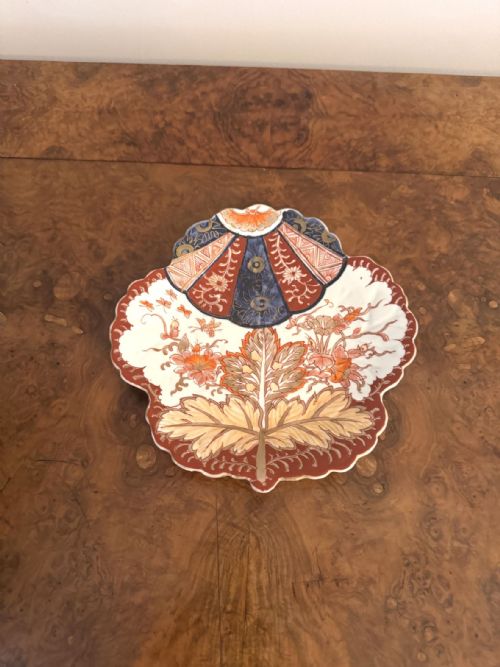

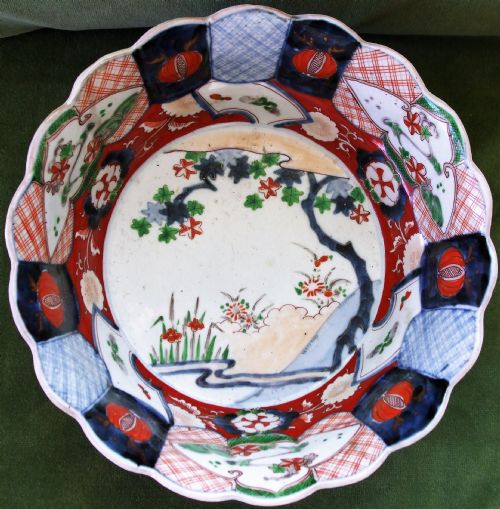


Imari Ware Display Bowl
These imari ware display bowls bring together cobalt blue, enamel, and gold leaf on porcelain from the Meiji and Edo periods.
Imari Ware Display Bowl
An imari ware display bowl is a striking ceramic piece created for visual impact, often taking the form of a decorative bowl, plate, or scalloped edge dish. These objects arrive from Japanese traditions spanning the Edo period, Meiji period, and Arita kilns, reaching back to the seventeenth century and extending into the nineteenth and twentieth centuries.
Buyers will most frequently encounter nineteenth century and nineteen-hundreds examples featuring Japanese Imari and Arita styles. Forms range from hexagonal vessels and tripod bowls to wide plates with scalloped edges intended for prominent placement.
The aesthetic relies on a distinct interplay of cobalt blue and enamel pigments, frequently heightened with gold leaf. These ceramics serve as focal points in a room, carrying centuries of ceramic history within their decorated wells and rims.
How they were made
Makers shaped these items from ceramic and porcelain before applying cobalt glaze beneath a clear finish. This underglaze blue forms the architectural foundation of the design.
Artisans then added overglaze enamel and gold leaf by hand, firing the pieces multiple times to fuse the pigments. This method produces the rich surface texture characteristic of Japanese Arita and Imari output.
The listings span multiple centuries, recording pieces from the seventeen hundreds through to the nineteen hundreds alongside Meiji and Edo period items.
What varies in quality
The standard of an imari ware display bowl rests upon the crispness of the cobalt blue underglaze and the precision of the enamel work. Superior examples demonstrate confident brushwork and balanced composition across the surface.
The application of gold leaf and the refinement of the porcelain body further distinguish finer pieces from standard production. Form also plays a part, with complex shapes such as hexagonal profiles and scalloped rims demanding greater skill from the potter.
The Imari Ware Display Bowl Glossary
- Imari
- A style of Japanese porcelain originating from the port of Imari, traditionally decorated in cobalt blue, iron red, and gold. This palette defines the visual character of the bowls.
- Arita
- The town in Japan where the ceramic industry for these wares was centred. Arita porcelain forms the material basis for early examples.
- Edo Period
- The period in Japanese history spanning from sixteen hundred and three to eighteen hundred and sixty-eight. Pieces from this era hold significant historical weight.
- Meiji Period
- The era in Japan lasting from eighteen hundred and sixty-eight to nineteen hundred and twelve. Many decorative bowls on offer originate from this time.
- Cobalt Blue
- A deep blue pigment used beneath the glaze that remains stable at high kiln temperatures. It provides the dominant dark tone in the decoration.
- Gilt
- A thin layer of gold applied to the surface of the ceramic. It highlights specific motifs within the overall design scheme.
Imari Ware Display Bowl: Frequently Asked Questions
What is an imari ware display bowl?
An imari ware display bowl is a decorative ceramic vessel originating from Japan, characterised by intricate painted designs in cobalt blue, enamel, and gold.
These pieces were made in various shapes, including scalloped edges and tripod bases, and were designed primarily for visual appreciation rather than utilitarian dining.
How do I date an imari bowl?
Dating relies on stylistic clues, potting techniques, and the specific palette of the enamels used across different eras.
Items span from seventeenth-century Arita wares to nineteenth-century Meiji productions, each showing subtle shifts in form and decorative density.
Where were these bowls made?
They were produced in Japan, specifically around the town of Arita in Hizen province.
Finished ceramics were then shipped out through the port of Imari, which gave the distinctive style its enduring western name.
How should I display an imari bowl?
These bowls suit placement on tables, sideboards, or open shelving where their vibrant colours and patterns can catch the light.
Their decorative nature makes them strong focal points in both traditional and modern interiors.