

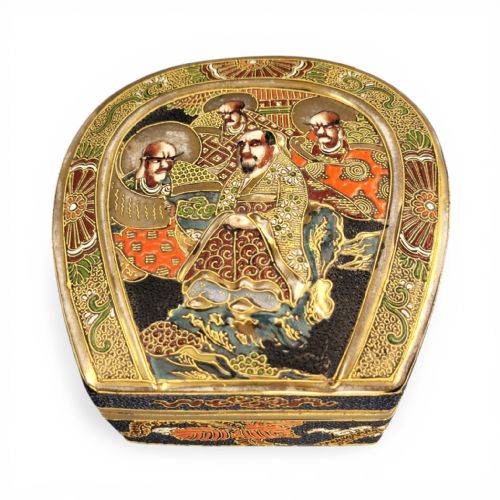


Japanese Earthenware Dishes
Japanese earthenware dishes are finely painted vessels from the nineteenth and early twentieth centuries, prized for dense enamels and gilt details.
Japanese Earthenware Dishes
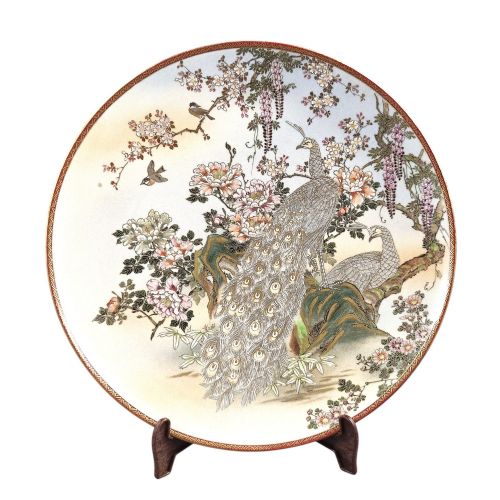
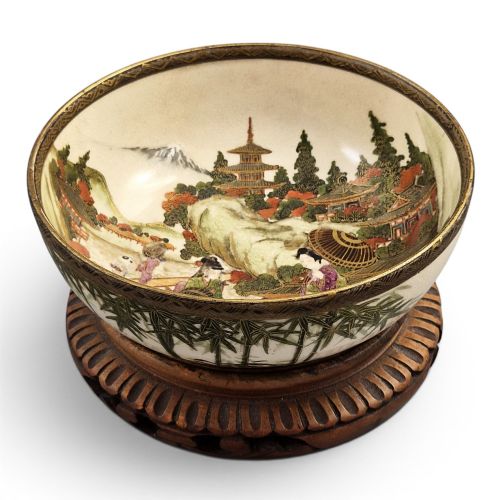
Japanese earthenware dishes encompass decorative plates, chargers, shallow dishes, and bowls produced primarily during the Meiji period and the early twentieth century. These pieces serve as visual records of traditional motifs, showing intricate scenes of figures, birds, flowers, and thousands of blossoms.
The version most commonly encountered on this page is Satsuma ware, originating from workshops in regions such as Kyoto and Yokohama. Such pieces range from compact trinket boxes and saucers to large decorative chargers.
How they were made
Potters shaped the earthenware bodies before applying specialised glazes that created a characteristic cream-coloured, crackled surface. Artisans then painted complex designs by hand using vibrant enamels.
Makers integrated raised relief work, known as moriage, alongside applied gold leaf and gilt accents to add depth and texture to the painted compositions.
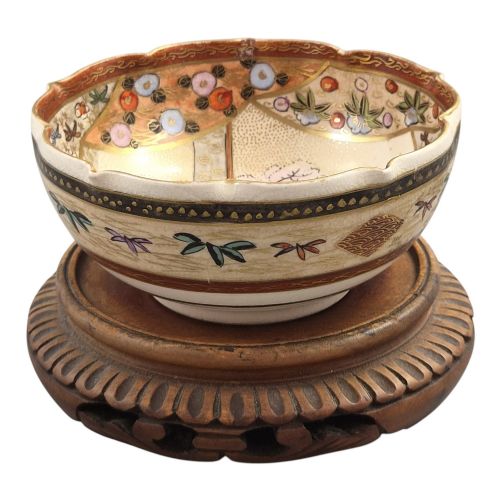
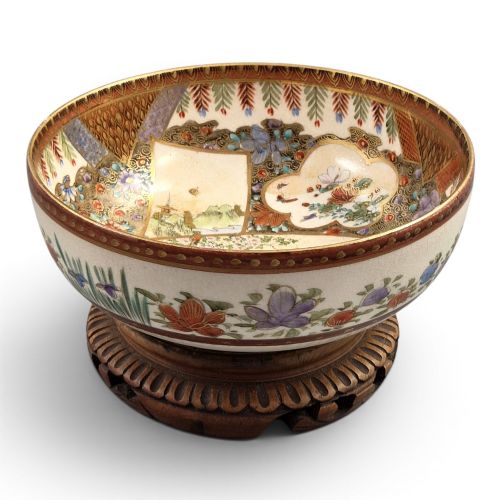
Some bowls are so densely painted with tiny blossoms that a single dish contains an entire botanical meadow captured in gold and enamel.
What varies in quality
The standard of painting determines the tier of the piece, separating rapid commercial output from masterworks with microscopic precision in multi-figure scenes and floral borders. Hand-painted detail in the enamel and the finesse of the gilt work dictate visual success.
The presence of a clear studio signature or factory mark indicates higher ambition, linking the dish to known Meiji period makers and specific artistic centres.
Koshida·Gyokkō·Kozan·Toshozan·Shuzan for Yasuda·Nikko·Hododa·Meizan
The Japanese Earthenware Dishes Glossary
- Satsuma
- A type of Japanese earthenware originating from Satsuma province, known for its ivory crackled glaze and colourful enamel decoration. It became a major export during the Meiji period.
- Moriage
- A decorative ceramic technique using piped clay to create raised relief patterns before painting and gilding. This adds tactile dimension to floral and avian motifs.
- Meiji Period
- The era in Japanese history spanning from 1868 to 1912, marked by industrialisation and a surge in decorative arts exported to Western markets. Most pieces on this page originate from this time.
- Charger
- A large decorative plate intended for display on a wall or sideboard rather than for dining use. These often feature complex narrative scenes.
- Millefleur
- A design style translating to thousand flowers, where the surface is densely covered in tiny, meticulously painted blooms. This pattern requires exceptional patience from the painter.
Japanese Earthenware Dishes: Frequently Asked Questions
Are these dishes safe for food?
These historical earthenware pieces are intended for decorative display rather than culinary use. The traditional enamels and soft bodies are not suited to modern dining.
Enjoy them as visual artworks on a stand or within a cabinet.
How do I identify Satsuma ware?
Look for a fine network of crackles across a warm, ivory-coloured earthenware body beneath painted enamel scenes. Gold leaf and raised details are typical characteristics.
Signatures or studio marks painted on the base often provide further attribution to Meiji period makers.
What period do these pieces date from?
The listings span the late nineteenth and early twentieth centuries, primarily covering the Meiji period and Edwardian era. Production methods during this time focused on export quality wares.
Dates are often estimated from stylistic evidence and specific artist signatures.
How should I display a charger?
Large chargers require sturdy plate stands or professional wall-mounting brackets to support their weight safely. Position them away from direct sunlight to protect the fragile enamels and gilt.
Keep them in stable indoor environments to preserve the delicate earthenware bodies.