
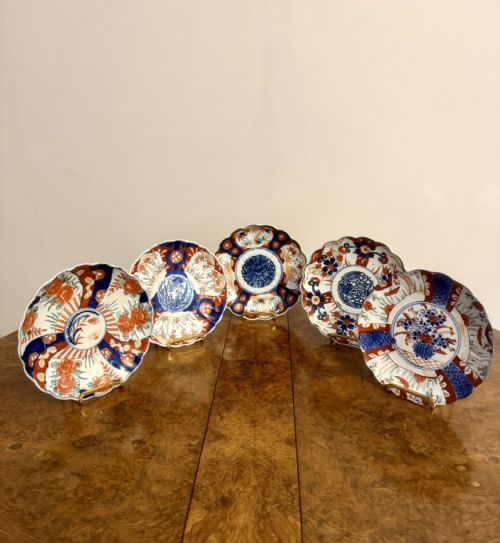


Japanese Ceramic Dish Set
These japanese ceramic dish set pieces bring historic craftsmanship to the table, offering a tangible connection to nineteenth-century kiln traditions.
Japanese Ceramic Dish Set
When you search for a japanese ceramic dish set, you encounter collections formed of decorative plates, shaped dishes, and matching bowls originating from the nineteenth century and around nineteen hundred. These groupings range from small assemblies of four or five pieces up to larger sets of fourteen or eighteen items.
The most common finds on this page are Japanese Imari plates featuring traditional decoration, alongside Satsuma ware and porcelain table services. Many of these groupings retain their original storage boxes, preserving the set intact over generations.
Forms vary from standard circular plates to shaped dishes and comprehensive tableware sets complete with matching bowls and saucers. They reflect both everyday dining and decorative display purposes from the Meiji period and late eighteen hundreds.
How they were made
Potters shaped these objects from porcelain and earthenware, applying complex glaze and enamel layers before firing. Many examples incorporate gold leaf or gilt details to highlight the painted motifs.
Decoration often includes detailed hand painting in characteristic colour palettes, seen on Black Ship Imari pieces and Thousand Flowers Satsuma designs. Artisans combined iron, enamel, and gold leaf on a ceramic base to achieve rich surface textures.
Listings feature porcelain and earthenware from the nineteenth century and nineteen hundred, spanning Meiji period Japanese styles.
What varies in quality
The distinction between standard examples and finer items lies in the precision of the hand painting and the application of enamel and gold leaf. Superior pieces display crisp brushwork and balanced compositions across every plate in the set.
Completeness and uniformity also drive distinction, particularly when sets include matching bowls, saucers, or their original storage boxes. Consistency in the ceramic body and the vibrancy of the glaze separate ordinary wares from outstanding collections.
The Japanese Ceramic Dish Set Glossary
- Imari
- A style of Japanese porcelain featuring a distinct palette of underglaze blue, iron red, and gold. It gained prominence through export trade to Europe during the Edo and Meiji periods.
- Satsuma
- A type of Japanese earthenware characterised by a pale, ivory-coloured cracked glaze decorated with polychrome enamels and gilt. This ware became particularly popular for export during the Meiji period.
- Meiji Period
- The era in Japanese history spanning from eighteen sixty-eight to nineteen twelve, marked by extensive modernisation and a surge in decorative arts produced for international markets.
- Porcelain
- A hard, white ceramic material fired at high temperatures, known for its translucency and ringing tone when struck. It forms the durable base for much traditional Japanese tableware.
- Black Ship
- A historical term for Western vessels arriving in Japan during the nineteenth century, which occasionally inspired decorative motifs on export ceramics.
Japanese Ceramic Dish Set: Frequently Asked Questions
What is an Imari plate?
An Imari plate is a traditional Japanese ceramic piece characterised by iron red, underglaze blue, and gilt decoration. These plates were produced for both domestic use and export during the nineteenth century and around nineteen hundred.
They are recognised by their densely patterned surfaces and rich colour palettes. Many survive today in matching sets or collections.
How do I care for antique ceramic sets?
Antique ceramic sets require gentle hand washing in lukewarm water using mild soap. Avoid abrasive sponges or harsh detergents that can damage the delicate enamel and gold leaf details.
Store the pieces safely in padded containers or their original wooden boxes to prevent chipping. Display them away from direct sunlight to preserve the vibrant pigments.
What is Satsuma ware?
Satsuma ware is a distinct style of Japanese earthenware featuring a characteristic ivory-coloured glaze covered in fine crackles. These pieces are typically adorned with intricate enamel painting and gilt highlights.
Originating from the Satsuma Province, this pottery became a staple of Meiji period export goods. Collectors prize them for their detailed floral and figural scenes.
How are these sets stored?
Many nineteenth-century tableware sets are accompanied by custom wooden storage boxes designed to keep the plates and dishes secure. These boxes often feature historical inscriptions or simple joinery suited to protecting fragile porcelain.
Using the original box helps maintain the integrity of a matching collection. It ensures that plates and bowls remain grouped together as intended by the maker.