



Japanese Ceramic Centrepiece
A Japanese ceramic centrepiece brings historic craftsmanship and striking glaze work into a room.
Japanese Ceramic Centrepiece
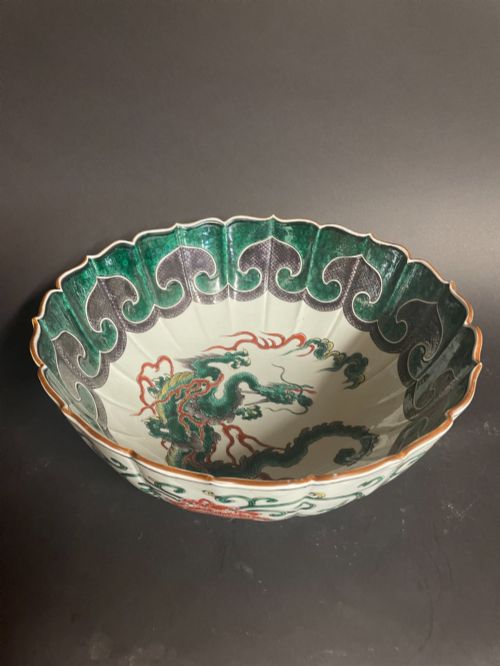
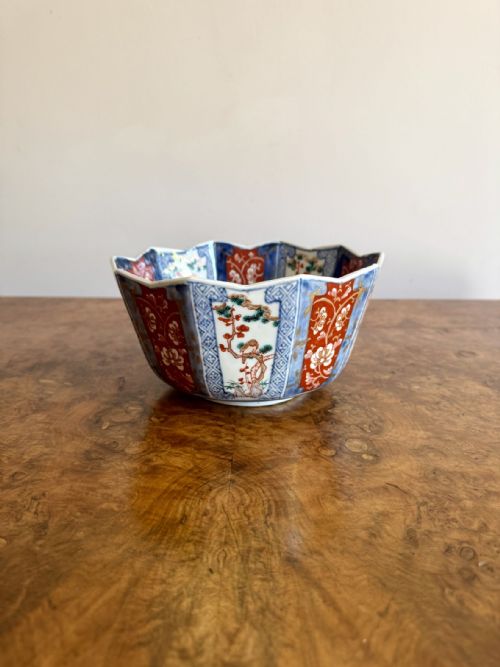
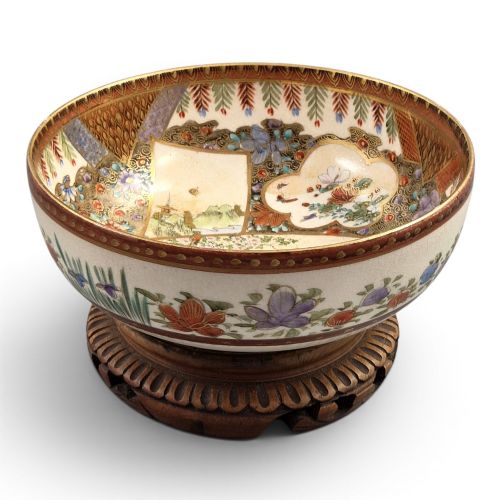
A japanese ceramic centrepiece appears primarily in the form of large decorative bowls originating from the nineteenth century and around nineteen hundred. These items frequently display traditional Japanese Imari patterns alongside Satsuma styles from the Meiji period and Arita designs.
Buyers encounter substantial scallop-edge vessels and monumental bowls designed to sit prominently on tables or surface displays. The selection draws heavily upon late nineteenth-century export production and Edwardian-era import tastes.
How they were made
Potters shaped these vessels from porcelain and earthenware before applying detailed enamel decoration and cobalt blue pigments. Artisans integrated gold leaf and gilt highlights to accentuate intricate patterns across the ceramic surface.
Certain pieces received wood stands to support the heavy bodies, while specialised glazes sealed the earthenware and porcelain forms. Master workshops employed signature motifs ranging from samurai battles to dense millefleur arrangements.
Listings feature porcelain and earthenware materials alongside enamel, gold leaf, and cobalt blue.
What varies in quality
The distinction between standard vessels and exceptional examples rests upon the precision of the hand-painted enamel and the inclusion of fine gilt work. Monumental scale and documented signatures from notable studios elevate specific bowls above ordinary production pieces.
Complexity of design heavily influences the character of each item, with multi-figural scenes and dense decorative schemes demanding greater skill than simpler geometric borders.
Kozan·Ryuzan·Kinkozan
The Japanese Ceramic Centrepiece Glossary
- Imari
- A style of Japanese porcelain decorated in underglaze blue and overglaze red, gold, and other colours. This distinctive palette became highly popular for export during the nineteenth century.
- Satsuma
- An earthenware type with a ivory crackle-glaze finish, typically decorated with elaborate polychrome enamels and gilding. These works often feature historical or narrative scenes.
- Meiji Period
- The era in Japanese history spanning from eighteen sixty-eight to nineteen twelve, noted for extensive craft exports to Western markets. Pieces from this time show remarkable technical refinement.
- Mon
- A traditional Japanese crest or emblem used to identify families or clans. These mon symbols frequently appear on high-quality ceramics as marks of patronage or origin.
- Arita
- The region in Japan renowned as the cradle of Japanese porcelain production. Works from this area set foundational standards for ceramic manufacturing.
Japanese Ceramic Centrepiece: Frequently Asked Questions
Where should I display a large bowl?
These decorative bowls suit prominent central locations such as dining tables, large sideboards, or dedicated display stands where their scale and colour can be fully appreciated.
Because many examples measure quite wide, ensure the supporting surface offers adequate depth and stability to bear the weight safely.
How do I identify a Satsuma bowl?
Satsuma pieces are distinguished by their characteristic earthenware bodies covered in a fine, creamy crackle glaze. They are heavily decorated with detailed polychrome enamels and gold leaf.
Many of these bowls also feature specific artist signatures or clan crests painted directly onto the base.
What is the difference between Imari and Arita?
Arita refers to the geographical hub of Japanese porcelain production where the raw ceramic techniques were developed. Imari is the specific decorative style involving cobalt blue, iron red, and gold that was shipped out through the port of Imari.
Thus, an Imari bowl is typically an Arita porcelain piece decorated in the classic Imari palette.
Can I use these bowls for serving food?
Antique decorative bowls are best reserved for display purposes rather than practical dining use. The historic enamels and gilt details can be sensitive to moisture, cutlery, and regular washing.
Preserving the dry interior protects the delicate nineteenth-century surface decoration from unnecessary wear.