


Japanese Bronze Cloisonne
Japanese bronze cloisonne brings together metalwork and vitreous enamel across chargers, vases, and table lamps from the Meiji and Edo periods.
Japanese Bronze Cloisonne
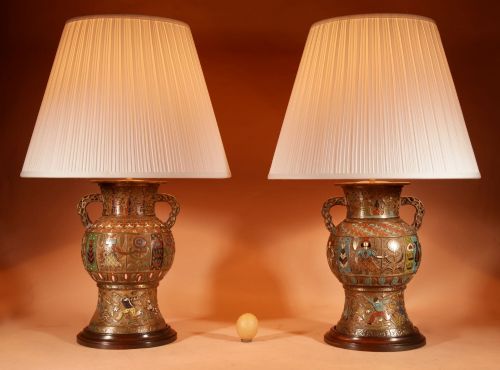
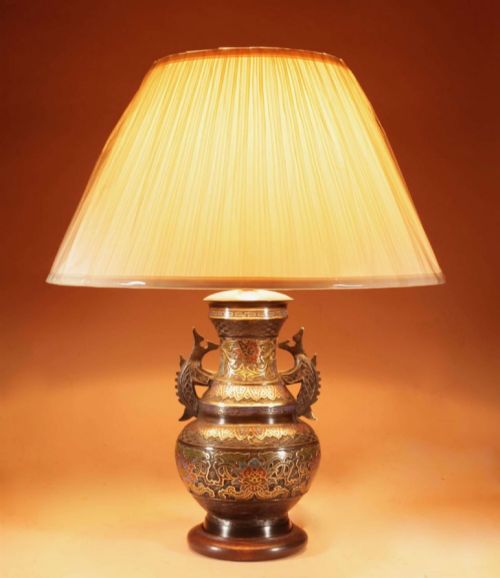
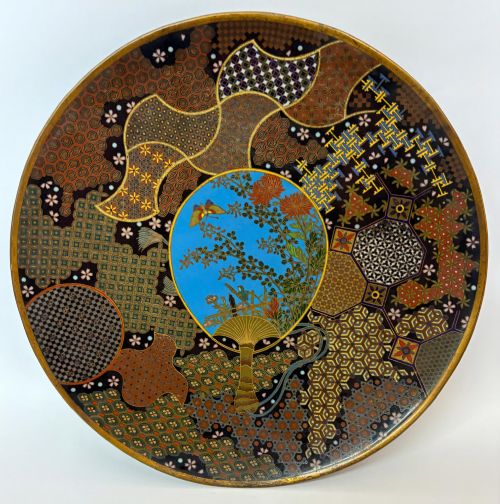
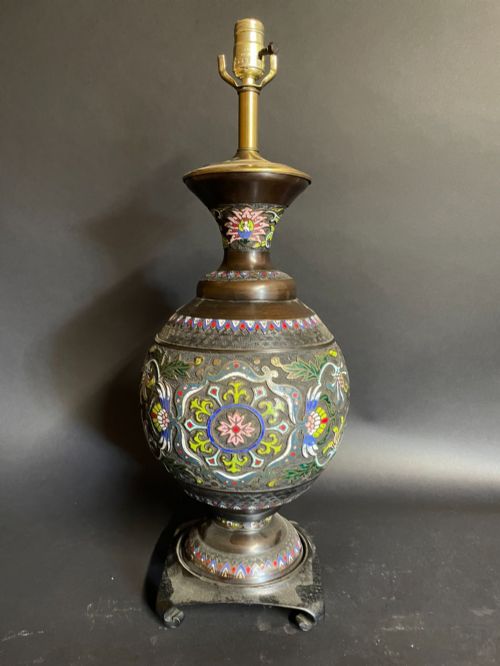
When searching for japanese bronze cloisonne, buyers encounter heavy metal vessels and wall chargers decorated with coloured enamel cells. These objects arrive primarily from the Meiji and Edo periods, reflecting a long heritage of metalcraft.
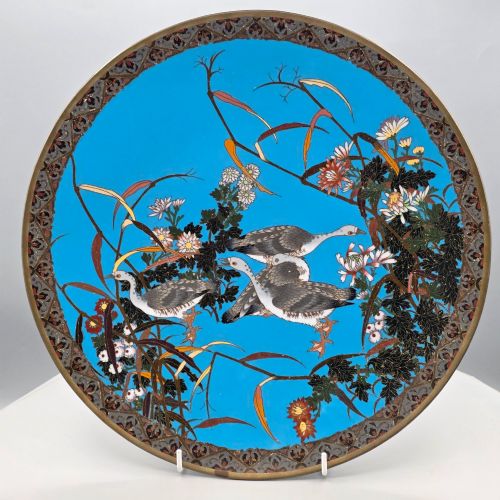
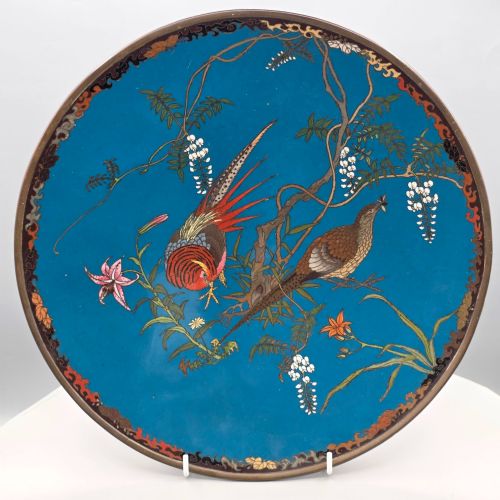
The selections span utilitarian forms adapted into table lamps alongside decorative plates, ginger jars, and hanging boat koro. Chargers dominate the visual landscape, often displaying birds, dragons, and floral motifs across circular fields.
Vessels range from modest miniature vases to large floor-standing examples over seventy centimetres tall. The forms draw on historical styles including Chinoiserie and archaic designs alongside traditional Japanese iconography.
Materials and Construction
Artisans built these pieces using a bronze or copper foundation, sometimes incorporating brass or wood supports. Thin metal wires were soldered onto the metal body to create raised compartments known as cloisons.
These individual cells were filled with vitreous enamel paste before undergoing multiple firings in a kiln. Once cooled, the surface was polished smooth to reveal the fine metal webbing framing each area of colour.
Some dragons depicted on these chargers appear surprisingly cheerful for mythical beasts.
Assessment of Quality
Quality rests upon the precision of the wirework and the control demonstrated in the enamel firing. Finer pieces display exceptionally thin, uniform wire cells forming intricate pictorial details without visible pitting or distortion in the coloured glass.
The weight and finish of the underlying bronze or copper armature also signal standard. Masterpieces achieve a seamless harmony between the metallic structure and the vitreous decoration, often accompanied by artist signatures.
Kinkozan
The Japanese Bronze Cloisonne Glossary
- Cloisonne Enamel
- A metalwork technique where thin wire partitions hold coloured glass paste before firing. This method creates detailed patterns bounded by fine metal lines.
- Champleve
- An enamel technique where troughs or cavities are cast directly into the bronze surface to receive the coloured paste. This differs from soldered wire cells.
- Charger
- A large decorative plate designed for display rather than dining. These wide circular surfaces often showcase complex pictorial scenes.
- Koro
- A traditional incense burner featuring a perforated lid and a supportive body. They frequently take imaginative shapes such as hanging boats.
- Meiji Period
- An era in Japanese history spanning from eighteen sixty-eight to nineteen twelve, noted for the flourishing of decorative arts exported globally. Pieces from this time show high technical refinement.
Japanese Bronze Cloisonne: Frequently Asked Questions
What is japanese bronze cloisonne?
These items are metallic objects, primarily vases, chargers, and lamps, decorated with compartmentalised enamel designs.
They combine cast bronze or copper bases with fused glass pastes separated by thin metal wires.
How were they used?
Many pieces served as ornamental display items in traditional interiors or were adapted later into functional table lamps.
Incense burners and sake kettles also fulfilled ceremonial and domestic roles within period households.
How do I date these pieces?
Dating relies on stylistic markers associated with the Meiji and Edo periods, alongside construction methods and material patination.
Signed works and specific motifs like dragons or specific floral arrangements help narrow the era of production.
How do I care for japanese bronze cloisonne?
Maintenance requires gentle dusting with a soft dry cloth to protect the delicate wire partitions and polished enamel surfaces.
Avoid chemical cleaners and excessive moisture which can harm the ancient bronze or brass foundations.