
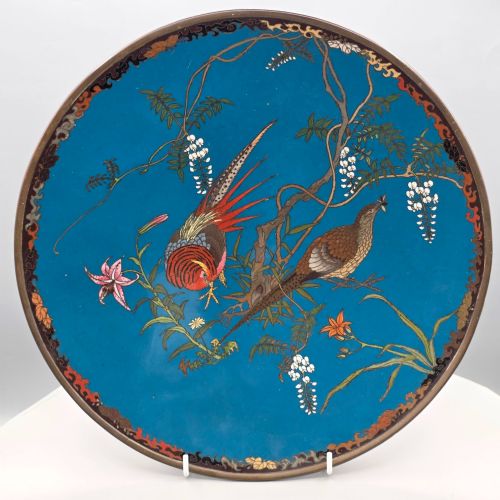
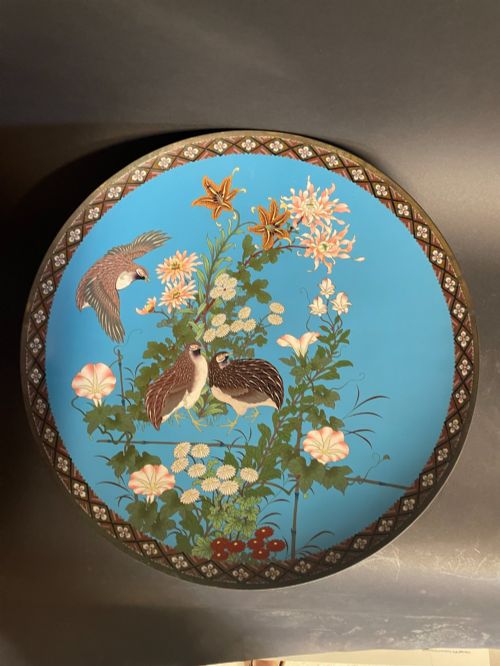


Japanese Bird Cloisonne Charger
A japanese bird cloisonne charger brings masterwork metalwork and avian imagery into a room, offering striking focal points for a wall or table.
Japanese Bird Cloisonne Charger
When you search for a japanese bird cloisonne charger, you are looking at large decorative plates and platters created in Japan primarily during the Meiji period and late Edo period. These pieces span production dates from the 1860s through to 1900, capturing a golden era of metalwork and enamelling.
The subjects depicted on these chargers focus heavily on nature, featuring birds such as the ho-o bird or phoenix, ibis, owls, and individual birds perched on branches alongside landscapes like Mount Fuji. The forms include standard circular chargers, octagonal trays, and porcelain plates utilising totai shippo techniques.
The most common versions met on this page are large enameled copper or brass chargers dating from the 1880s and 1890s. They combine intricate wirework with coloured enamels to render vivid avian scenes across diameters that often exceed thirty centimetres.
What varies in quality
The finesse of the wirework largely dictates the distinction between standard production and top-tier examples. Finer, thinner copper wires allow for more complex plumage and facial details on the birds, whereas thicker lines produce a coarser design.
The depth and uniformity of the enamel colouration further separate ordinary items from masterworks. Superior pieces display smooth, evenly fired fields without pitting or cloudiness, alongside deliberate integration of signature marks and pictorial backgrounds.
The listings here span from the 1860s late Edo period through the Meiji era up to 1900, incorporating brass, copper, bronze, and porcelain.
The Japanese Bird Cloisonne Charger Glossary
- Cloisonne Enamel
- A metalwork technique where thin wires form raised barriers on a vessel body to contain coloured glass pastes before firing. This method creates the distinctive cellular patterns defining these chargers.
- Totai Shippo
- A variation of cloisonne where the enamel is applied directly onto a porcelain base rather than a metal body. Pieces utilising this method often feature textural elements like tree bark.
- Ho-o Bird
- A mythical Chinese phoenix adopted into Japanese decorative arts as a symbol of virtue and grace. It appears frequently with ornate tail feathers on nineteenth-century chargers.
- Charger
- A large ornamental plate designed primarily for display on walls or tabletops rather than everyday dining use. These items serve as substantial focal points in a room.
- Meiji Period
- The era in Japanese history spanning from 1868 to 1912, characterised by a massive expansion in decorative arts exported globally. Much of the extant metalwork originates from this time.
Japanese Bird Cloisonne Charger: Frequently Asked Questions
How were these chargers displayed?
These large decorative plates were principally produced for display rather than functional dining use. Owners typically mounted them on walls or placed them on sturdy stands to showcase the detailed avian scenes.
Because of their substantial diameters, often ranging from thirty to over fifty centimetres, they acted as prominent visual anchors in domestic interiors.
What birds appear on these chargers?
The avian subjects span both natural and mythical creatures. Artisans frequently rendered the ho-o bird, or phoenix, alongside ibises, owls, and generic songbirds perched on flowering branches.
These depictions often incorporate contextual scenery such as Mount Fuji, tree bark textures, and mon emblems to enrich the pictorial narrative.
How do I date a cloisonne charger?
Dating relies on stylistic shifts, material combinations, and occasionally maker signatures found on the reverse or base. Pieces originating in the 1860s often fall into the late Edo period, displaying robust forms and deep enamel tones.
Items from the 1880s through to 1900 reflect the height of the Meiji period, where wirework became increasingly microscopic and technically refined.
What is totai shippo?
Totai shippo refers to wire-work enamelling executed over a porcelain core instead of the traditional copper or brass foundation. This technique produced translucent or textured effects that mimic other materials.
Plates utilising this method frequently incorporate simulated tree bark surfaces alongside bird and floral motifs.