




Jacobean Style Side Chairs
Jacobean style side chairs bring heavy oak frames and carved details into dining rooms, offering a sturdy seat rooted in seventeenth-century design.
Jacobean Style Side Chairs
Jacobean style side chairs comprise rigid timber seating built mostly from oak, appearing as single items, pairs, or larger matched sets. When examining jacobean style side chairs, buyers encounter pieces spanning genuine seventeenth-century origins alongside later nineteenth-century revivals and early twentieth-century copies.
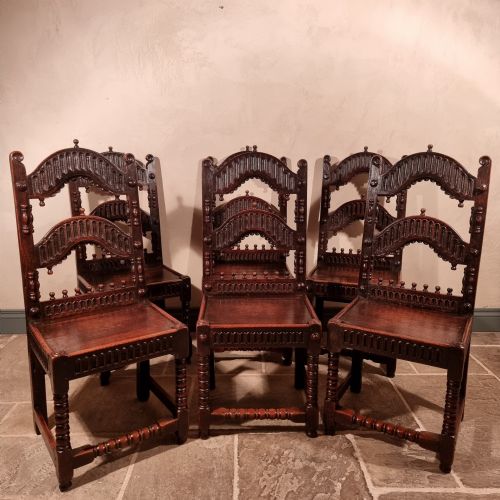
The form typically lacks arms, designed to tuck against a dining table or stand neatly in a hallway. Surviving examples range from plain high-backed chairs to elaborately carved specimens incorporating regional British designs like Derbyshire or Yorkshire patterns.
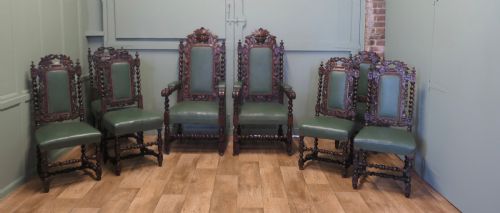
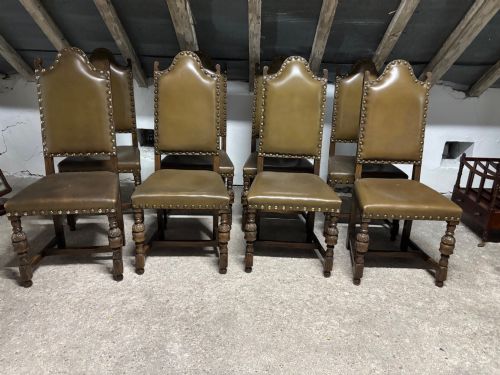
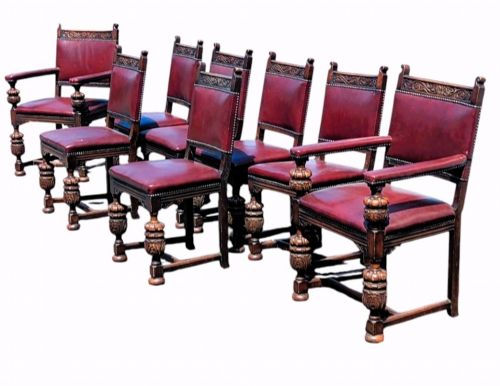
Makers across the Victorian, Edwardian, and interwar periods frequently reproduced these heavy timber forms to satisfy demand for historic domestic interiors. Buyers frequently find sets of six or eight dining chairs alongside individual hall chairs and backstools.
Materials and Construction
Solid oak serves as the primary structural timber across nearly all examples, supplemented occasionally by beech. Joinery relies on traditional pegged mortise and tenon joints to bear the weight of heavy upright frames.
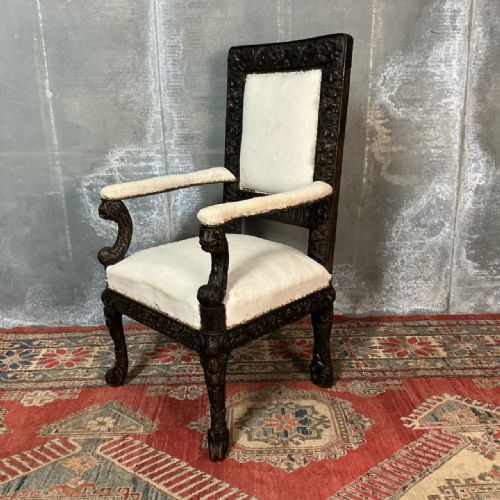
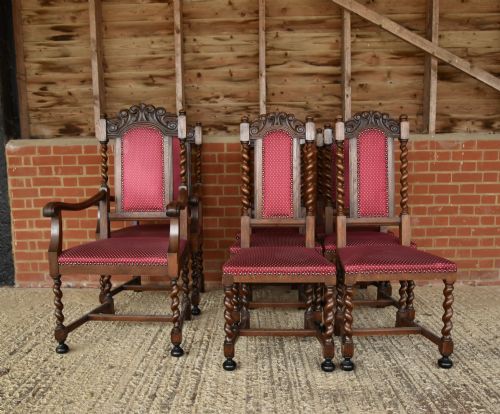
Carving provides the principal ornament, executed directly into the dense wood of the crest rails, stiles, and splats. Turning lathes shape upright posts into barley twist or bobbin columns.
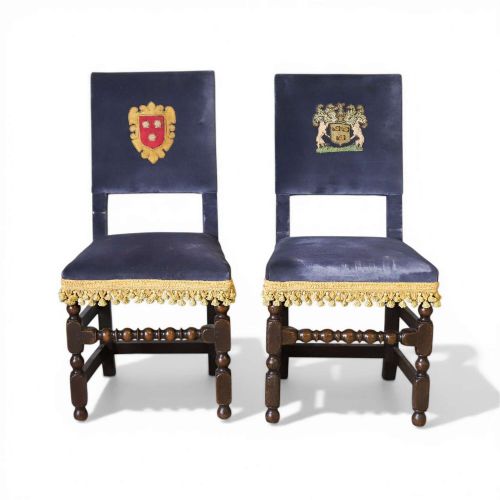
Seating surfaces utilise leather, cane, woven rattan, or textiles including velvet and upholstery fabric, secured with brass tacks.
Listings feature oak construction paired with cane, leather, brass, and velvet across seventeenth-century, Victorian, and Edwardian periods.
Quality Variations
The crispness and depth of the timber carving separate standard production from superior craftsmanship. Sharp undercuts and well-defined relief work on the crest rails indicate skilled execution rather than mechanical moulding.
The integrity of the oak frame and the tightness of the original joints dictate structural longevity. Heavy timber demands precise joinery so that uprights and stretchers remain rigid under daily use.
The choice of secondary materials, from fine grain leather to tightly woven cane or thick velvet, alters the tactile presence of the chair.
The Jacobean Style Side Chairs Glossary
- Backstool
- An early term for an upholstered chair without arms, providing a supportive upright back. It sits lower than later formal dining seats.
- Splat
- The vertical wooden strip down the centre of the backrest. It often bears central carving or heraldic crests.
- Stile
- The upright vertical post forming the outer edge of the chair back. These frame the central panel or splat.
- Barley twist
- A cylindrical wooden component turned in a spiral resembling a twisted rope. It appears frequently on chair legs and stretchers during the revival periods.
- Derbyshire style
- A regional seventeenth-century chair type distinguished by an open arcaded backrail and carved crest. Surviving examples show distinct local woodworking traditions.
Jacobean Style Side Chairs: Frequently Asked Questions
Are these chairs comfortable for daily dining?
Most jacobean style side chairs feature upright wooden backs and firm seats upholstered in leather, cane, or fabric. They encourage an erect posture rather than slouching.
Adding loose cushions can soften the timber seat for extended dinner parties while preserving the historic appearance.
How do I spot a true seventeenth-century piece?
Genuine seventeenth-century chairs show tool marks from hand axes and pit saws, along with timber shrinkage appropriate to age. Joints often rely on pegged hand-cut mortises.
Revival pieces from the nineteenth and twentieth centuries display mechanical saw marks and standardised turning that reveal modern workshop production.
What is a backstool?
A backstool is a seventeenth-century form of seating that lacks arms but offers a padded or wooden backrest. It functioned as a primary seat for dining or parlour use before standard dining sets became common.
These pieces sit compactly against walls or tables due to their narrow footprint.
Can I mix these chairs with a modern table?
The dark tones of polished oak and the strong vertical lines of high backs contrast sharply with sleek modern surfaces. Pairing them with a simple timber or glass table highlights their architectural carving.
Matched sets of six or eight provide a unified look around larger dining spaces.