
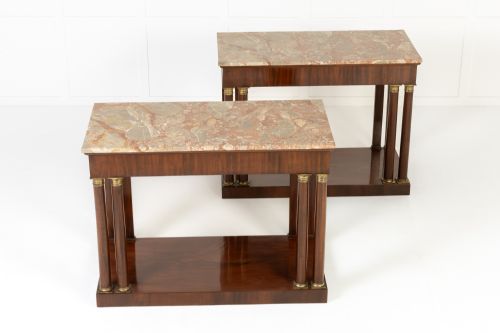


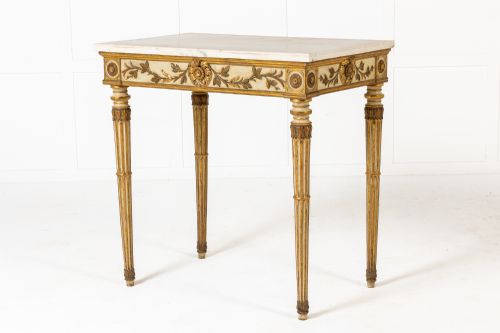
Italian Neoclassical Console Table
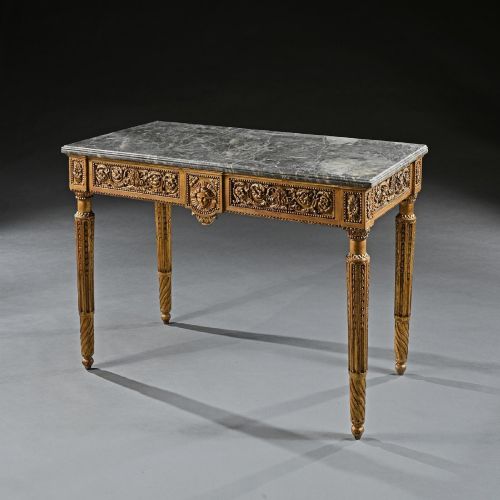
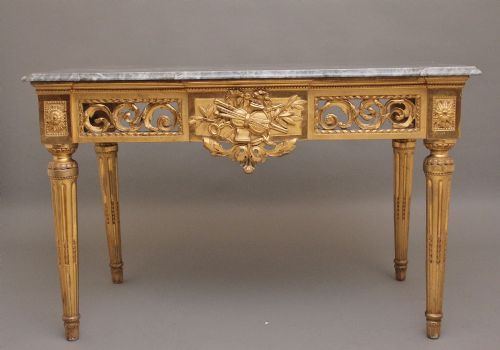
An italian neoclassical console table brings formal proportion and classical restraint to a room, offering a surface of marble or wood supported by carved and painted frames.
Italian Neoclassical Console Table
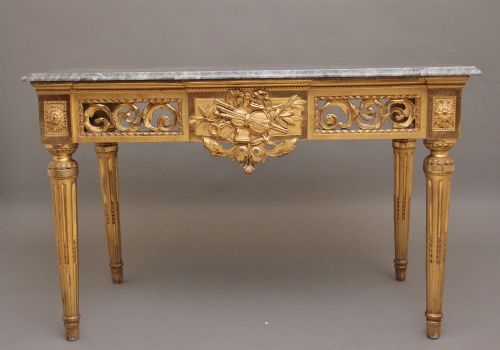
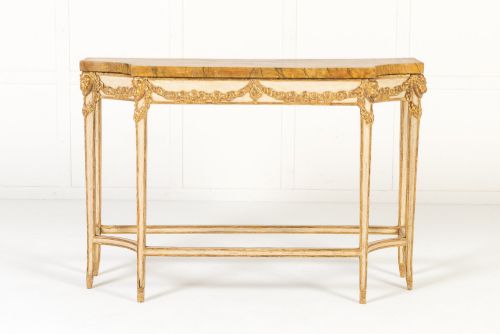
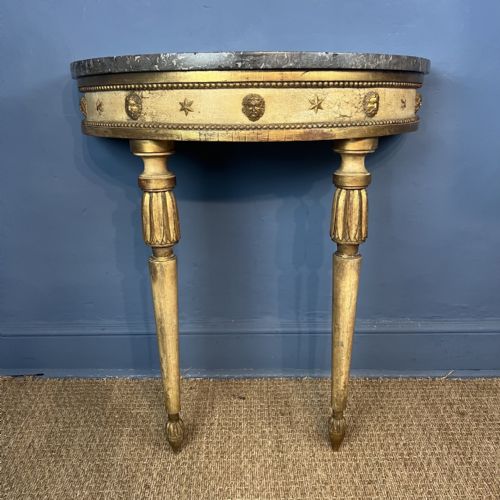
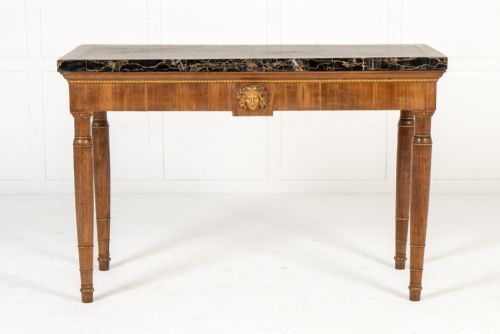
An italian neoclassical console table is a formal wall-mounted or freestanding surface designed to anchor a room with classical symmetry. These pieces date principally from the eighteenth and nineteenth centuries, with occasional examples from later decades carrying the same architectural vocabulary.
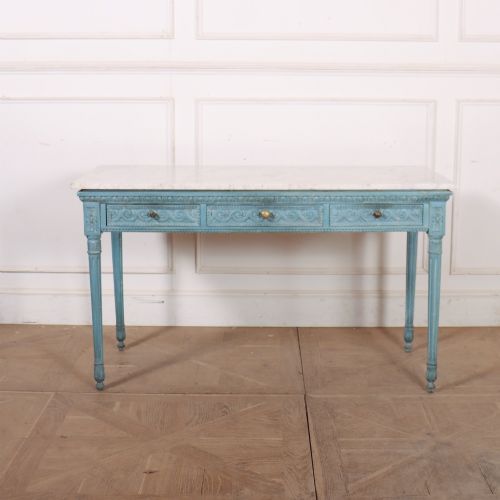
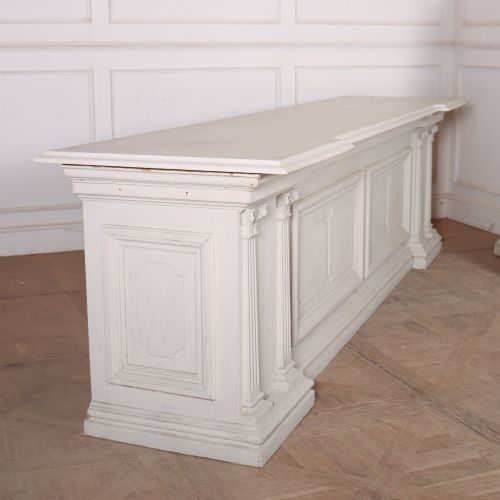
The form appears in several distinct guises across the inventory. Alongside traditional console tables, the selection includes painted counters, side cabinets, side tables, and games tables built within the neoclassical idiom.
Materials span from richly figured marbles to painted wood, gesso, giltwood, gold leaf, walnut, mahogany, and kingwood. Surfaces are frequently painted, parcel gilt, or finished to simulate porphyry.
How they were made
Carpenters and joiners built the structural frames from timbers such as walnut, mahogany, and kingwood, employing traditional jointing methods. Carved wooden elements were frequently coated in gesso before receiving layers of paint or gold leaf.
Surface ornament relied heavily on hand painting, parcel gilding, and faux finishes such as faux porphyry to emulate costly stones. Tops were predominantly formed from solid marble or specimen marble inset into wooden frames.
What varies in quality
The distinction between standard and superior pieces rests upon the crispness of the carved detail and the depth of the finish. Tables featuring hand-carved giltwood or detailed figural elements such as dolphins demonstrate a higher level of artisanal commitment than simpler painted equivalents.
The selection of materials dictates the standing of the piece, particularly the quality of the marble top and the sophistication of the painted or parcel-gilt decoration. Exhibition pieces and works carrying documented attribution display finer proportions and more complex marquetry or inlay work.
Pietro Ferrario
The Italian Neoclassical Console Table Glossary
- Console table
- A table designed to stand against a wall, traditionally supported by two or four legs or fixed directly to the wall with brackets.
- Giltwood
- Wood that has been coated with gold leaf or powder, providing a metallic surface finish that reflects light across carved details.
- Gesso
- A plaster mixture applied to wood surfaces to create a smooth base for painting or gilding.
- Parcel gilt
- A decorative treatment where only specific portions of a wooden or painted object are highlighted with gold leaf.
- Specimen marble
- A top assembled from multiple distinct fragments of coloured marble arranged in geometric or decorative patterns.
Italian Neoclassical Console Table: Frequently Asked Questions
Where should a console table go?
These tables are traditionally placed against a wall in a hallway, drawing room, or reception space where floor space is limited. Their shallow depth allows them to sit beneath mirrors or paintings without obstructing movement.
Because many examples were originally designed to stand against architectural focal points, they work well in pairs or as standalone statement pieces in formal interiors.
Are these tables freestanding?
Console tables historically required partial wall support, though many surviving examples function as freestanding side tables with four legs. The method of support depends on the specific form and period of the piece.
Buyers should examine the leg configuration and frame structure to determine whether a wall bracket is necessary for stability during daily use.
How do I identify a neoclassical style?
Neoclassical pieces draw inspiration from classical antiquity, featuring straight lines, symmetrical proportions, and restrained ornamentation derived from Greek and Roman architecture. Look for motifs such as fluted legs, classical urns, and geometric inlay.
Unlike the curved excess of earlier baroque and rococo styles, neoclassical design values order, balance, and architectural clarity.
What is a faux porphyry finish?
Faux porphyry is a paint technique used to simulate the deep reddish-purple imperial stone prized by ancient Romans. Artisans layered pigments to mimic the characteristic white and dark crystals embedded in the stone.
This method allowed makers to achieve the appearance of costly mineral tops or frames using accessible timber bases.
How do I care for painted wood?
Painted and gilt surfaces require gentle dusting with a dry, soft cloth to prevent the accumulation of abrasive particles. Avoid moisture, chemical solvents, and abrasive cleaners that can lift delicate gesso or gold leaf.
Placing the table away from direct sunlight and fluctuating heat sources will protect the painted finish and underlying wood from cracking.