


Italian Coastal Landscape Art
Italian coastal landscape art captures the sunlit harbours, fishing ports and azure waters of the Mediterranean through the eyes of visiting and local artists.
Italian Coastal Landscape Art
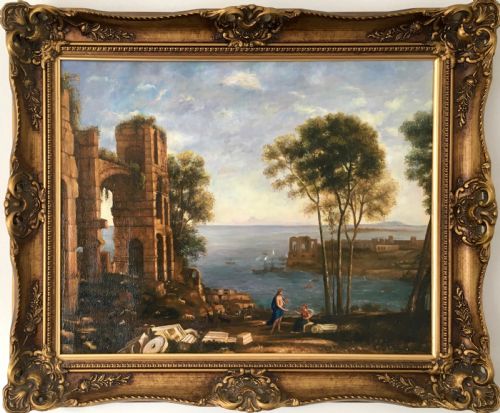
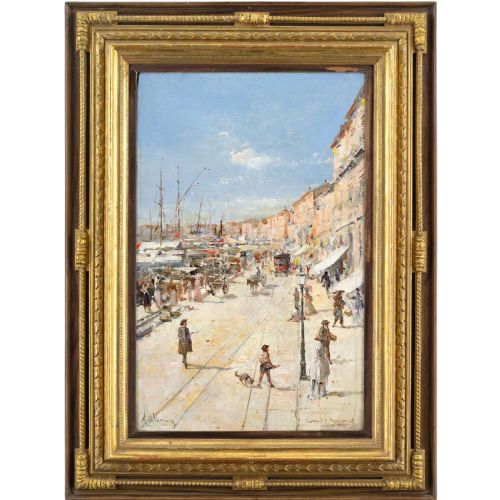
Italian coastal landscape art encompasses framed paintings, watercolours and gouaches depicting scenes from the Bay of Naples, Capri, Sorrento, Venice and Sicily. These works span the nineteenth century, the Edwardian era and the mid-twentieth century, recording the topography and daily life of the Italian coastline.
Buyers encounter everything from intimate miniature oil paintings on wood panels to grand nineteenth-century watercolours and sets of topographical gouaches. Many pieces originate from the Grand Tour tradition, bringing souvenirs of Mediterranean vistas back to British homes.
How they were made
Artists working on the coast utilised oil paint on canvas or wood panels alongside watercolour and gouache on paper to capture the brilliant light of the Mediterranean. These pigments were often housed within gilded wood frames that complemented the maritime subjects.
Techniques range from the loose brushwork of mid-century impressionism and the School of Posillipo to the precise detail required for miniature paintings and architectural landmarks.
Current listings feature oil on canvas, gouache and watercolour works dating from the Victorian period through to the mid-twentieth century.
What varies in quality
Quality rests in the handling of light and atmosphere, distinguishing works that convey the specific warmth of an Italian harbour from stiffer, formulaic topographical records. The fluency of the brushwork in rendering water, figures and distant headlands defines the upper tier.
The integrity of the framing also matters, as original nineteenth-century gilded wood frames designed specifically for the canvas contribute significantly to the visual weight and historical context of the piece.
Augusto Alberici·Carlo Ferranti·Fernando Del Basso·William Raymond Dommersen·Consalvo Carelli·Francesco Guardi·Arthur Joseph Meadows·John D. Walker
The Italian Coastal Landscape Art Glossary
- Gouache
- An opaque watercolour paint that dries to a matte finish, frequently utilised in nineteenth-century Neapolitan views for its dense, vibrant colour.
- Grand Tour
- A traditional trip through Europe undertaken by upper-class young men in the eighteenth and nineteenth centuries, resulting in the collection of art and local views.
- School of Posillipo
- A nineteenth-century group of Neapolitan painters who focused on landscape and marine art, known for observing nature directly from life.
- Capriccio
- An architectural fantasy placing together buildings, ruins and other architectural elements in a fictitious picturesque arrangement.
Italian Coastal Landscape Art: Frequently Asked Questions
How do I identify a School of Posillipo painting?
Look for a focus on naturalistic light, coastal topography around Naples, and atmospheric handling of the sea and sky, often produced during the nineteenth century. These works frequently depict local fishermen or volcanic backdrops like Vesuvius.
Followers and contemporaries of the movement shared a commitment to painting outdoors to capture shifting Mediterranean conditions accurately.
What is the difference between gouache and watercolour?
Watercolour is transparent, allowing the white of the paper to shine through the pigment and create luminosity. Gouache includes a white pigment additive that makes the paint opaque, yielding solid, saturated blocks of colour.
Nineteenth-century artists often combined both mediums on paper to achieve both bright highlights and deep shadows in coastal scenes.
How should I hang nineteenth-century watercolours?
Keep works on paper away from direct sunlight to prevent the fading of delicate watercolours and gouache pigments. Maintaining stable indoor humidity also protects both the paper support and the antique wooden frame.
Glazing with UV-filtering glass provides an extra layer of conservation security for pieces originating from the Victorian era.
Why are so many pieces from Naples and Capri?
These locations formed essential stops on the nineteenth-century Grand Tour, drawing travellers who wished to commission or purchase local views as mementos. Local artists and studios catered specifically to this demand with portable watercolours and oils.
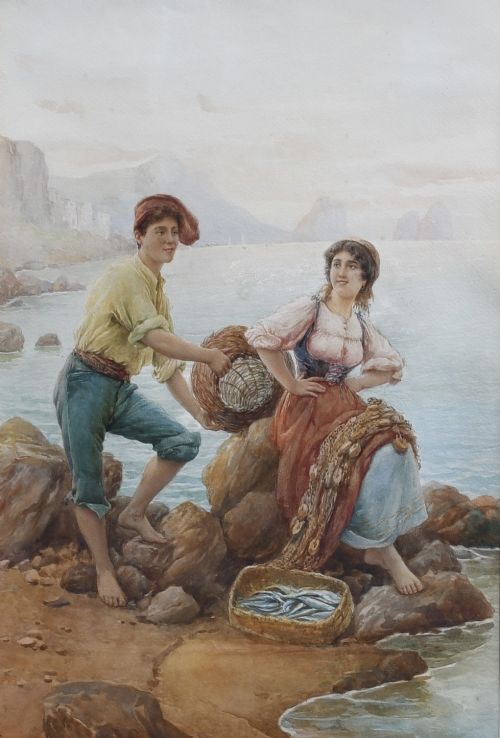
Subjects such as fishermen resting by the sea and views across the bay offered buyers a romanticised window onto Italian life.