


Italian Baroque Candlesticks
These Italian baroque candlesticks are grand altar-style candle-holders that bring rich giltwood presence and theatrical scale to a room.
Italian Baroque Candlesticks
When you search for italian baroque candlesticks, you find grand altar-style candle-holders designed for ecclesiastical and formal settings. These pieces carry the heavy architectural presence typical of the period.
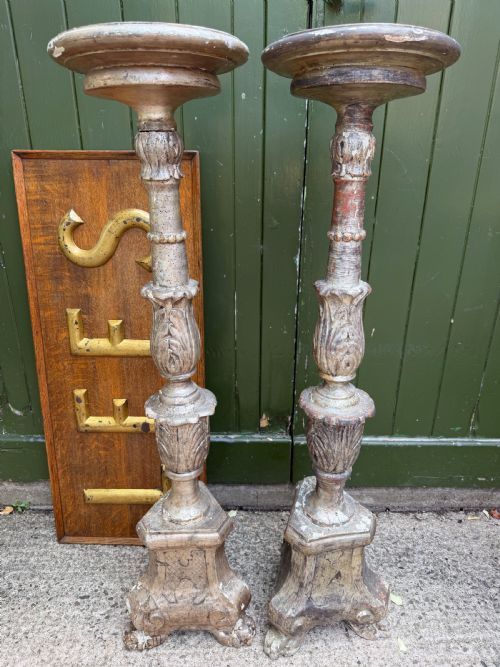
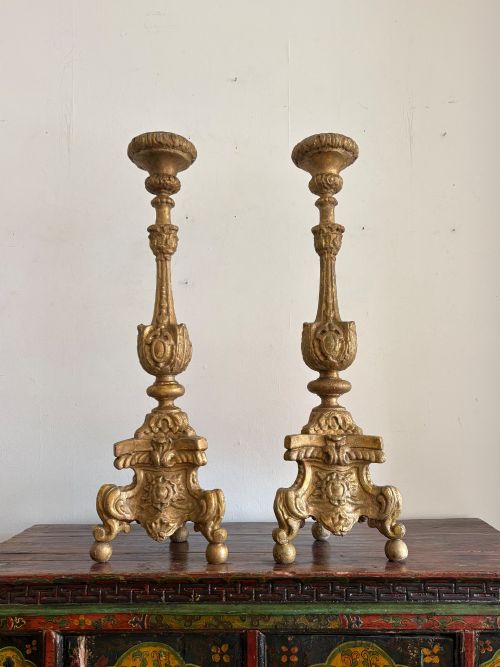
The versions most likely to be met on this page are eighteenth-century pairs from Italy, particularly Venice, rendered in carved and gilded wood. They stand at impressive proportions, reflecting their original church function.
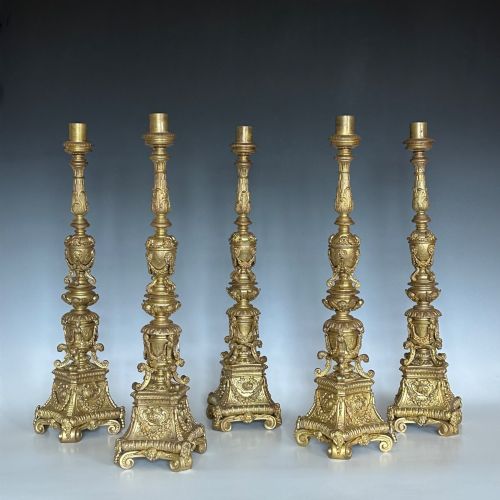
Examples appear in both the Italian Baroque and subsequent Rococo styles, capturing the exuberant decoration of these periods. Gilt bronze and ormolu variants also occur alongside the dominant giltwood forms.
How they were made
Wood serves as the primary substrate, shaped through carving before receiving layers of gesso to prepare the surface. Artisans then applied gold leaf to create the brilliant reflective finish seen on the carved wood and giltwood examples.
Metal pieces utilise gilt bronze and ormolu, combining metal casting techniques with precise surface gilding. Paint often provides additional depth and detail beneath or alongside the gold leaf layers.
Many of these towering altar pieces spent centuries blinking through incense haze before retiring to very polite drawing rooms.
What varies in quality
The depth and vigour of the carving separate the finer pieces from simpler work, with dynamic movement defining the best examples. Crisp detail in the gesso and gold leaf application shows the hand of a skilled artisan rather than hurried production.
Scale and proportion govern the visual impact, as larger altar candlesticks demand careful balance to maintain their architectural harmony. The preservation of the original gilt surface remains crucial to the integrity of each piece.
The Italian Baroque Candlesticks Glossary
- Giltwood
- Wood that has been covered with a thin layer of gold leaf. This technique provides the luminous metallic surface characteristic of baroque church furnishings.
- Gesso
- A plaster mix applied to carved wood to create a smooth surface for gilding. It holds fine detail and gives the gold leaf its bright base.
- Ormolu
- Finely ground high-carat gold applied to a bronze object. The term describes the rich golden finish found on metal candlesticks from the period.
- Altar-type
- A descriptive term for candle-holders sized and styled for church altars. These pieces typically display impressive proportions and architectural motifs.
Italian Baroque Candlesticks: Frequently Asked Questions
What are italian baroque candlesticks?
These pieces are large altar-style candle-holders originating from eighteenth-century Italy. They were created for ecclesiastical use and display grand architectural forms.
Carved wood, gesso, and gold leaf define their construction, resulting in rich reflective surfaces that suit formal domestic interiors today.
How were they used originally?
Original placement centered on church altars, where pairs of tall candlesticks provided illumination and visual splendour during services. Their impressive scale matched the lofty interiors of Italian churches.
Over time, many migrated into secular collections, prized for their theatrical presence and dramatic baroque styling.
How do you live with them?
Placing these tall candlesticks on console tables or sideboards allows their impressive proportions to anchor a room. They require stable surfaces and clearance from modern traffic.
Keep them away from direct heat sources and moisture to protect the delicate gesso and gold leaf surfaces from cracking or flaking.
How do you tell periods apart?
Baroque pieces display heavy architectural symmetry, bold scrollwork, and a strong sense of theatrical drama. Subsequent rococo elements introduce lighter, more asymmetrical curves and playful organic motifs.
Material analysis also helps, noting the shift from carved giltwood towards gilt bronze and ormolu details in later iterations.