


Islamic Revival Table
An islamic revival table brings geometric intricacy and rich inlay into a room, offering a functional surface rooted in centuries of Near Eastern design.
Islamic Revival Table
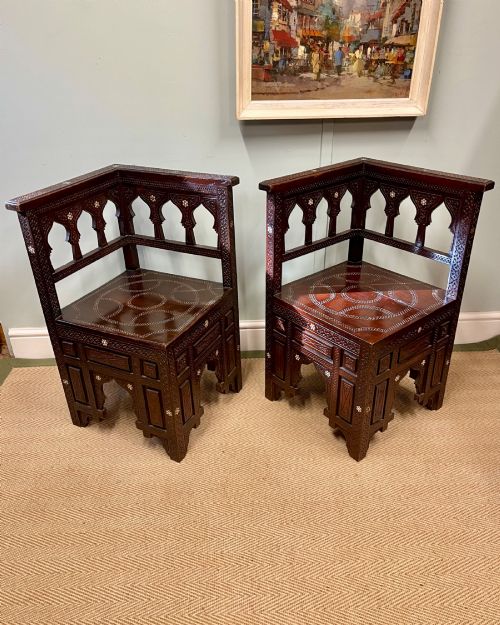
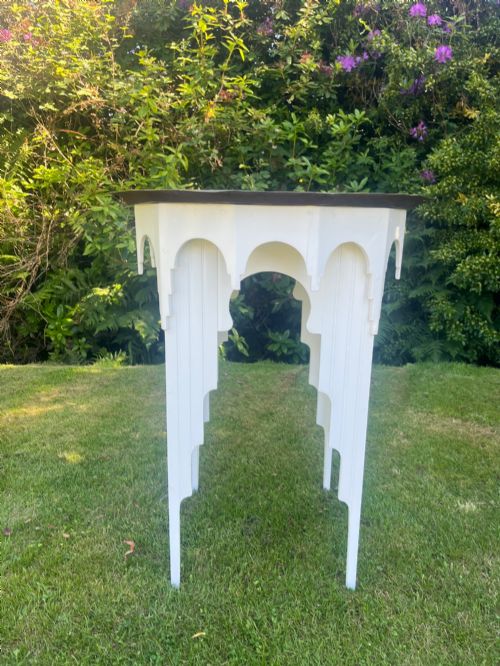
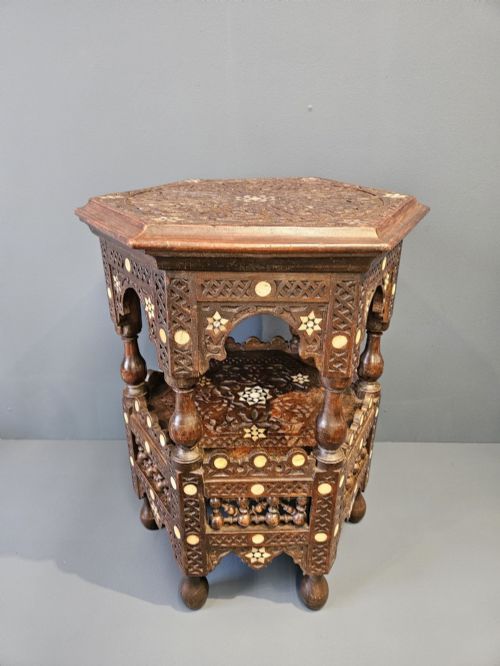
When you search for an islamic revival table, you encounter portable and permanent surfaces designed to catch the eye through complex woodwork and metallic detailing. These pieces draw on Moorish, Mamluk, Ottoman, and Syrian design traditions, emerging primarily in the nineteenth and early twentieth centuries to satisfy European and British fascination with orientalist aesthetics. The most common format you will meet on this page is the hexagonal occasional table or kursi, alongside larger centre tables and folding tray tables.
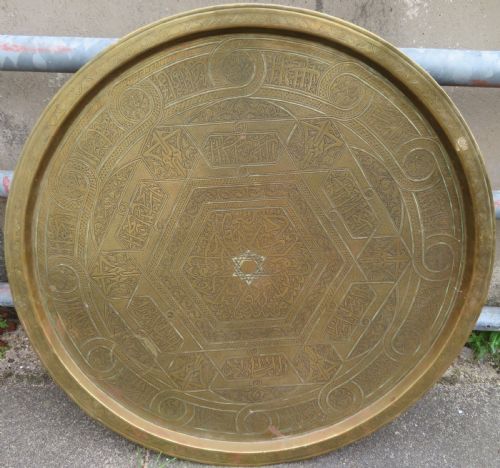
Makers of the period adapted traditional forms like the low kursi into side tables and lamp tables suited to Victorian and Edwardian drawing rooms. Alongside tables, related forms such as cairoware trays, chests, and Quran stands appear in the evidence, sharing the same decorative vocabulary. These objects range from compact occasional pieces to large centre tables, each defined by patterned surfaces rather than plain timber.
How they were made
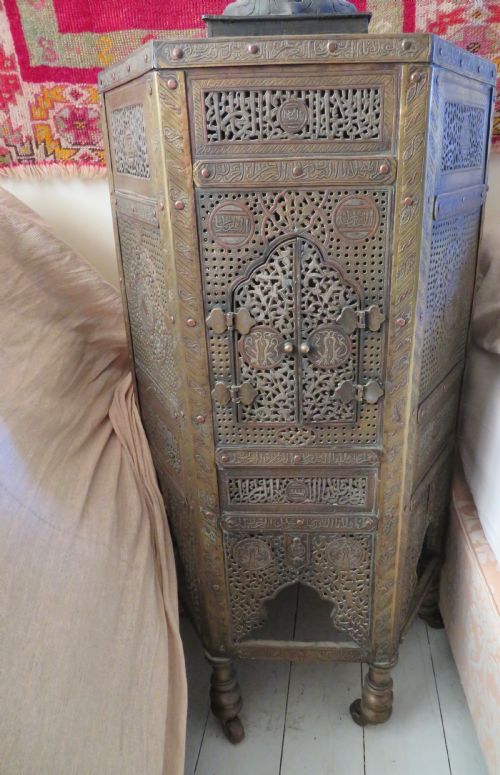
The construction of an islamic revival table relies on dense hardwoods such as walnut, which provide a stable base for elaborate surface decoration. Joinery often takes an octagonal or hexagonal form, utilising intricate openwork and lattice panels that require precise carpentry skills.
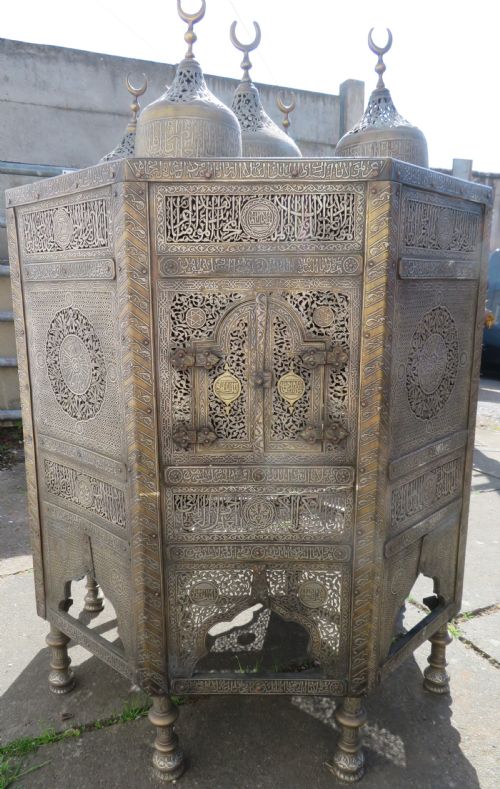
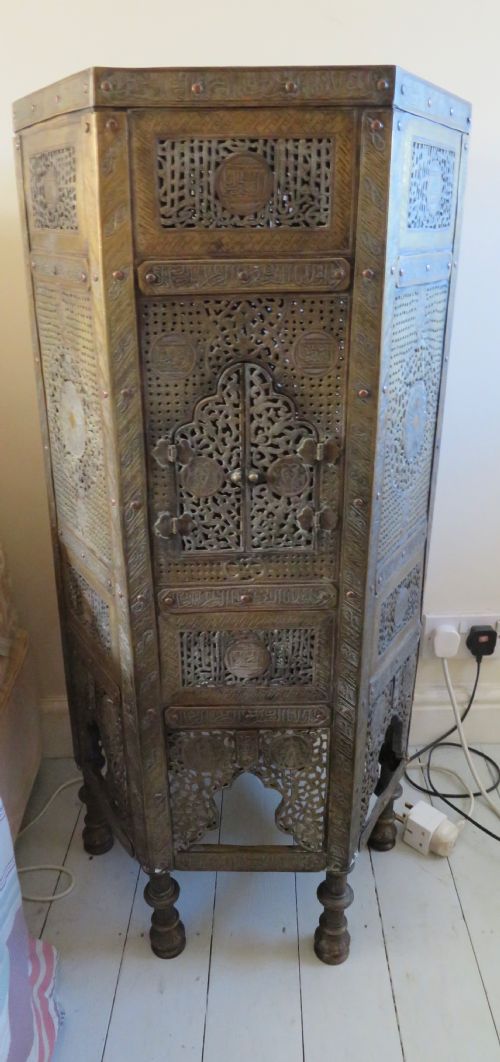
Surfaces are transformed through extensive inlay using mother-of-pearl, bone, copper, and white metal, creating striking contrasts against the dark timber. In cairoware pieces, brass is heavily engraved and sometimes inlaid with silver and gold, building up layered geometric and calligraphic motifs.
Materials recorded across current pieces include mother-of-pearl, bone, walnut, copper, brass, and white metal combined in hexagonal and octagonal forms.
What varies in quality
Quality in these pieces rests upon the precision and completeness of the inlay work, where denser applications of mother-of-pearl and bone distinguish finer examples. The crispness of the brass engraving on cairoware surfaces and the tightness of the wooden lattice joints dictate the overall execution.
The architectural ambition of the piece also separates grades, with metamorphic designs and complex multi-sided forms demonstrating greater skill than simpler occasional tables. Preservation of the delicate inlays and original metalwork directly influences the integrity of each surface.
Liberty
The Islamic Revival Table Glossary
- Kursi
- A traditional low stool or table, often hexagonal or octagonal, used in Middle Eastern domestic spaces. In revival pieces, these were frequently adapted to standard European table heights.
- Cairoware
- Metalwork originating from Cairo in the late nineteenth and early twentieth centuries, typically consisting of brass vessels and tables deeply engraved and inlaid with copper, silver, and gold.
- Moorish Revival
- An architectural and decorative style that draws inspiration from the medieval Moorish art of Spain and North Africa. It is characterised by horseshoe arches, intricate geometric patterns, and rich surface ornamentation.
- Mamluk Revival
- A design movement referencing the ornate metalwork, glass, and woodwork of the Mamluk Sultanate. Pieces in this style emphasise heavy brass construction and dense geometric engraving.
- Mother-of-Pearl
- The iridescent inner layer of certain mollusc shells, harvested and cut into tiny geometric polygons for inlay work. It provides a luminous contrast against dark hardwood frames.
Islamic Revival Table: Frequently Asked Questions
What is an islamic revival table?
An islamic revival table is a nineteenth or early twentieth century piece of furniture inspired by Moorish, Ottoman, or Syrian design traditions. These tables incorporate intricate geometric woodwork and detailed metal or shell inlay.
They reflect the period's broad European interest in Near Eastern craftsmanship, adapting traditional forms like the low kursi into functional occasional and centre tables for Western homes.
How do I date an islamic revival table?
Dating relies on examining the timber construction, the style of the inlay, and any stylistic markers associated with specific decades. Pieces often span from the Victorian era through the early twentieth century.
Moorish and Mamluk revival designs became particularly popular during the late nineteenth century, while later examples from the 1920s and 1930s sometimes show influences from Liberty style production or commercial Egyptian export workshops.
Where were these tables made?
These pieces were manufactured both in workshops across the Middle East and North Africa, including Cairo and Damascus, and by European firms producing orientalist furniture.
Many items were created specifically for export to British and European markets, combining traditional regional craft techniques with forms suited to Western domestic interiors.
How do I care for inlaid wooden tables?
Care involves maintaining stable humidity levels in the room to prevent the hardwood from shrinking and loosening the delicate mother-of-pearl or bone inlays. Dusting should be done gently with a dry, soft cloth.
Avoid using harsh liquid polishes or commercial cleaners that might seep beneath the raised metal wires or damage the organic inlay materials.