
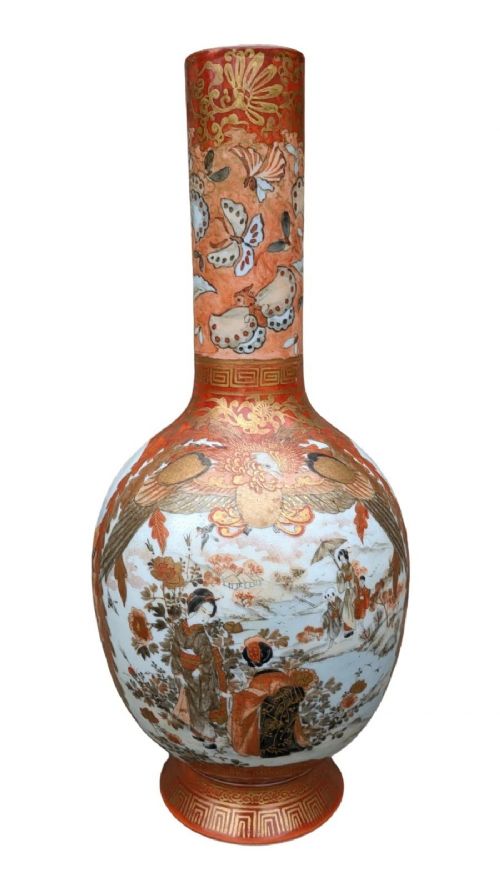


Iron Red Kutani Urns
Iron red kutani urns are porcelain vessels prized for their striking palette and craftsmanship, offering collectors a bold centrepiece for display.
Iron Red Kutani Urns
Iron red kutani urns encompass Japanese ceramic vessels and vases originating primarily from the nineteenth century, including the Meiji period. The pieces appearing here take the form of vases, ginger jars, and floor vases, often presented in matched pairs.
Buyers encountering this selection will most frequently find nineteenth-century examples, ranging from smaller hand-painted items to large floor vases with flared necks. These items reflect the Japanese export trade of the era, combining traditional forms with decorative painting in characteristic palettes.
Materials and Techniques
These items are constructed from porcelain and decorated using enamel alongside gold leaf or gilt details. Artisans applied hand-painted designs directly onto the ceramic body, integrating the distinctive iron red pigment into the overarching decorative scheme.
The physical form is shaped from porcelain clay before firing and glazing, followed by intricate overglaze enamel work. The application of gilt highlights provides contrast against the iron red tones characteristic of the Meiji period output.
Assessing Quality
Quality in these porcelain vessels rests upon the precision and complexity of the hand-painted enamel decoration. Finer examples display disciplined brushwork and careful integration of gold leaf that remains crisp across the surface.
Scale and proportion also define the upper tier, particularly in large pairs and floor vases where symmetry between companions requires greater potter skill. The depth of the iron red tone and the restraint of the gilt accents separate standard export output from superior work.
The Iron Red Kutani Urns Glossary
- Kutani
- A style of Japanese porcelain originating from Ishikawa prefecture, known for rich overglaze enamel decoration. The tradition encompasses distinct colour palettes including the prominent iron red tones found on nineteenth-century vases.
- Meiji Period
- The era in Japanese history spanning from 1868 to 1912, characterised by extensive export of decorative arts to the West. Pieces from this time often exhibit elaborate hand-painting and substantial scale.
- Enamel
- Vitreous material fused to the surface of porcelain through firing to provide colour and pattern. It forms the primary decorative medium for the intricate scenes depicted on these vessels.
- Gilt
- A thin layer of gold applied to the surface of the porcelain to accentuate specific decorative elements. This metallic detail interacts with the iron red enamel to create contrast.
- Ginger Jar
- A high-shouldered ceramic vessel with a rounded body, originally used for storing spices but frequently collected as an ornamental display piece.
Iron Red Kutani Urns: Frequently Asked Questions
What periods do these pieces date from?
The items catalogued here date from the nineteenth century, specifically encompassing the Meiji period and spanning decades such as the 1870s, 1880s, 1890s, and 1900.
This timeframe captures the height of Japanese export porcelain production, when workshops produced both utilitarian jars and large decorative vases for international markets.
How were these vessels used originally?
While ginger jars initially served practical storage functions, the larger vases and floor vases were created primarily for interior display. Their substantial scale and elaborate hand-painted decoration suited the Victorian and Meiji export taste for ornate domestic furnishings.
Today, they function principally as decorative objects rather than utility items, often displayed in pairs to anchor a room.
How do I care for iron red kutani urns?
Maintenance requires gentle handling and dusting with a soft, dry cloth to protect the overglaze enamel and gilt details. Moisture and harsh cleaning agents should be avoided, as they can degrade the painted surface over time.
Placement away from direct sunlight preserves the vibrancy of the iron red pigments and the integrity of the gold leaf highlights.
How can I distinguish between the different sizes?
The listings range from small hand-painted cabinet pieces to imposing floor vases measuring up to fifty-four inches. Dimensions and descriptions indicate whether a piece is an individual container or part of a matched pair.
Examining the proportion of the neck to the body helps identify the specific vessel type, such as whether a piece functions as a ginger jar or a flared-neck vase.