


Inlaid Wood Dressing Table
When you search for an inlaid wood dressing table, you discover pieces designed for the bedroom that combine functional storage with decorative marquetry.
Inlaid Wood Dressing Table
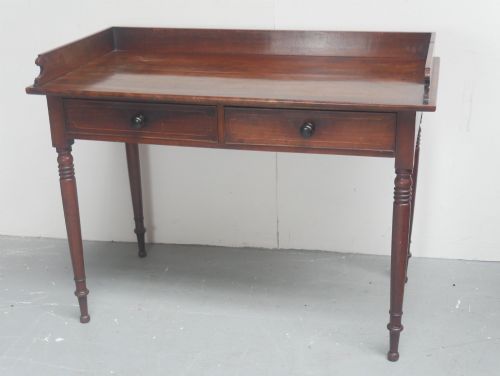
An inlaid wood dressing table combines timber construction with decorative surface ornamentation, often incorporating mirrors and drawers for personal grooming. The evidence shows these pieces appearing across the Georgian, Victorian, and Edwardian periods.
You are most likely to meet Edwardian satinwood or mahogany examples on this page, alongside earlier Victorian rosewood and kingwood variations. These range from full-sized tables with oval mirrors to compact table-top mirrors and shaving stands.
Makers such as Edwards and Roberts and James Shoolbred produced notable versions during the nineteenth and early twentieth centuries. Alongside these, Dutch marquetry and French influenced poudreuses appear within the records.
Materials and construction
Cabinet makers utilised a foundation of solid mahogany, walnut, or rosewood, applying satinwood, boxwood, and tulipwood veneers to create contrasting borders and panels. Wood inlay and marquetry techniques formed intricate geometric or floral patterns across the drawer fronts and table tops.
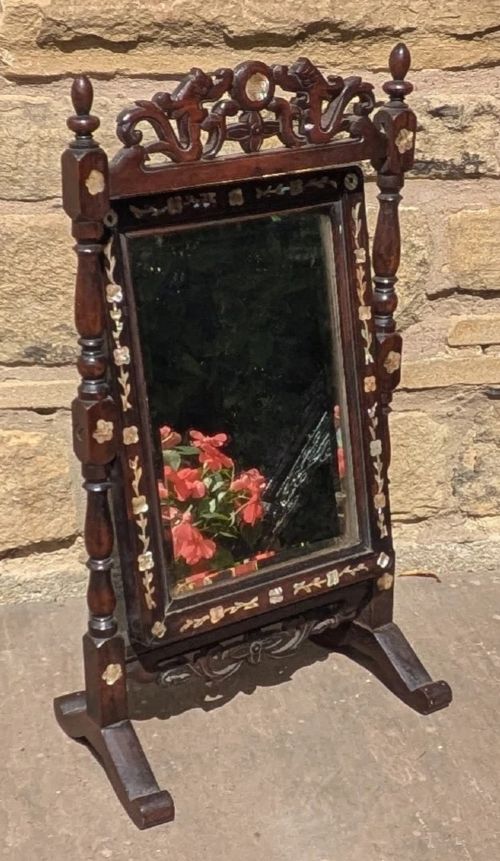
Brass fittings, glass swing mirrors, and occasional bone or mother of pearl details completed the construction. Carpenters employed crossbanding and banding to frame the primary timber grains effectively.
Listings feature mahogany, satinwood, and rosewood constructions enhanced by boxwood and tulipwood banding across the nineteenth and early twentieth centuries.
Distinguishing quality
The standard of an inlaid wood dressing table rests on the precision of the marquetry and the choice of secondary timbers. Finer examples display tightly executed botanical or geometric patterns without gaps in the contrasting veneers.
The integration of original bevelled glass mirrors, substantial brass hardware, and secondary drawer linings of solid mahogany rather than softwood elevate a piece. Maker attribution also separates standard production furniture from superior workshops.
H Mitchell·Edwards and Roberts·James Shoolbred·Maple and Co
The Inlaid Wood Dressing Table Glossary
- Marquetry
- The art of applying pieces of veneer to a structure to form decorative patterns. Craftsmen cut various coloured woods to fit precisely together before gluing them to the carcass.
- Satinwood
- A durable timber with a lustrous yellow sheen utilised extensively for cabinet making and banding. It provides a bright contrast against darker woods like mahogany and rosewood.
- Crossbanding
- A strip of veneer applied perpendicularly to the grain of the main surface. This technique frames the top or drawer front with a neat border.
- P poudreuse
- A French dressing table or vanity desk equipped with folding compartments and mirrors. These multi-purpose items date across the nineteenth century.
- Swing mirror
- A looking glass mounted on vertical pivots within a frame, allowing the user to tilt the angle. These often sit upon dressing tables or act as standalone table-top items.
Inlaid Wood Dressing Table: Frequently Asked Questions
What periods do these tables come from?
The available records show pieces originating primarily from the Georgian, Victorian, and Edwardian eras. Edwardian satinwood and Victorian rosewood examples appear most frequently.
Earlier pieces from the Georgian period and around eighteen hundred also feature, alongside late nineteenth century continental and Dutch marquetry designs.
Are the mirrors original to the tables?
Many dressing tables retain their original swing mirrors, often supported by scroll carved arms or upright pillars. Bevelled glass and matching timber frames indicate original manufacture.
Some surviving pieces are found without their original mirrors or take the form of writing tables and desks adapted for similar bedroom use.
What woods were used for the inlay?
Cabinet makers utilised boxwood, satinwood, and tulipwood to create contrasting bands and pictorial marquetry. These lighter timbers stood out against darker primary woods like mahogany, walnut, and kingwood.
Additional materials such as bone and mother of pearl occasionally supplement the wooden inlays on specific Victorian and nineteenth century pieces.
How do I identify a maker?
Certain workshops stamped their names directly onto the drawer timbers or applied paper trade labels to the interior surfaces. Documented makers include Edwards and Roberts, James Shoolbred, and Maple and Co.
Construction methods and distinct veneer choices also help attribute pieces when physical stamps are absent.