
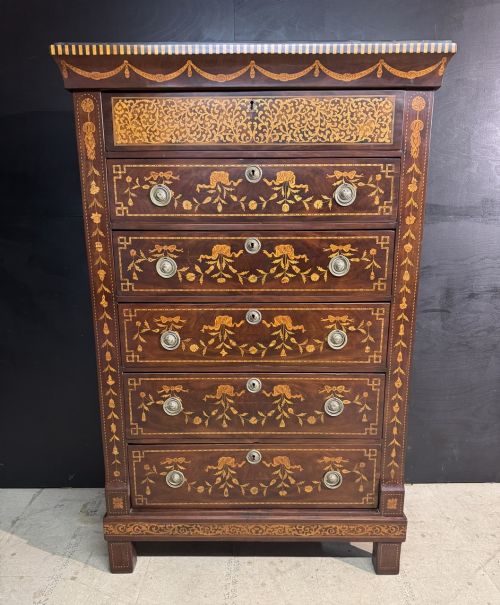
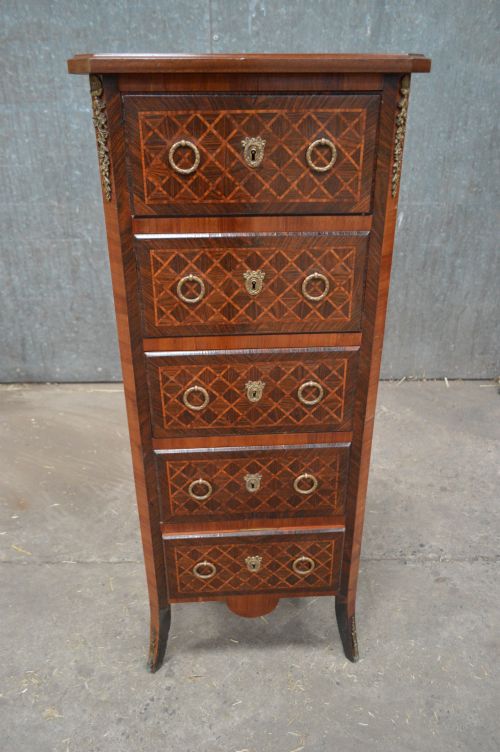

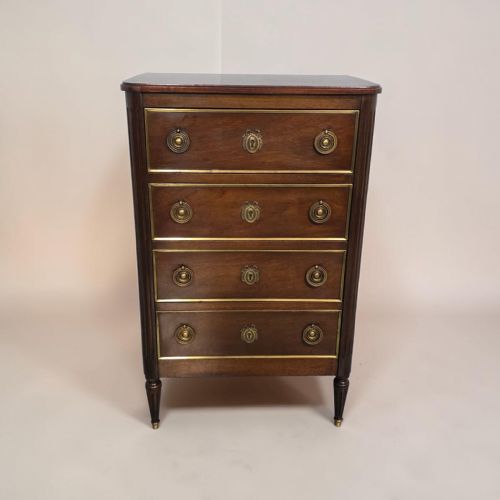


Inlaid Semainier Chest
An inlaid semainier chest is a tall, narrow drawer unit built for the bedroom, offering seven tiers of storage with distinct aesthetic refinement.
Inlaid Semainier Chest
An inlaid semainier chest provides a slender profile designed for compact spaces while maintaining multiple tiers of drawers. You will frequently encounter examples from the nineteenth century alongside pieces attributed to Edwardian production.
The materials and decoration span diverse regional workshops, incorporating Dutch marquetry traditions alongside French cabinet-making styles. These tall chests manifest variously as pedestal forms, Wellington chests, and secretaire configurations.
Makers utilised specific timber choices to define the exterior surface, pairing structural carcases with decorative veneers. The resulting pieces reflect stylistic revivals ranging from Louis XV and Louis XVI to Dutch neoclassical designs.
Materials and Construction
Cabinet makers built the structural carcase using dense timbers such as mahogany, walnut, and rosewood, often applying contrasting veneers of satinwood or kingwood. Complex patterns emerge through marquetry and parquetry techniques, embedding various wood species into the primary surface.
Many examples incorporate decorative metalwork, utilising ormolu mounts and brass stringing to accentuate the drawer borders and corners. Selected pieces feature fitted marble tops that provide a durable and polished upper surface.
The inventory records Dutch marquetry, French transitional styles, and Wellington chest forms among the available tall drawer units.
Craftsmanship and Detail
The precision of the veneer work dictates the visual success of the piece, particularly where floral marquetry or geometric parquetry meets the edges of the drawers. Artisans demonstrated skill through the seamless integration of brass inlays and the alignment of grain across multiple tiers.
Structural integrity depends on the internal drawer construction and the integration of heavy stone surfaces where marble tops are present. Refinement shows in the handling of period revival details, such as the proportions of Louis style mounts or neoclassical banding.
Maison Krieger·Maple & Co.
The Inlaid Semainier Chest Glossary
- Semainier
- A tall, narrow chest traditionally featuring seven drawers, one for each day of the week. This form originated in France during the eighteenth century.
- Marquetry
- The art of applying decorative pieces of veneer to a structure to form intricate floral or pictorial designs. It creates patterned surfaces using contrasting woods.
- Parquetry
- A geometric mosaic of wood pieces used for decorative floors and furniture surfaces. It relies on symmetrical angles rather than flowing pictorial motifs.
- Ormolu
- Gilded bronze used for decorative mounts on furniture. It adds metallic contrast to wooden cabinet surfaces.
- Wellington Chest
- A sturdy vertical chest of drawers secured by a hinged locking side pilaster. This form provides deep capacity within a narrow footprint.
Inlaid Semainier Chest: Frequently Asked Questions
What is a semainier chest?
A semainier chest is a tall, slender furniture piece traditionally containing seven drawers.
This vertical format was designed to hold a week's worth of personal linen and garments within a minimal floor space.
How do I spot French styles?
French styles often display intricate marquetry, ormolu mounts, and shaped marble tops.
Cabinet makers working in these traditions frequently utilised rosewood, kingwood, and walnut veneers to create decorative surface patterns.
Where were these chests placed?
These chests were designed primarily for private bedrooms and dressing rooms.
Their narrow footprint allowed them to fit into tighter spaces where a wide chest of drawers would prove impractical.
What woods were used?
Common structural timbers include mahogany, walnut, and rosewood.
Surface decoration frequently incorporates lighter contrasting woods such as satinwood and maple for detailed inlay work.