



Inlaid Mahogany Sewing Table
An inlaid mahogany sewing table brings refined timber and delicate stringing to domestic spaces, offering hidden storage for needlework.
Inlaid Mahogany Sewing Table
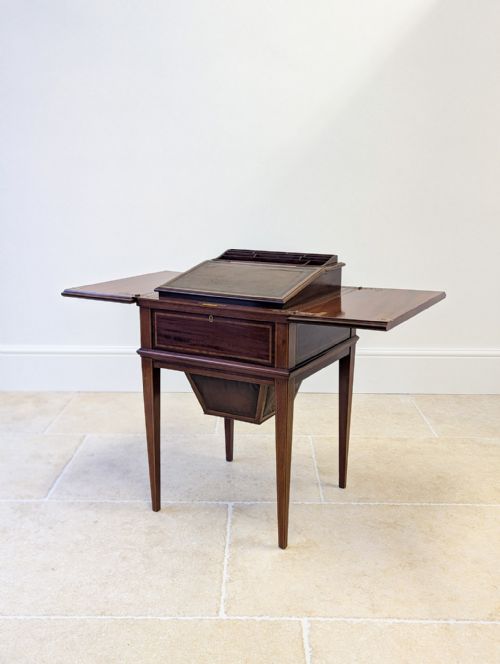
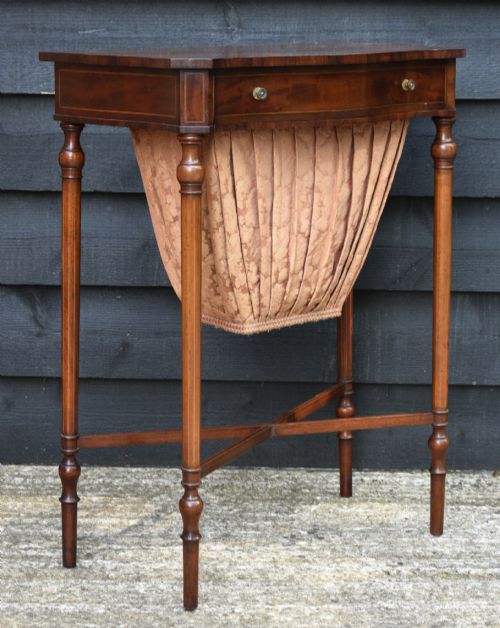
An inlaid mahogany sewing table combines timber frames with contrasting stringing and banding, functioning primarily as a specialised piece for needlework and small domestic tasks. These pieces appear across several periods, most notably in Georgian, Regency, and Edwardian formats.
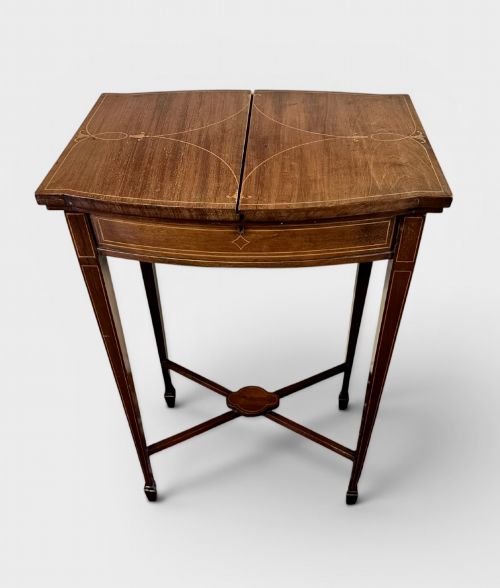
The version most commonly met on this page is the Edwardian iteration, often featuring lightwood stringing, fitted interiors, and drop leaves or silk baskets. Alongside these, Regency and Georgian examples present robust timber framing with Pembroke or pedestal forms.
Construction and Materials
Cabinet makers utilised solid mahogany and flame veneers for the primary carcases, providing a rich, dark ground for decorative detail. Secondary woods provided structural stability inside drawers and compartments.
Inlay work relied on contrasting timbers such as satinwood and boxwood, cut into fine lines or geometric patterns to frame panels and borders. Silk and fabric components were integrated into internal storage baskets and folding work bags.
Listings span multiple eras from the eighteenth century through the Edwardian period, uniting mahogany, satinwood, and boxwood with silk and brass elements.
Judging Quality
The refinement of the inlay work separates ordinary pieces from superior examples, with crisp, tightly fitted boxwood and satinwood stringing indicating skilled handiwork. Precision in the jointing of drawers and secret compartments further distinguishes finer workshops.
Timber selection governs the visual depth of the surface, where figured flame mahogany exhibits lively grain patterns rather than flat planes. The integration of functional elements, such as smooth rising mechanisms and original silk baskets, elevates the standing of a piece.
The Inlaid Mahogany Sewing Table Glossary
- Pembroke table
- A small occasional table with hinged drop leaves on two opposing sides. These tables often incorporate single or double drawers.
- Stringing
- A narrow strip of contrasting timber inlaid into a channel on the surface of the wood. This technique outlines drawers, borders, and tabletops.
- Satinwood
- A durable exotic timber with a lustrous yellowish sheen, frequently used for contrasting inlay and veneering. It contrasts sharply against dark mahogany.
- Drop leaf
- A hinged flap on a tabletop that raises to extend the surface area and drops down when not required. It allows the furniture footprint to adapt to smaller spaces.
Inlaid Mahogany Sewing Table: Frequently Asked Questions
What is a sewing table used for?
A sewing table serves as a compact storage unit for needlework, thread, and small accessories. Many examples incorporate fitted interior compartments and hanging fabric baskets to organise materials.
Historically, these tables functioned in parlours and drawing rooms where ladies engaged in embroidery and hand sewing. They provided a tidy surface for active projects while maintaining a decorative appearance in the room.
How do I date an Edwardian sewing table?
Edwardian sewing tables typically date from the late nineteenth century up to the First World War. They frequently display light satinwood inlay, tapered legs, and lift-up tops with silk work bags.
Unlike heavier Georgian or Regency pieces, Edwardian examples often favour lighter proportions and serpentine edges. The interior fittings tend to feature partitioned trays designed for contemporary sewing notions.
Are these tables sturdy enough for daily use?
These tables are built from solid timber and sturdy veneers, making them durable for everyday placement in living areas. Their smaller proportions mean they function well as lamp or side tables.
Care should be taken with older drop leaves and delicate inlay work during relocation. Regular maintenance of the mahogany surface preserves the timber against excessive dryness.
What is the difference between a work table and a sewing table?
A work table and a sewing table describe functionally overlapping forms used for domestic crafts. Both terms appear interchangeably in period descriptions and modern listings.
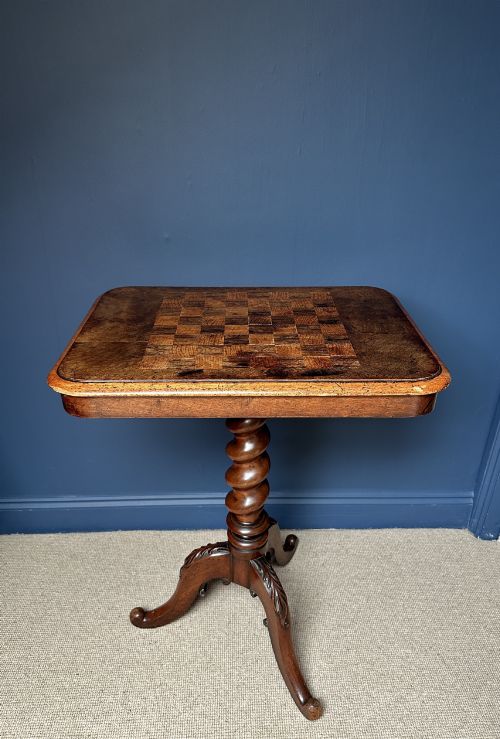
Specific variations might include chess boards on the top or writing surfaces with rear screens. The presence of internal compartments or fabric baskets generally confirms the primary use for needlework.