

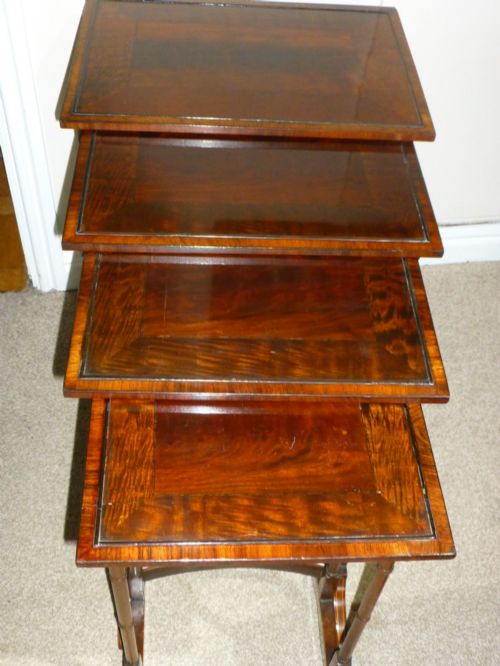

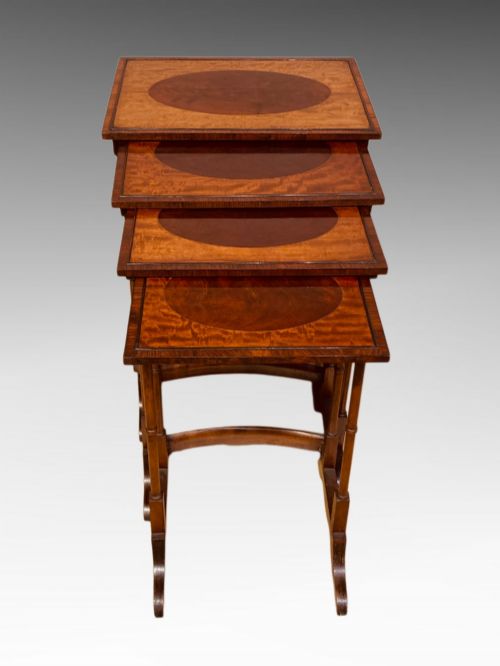


Inlaid Mahogany Quartetto Nest
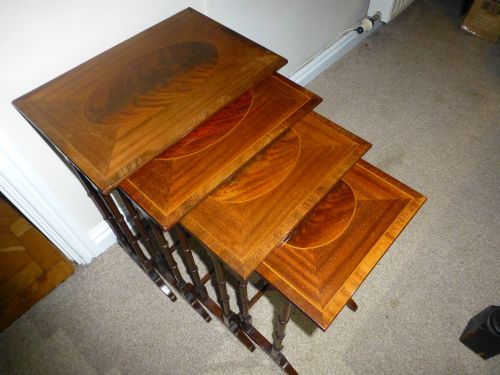
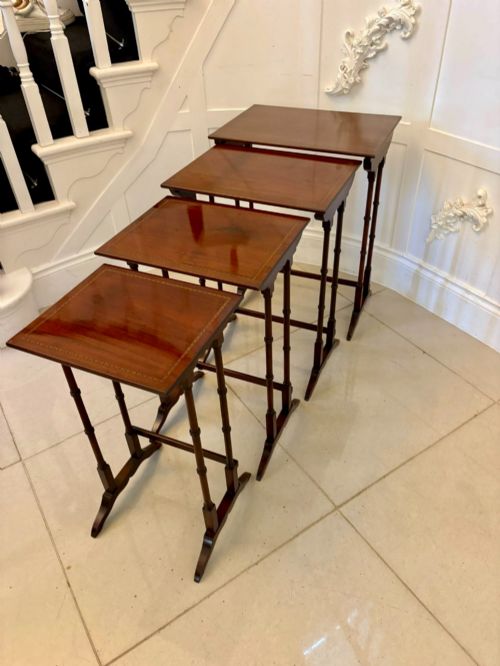
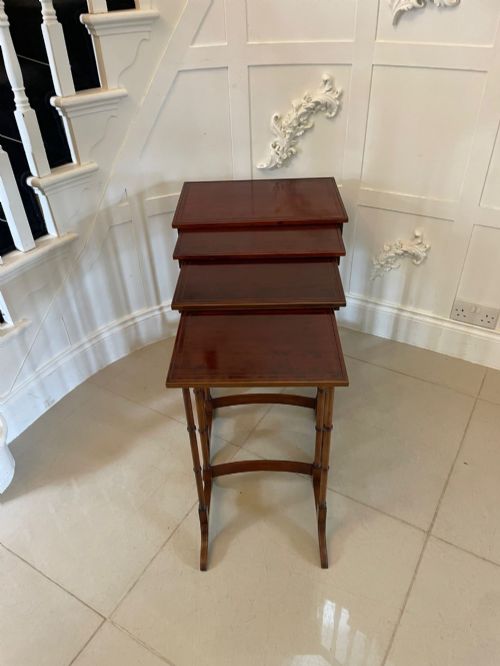
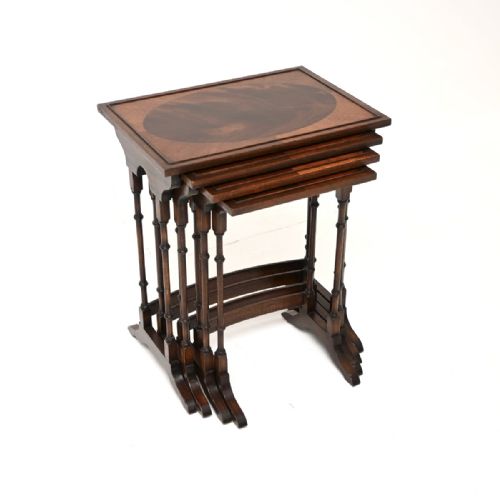
An inlaid mahogany quartetto nest brings four stacking occasional tables together in one footprint, offering clever versatility for period interiors.
Inlaid Mahogany Quartetto Nest
When you search for an inlaid mahogany quartetto nest, you encounter sets of graduating tables designed to slide neatly beneath one another when not in use. The evidence shows these pieces appearing most frequently from the Victorian and Edwardian periods, often adhering to Georgian and Sheraton revival styles.
Most examples consist of four tables, though variations of three tables also surface in the listings. They serve as adaptable occasional, coffee, lamp, or wine tables within a drawing room or parlour.
The form relies on proportion, with each smaller table clearing the legs and underframe of the one above it. This ingenious descending scale defines the traditional quartetto design seen across nineteenth and early twentieth century examples.
Materials and construction
Cabinet makers utilised mahogany as the primary timber, often enhanced with fine veneer surfaces. This was paired with contrasting timbers for inlay work.
Satinwood and boxwood feature heavily in the evidence as inlay and crossbanding materials, creating sharp geometric borders and decorative stringing along the tops. Selected Edwardian pieces also incorporate brass inlay for added detail.
Construction techniques focused on stability and light weight, employing slender square tapered legs to support the stacking frames without adding bulk to the room.
Inlaid Mahogany Quartetto Nest Retail Price Guide 2026
Typical asking prices for inlaid mahogany quartetto nest among the pieces listed under this phrase on Sellingantiques today, from the lower quarter to the upper quarter. They describe what is for sale here now, not the wider market.
The listings show these nesting tables spanning from the Victorian era through the Edwardian period and into the nineteen-thirties.
Judging quality in a nest of tables
Quality rests upon the crispness of the cabinet work and the precision of the timber matching across all four surfaces. Superior examples demonstrate meticulous hand-cut inlay and tight joints that allow each table to glide smoothly into place.
The choice of secondary woods and the richness of the mahogany figure also separate standard workshop output from finer productions. Finer tables maintain structural integrity and balanced proportions whether stacked as a single unit or deployed separately around a room.
The Inlaid Mahogany Quartetto Nest Glossary
- Quartetto
- A set of four graduating tables designed to nest together. The term originates from nineteenth-century furniture nomenclature for nested sets.
- Crossbanding
- A strip of veneer applied to the border of a tabletop with the grain running perpendicular to the centre panel. This technique frames the inlaid decoration.
- Stringing
- A narrow line of contrasting timber inlaid into grooves on the furniture surface. Boxwood and satinwood are typical choices for this linear detail.
- Sheraton Revival
- A late nineteenth and early twentieth-century design movement inspired by the neoclassical furniture of George Sheraton. It relies on straight lines, tapered legs, and delicate marquetry.
- Serpentine form
- A gently undulating curved outline seen on the front edges of specific tabletop designs. This shape requires advanced woodworking skill to execute properly.
Inlaid Mahogany Quartetto Nest: Frequently Asked Questions
What is a quartetto nest?
A quartetto nest is a set of four graduating occasional tables designed to slide neatly beneath one another. They provide multiple surface options while occupying the floor space of a single small table.
Cabinet makers developed these nesting sets during the nineteenth century for drawing rooms and parlours. They allow hosts to provide temporary surfaces for drinks or books before stacking them away compactly.
How do I date an Edwardian nest?
Dating relies on stylistic markers, timber characteristics, and construction methods recorded across the period. Edwardian examples often draw heavily on Sheraton revival designs.
Many pieces from this era combine mahogany with satinwood inlay and square tapered legs. Examining the underside and interior surfaces often reveals period-specific manufacturing techniques.
Where were these tables used?
These tables served primarily as versatile occasional furniture in principal reception rooms. Victorian and Edwardian households placed them beside seating areas for lamps or tea.
Because they could be separated instantly, they offered practical flexibility for entertaining guests. Once the gathering ended, the tables returned to their stacked arrangement against a wall.
What is satinwood crossbanding?
Crossbanding involves applying a decorative border of veneer where the wood grain runs across the width of the band rather than lengthwise. Satinwood provides a bright, contrasting pale yellow tone.
In these nests, makers used satinwood crossbanding to frame the richer reddish-brown mahogany tabletops. This technique highlights the geometric form of each graduating surface.