

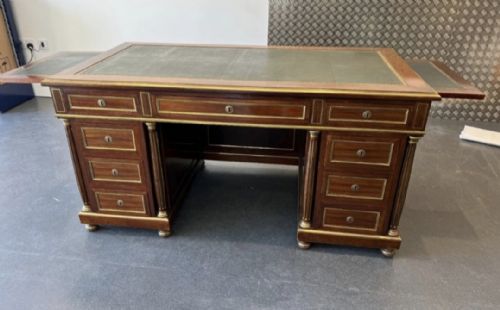


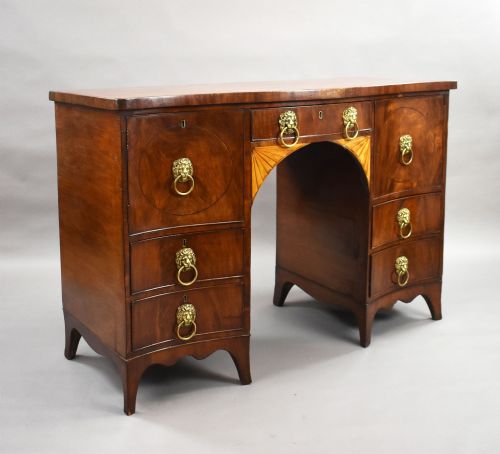


Inlaid Mahogany Pedestal Desk
An inlaid mahogany pedestal desk brings functional elegance to a study, offering sturdy twin pedestals and detailed woodwork.
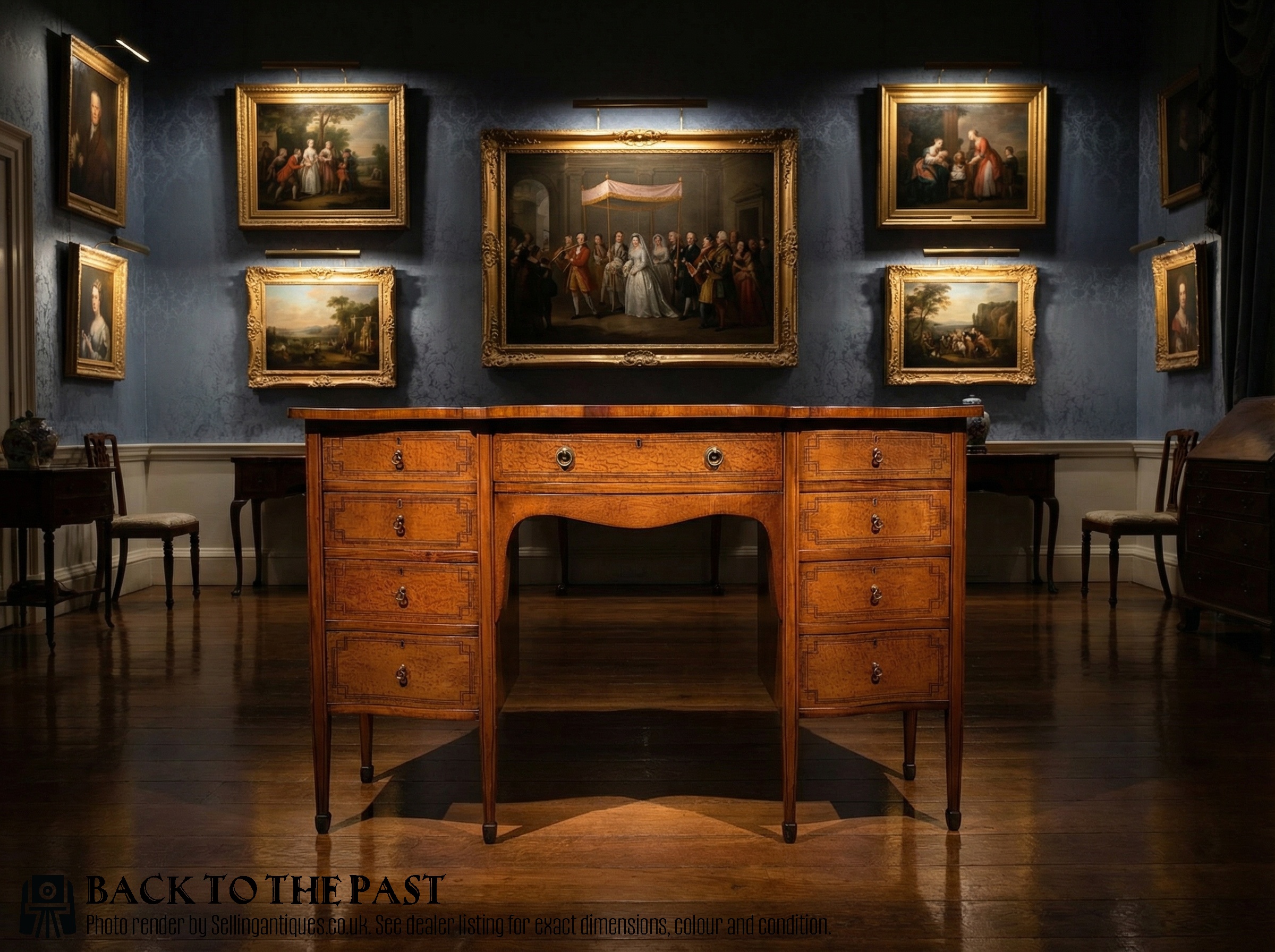
Inlaid Mahogany Pedestal Desk
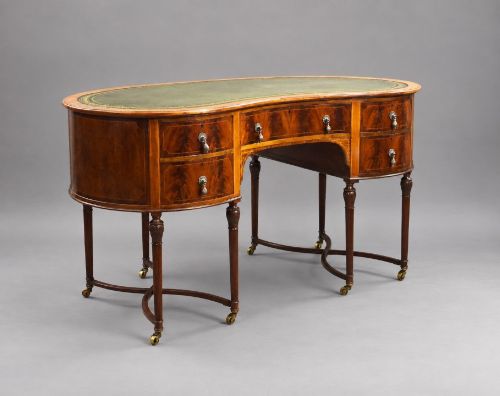
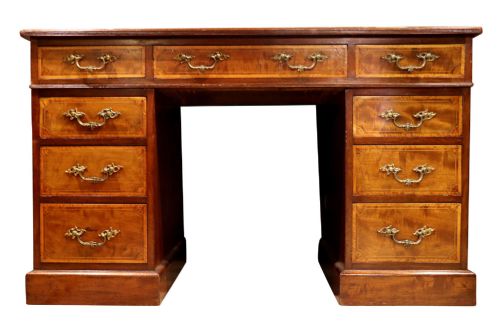
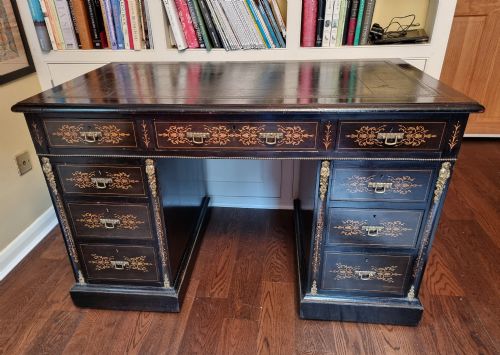
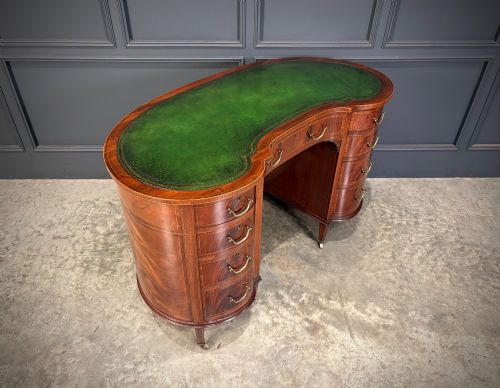
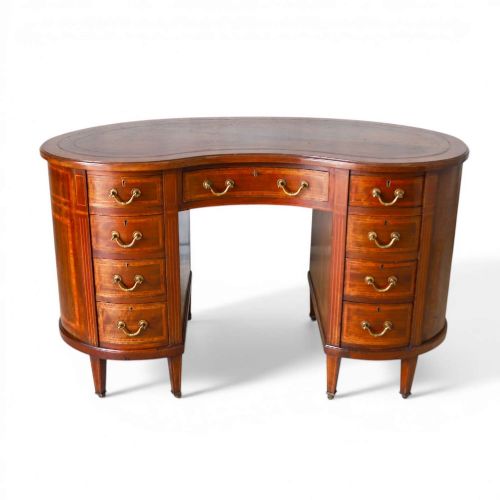
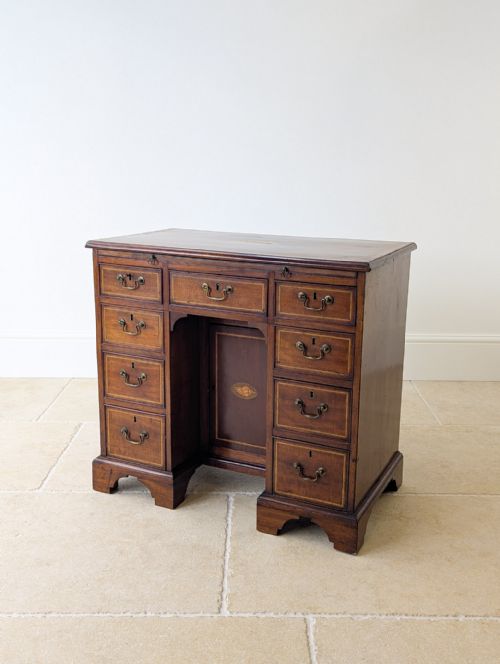
An inlaid mahogany pedestal desk is a substantial workspace featuring two banks of drawers supporting a central writing surface. The form originates primarily in the Georgian period and continues through the Victorian and Edwardian eras.
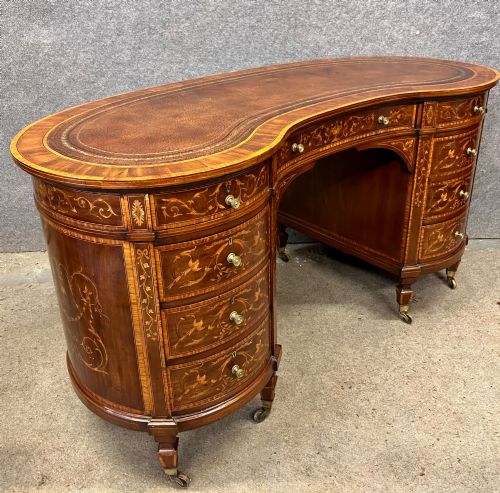
Makers frequently employ satinwood inlay and contrasting crossbanding to frame the drawer fronts and top edges. Examples on this page span the late eighteenth century through to the Edwardian period, with Edwardian and Victorian iterations appearing most often.
Surfaces frequently incorporate inset leather writing panels alongside traditional pedestal configurations. Buyers encounter freestanding variations designed for room placement as well as standard writing tables.
How They Were Made
Cabinet makers construct the primary carcase from solid mahogany or flame mahogany veneers laid over secondary timbers. Satinwood and contrasting dark woods are hand-cut and fitted into recessed channels to form geometric or floral marquetry motifs.
Original hardware, including brass handles and escutcheons, complements the structural timber. Leather writing surfaces are tooled with gold leaf borders and affixed directly to the desktop timber.
Architects desks on this page feature adjustable sloping surfaces designed for standing draftsmen.
What Varies in Quality
The precision of the cabinetwork and the subtlety of the satinwood inlay dictate the grade of a piece. Finer workshops utilise deeply figured flame mahogany and crisp, intricate marquetry rather than simpler linear banding.
Attribution to prominent firms such as Edwards & Roberts or Maple & Co marks a higher standard of construction and design. Original fixtures, intact tooled leather inserts, and well-figured secondary timbers further distinguish superior examples.
Edwards & Roberts·James Shoolbred·Maple & Co·Wolfe & Hollander
The Inlaid Mahogany Pedestal Desk Glossary
- Pedestal desk
- A heavy writing table comprising two separate drawer units supporting a single top. The design provides ample storage while maintaining a formal architectural presence.
- Crossbanding
- A strip of veneer applied across the grain of the primary surface to form a contrasting border. This technique highlights the edges of drawers and tabletops.
- Marquetry
- Elaborate decorative patterns formed by fitting together small pieces of coloured wood veneer. Artisans use this method to create intricate floral or pictorial designs.
- Satinwood
- A durable, yellowish timber native to India and Ceylon utilised extensively for contrasting stringing and inlay. It provides a bright visual accent against dark mahogany.
- Flame mahogany
- Timber harvested from the branch crotches of the mahogany tree, exhibiting a distinct rippled grain pattern. Cabinet makers prize this wood for its dramatic visual movement.
Inlaid Mahogany Pedestal Desk: Frequently Asked Questions
How do I spot an Edwards & Roberts desk?
Makers from this firm often stamped their drawer tops or applied paper trade labels inside the cabinetwork. Their pieces are characterised by refined marquetry and substantial construction.
Cabinetry from this workshop frequently displays high attention to detail in the satinwood inlay and original brass hardware.
Are these desks finished on the back?
Many surviving examples feature finished mahogany backs intended for placement in the centre of a room rather than against a wall. Such freestanding pieces allow access from multiple sides.
Earlier formats generally prioritize a single front orientation with simpler paneling on the reverse side.
What is a Carlton House desk?
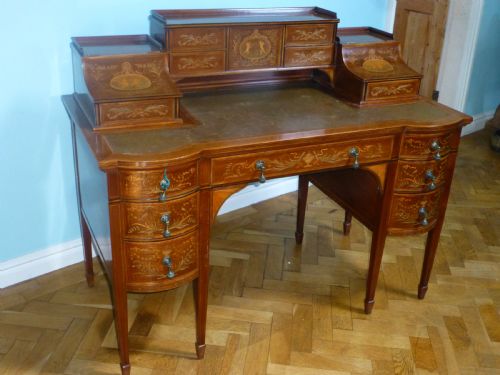
This specific variant incorporates a curved superstructure of small drawers and pigeonholes above the main writing surface. The layout offers specialised compartments for correspondence and documents.
Such forms appear during the Georgian period and undergo a revival in Victorian and Edwardian workshops.
How do I care for the leather top?
Original leather surfaces require periodic treatment with neutral leather balms to prevent cracking and preserve the gold tooling. Avoid harsh chemical cleaners and excessive moisture during maintenance.
Protecting the insert from direct sunlight prevents fading of the dyed hide.