
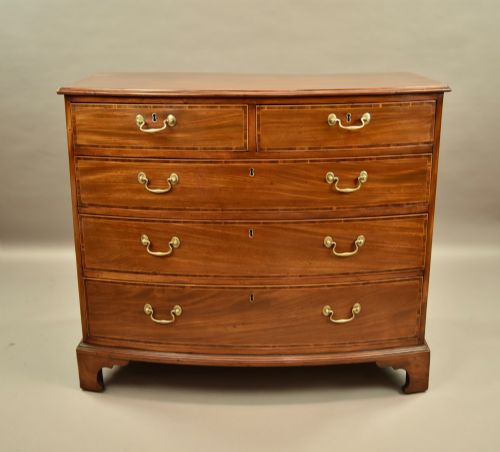
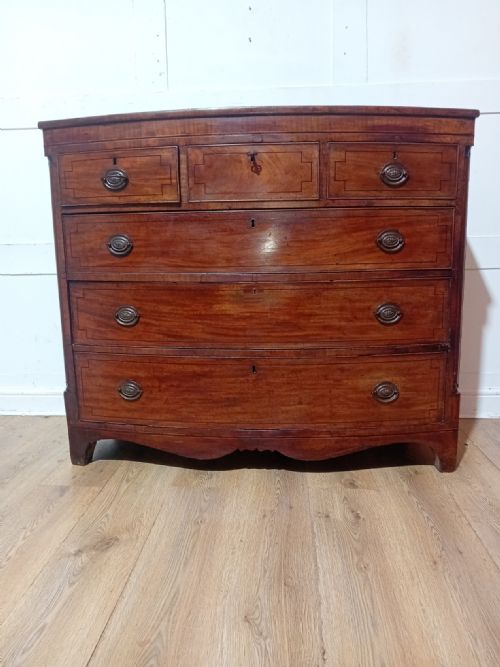


Inlaid Mahogany Bowfront Chest
An inlaid mahogany bowfront chest combines curving fronts with rich timber grain and fine contrasting stringing, offering practical storage with striking visual presence.
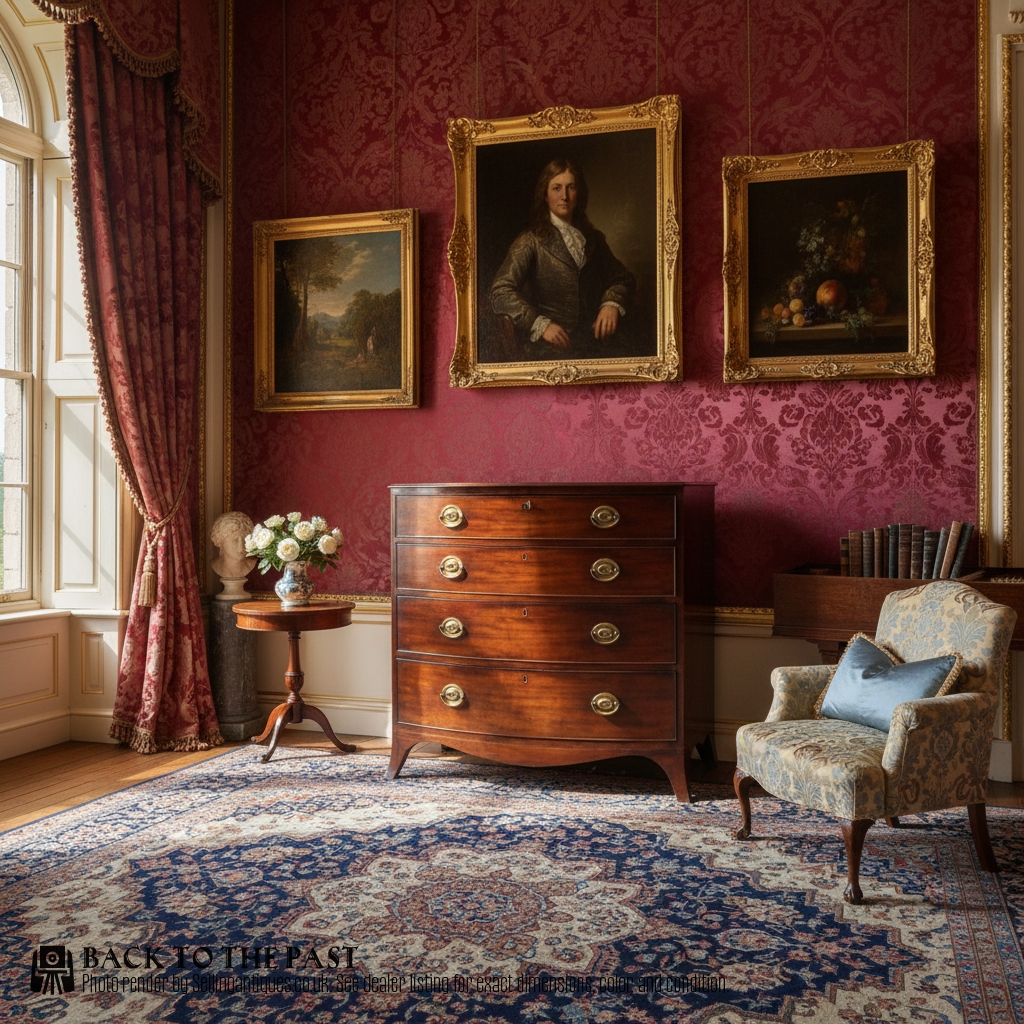
Inlaid Mahogany Bowfront Chest
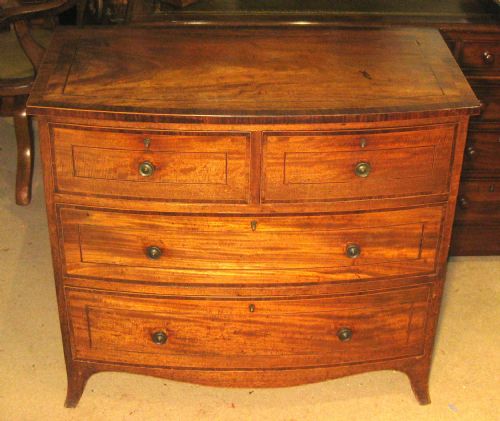
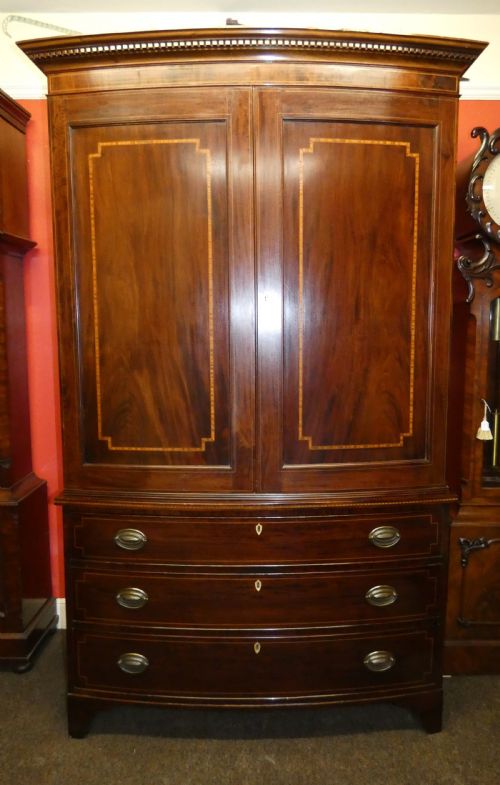
An inlaid mahogany bowfront chest is a case furniture piece defined by its convex curving front and dark tropical hardwood construction. The form appears primarily across Georgian, Regency, and Edwardian periods, including variations such as tallboys, linen presses, and smaller bedside or bachelors chests.
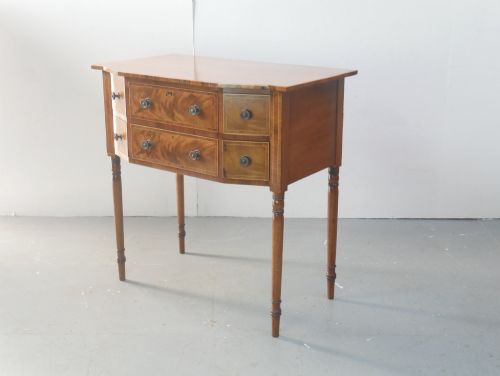
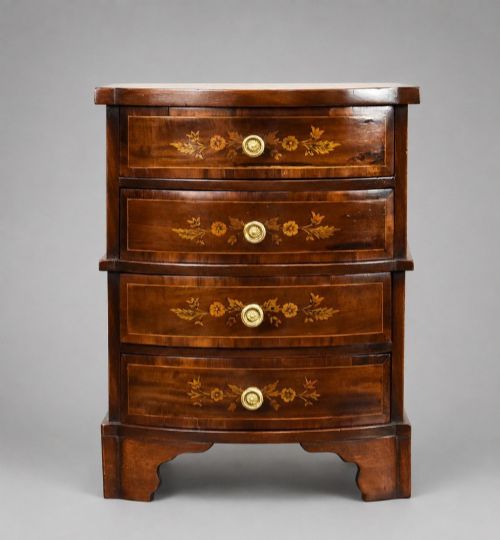
The version you are most likely to meet on this page is a standard chest of drawers dating from the eighteenth or nineteenth century, featuring distinct boxwood or satinwood stringing along the drawer edges and top. Pieces range from large proportions down to compact miniatures, sometimes incorporating side cabinets or commodes.
Makers and designers of these chests utilised the curved silhouette to soften room layouts while providing deep internal drawer space. Surviving examples demonstrate how cabinetmakers adapted the bowfront shape across different stylistic revivals like the Sheraton period.
How they were made
Cabinetmakers constructed the primary carcass using solid or veneered mahogany, frequently selecting flame mahogany for the drawer fronts to create a figured, rippled grain pattern. This timber was planed and curved to form the characteristic bow shape before receiving its final polish.
Contrasting details were achieved through delicate wood inlay using light timbers such as boxwood and satinwood, often forming geometric stringing or patterned borders. Brass hardware, including drop handles and escutcheons, was then fitted to complete each drawer.
Internal framing utilised secondary woods to support the graduating drawers, ensuring the curved carcass maintained structural stability over centuries of use and seasonal humidity changes.
Miniature chests allowed master cabinetmakers to showcase their dovetailing skill to prospective clients through tiny, fully functioning drawers.
What varies in quality
The distinction between ordinary and superior pieces rests on the choice of timber and the precision of the cabinetwork. High-grade examples display heavily figured flame mahogany with carefully matched grain across consecutive drawer fronts, whereas lesser pieces utilise plain, uniform boards.
The refinement of the wood inlay separates standard production from master craftsmanship. Crisp, tightly fitted boxwood stringing and well-executed marquetry demonstrate superior hand-cutting, while coarse or uneven inlay reveals hurried workshop methods.
Proportion and scale also dictate the standing of a piece. Well-balanced cornices, neatly integrated bracket or ogee feet, and drawers that retain their original brass handles and smooth sliding action elevate the overall standard of the furniture.
Edwards and Roberts
The Inlaid Mahogany Bowfront Chest Glossary
- Bowfront
- A convex curving front profile designed to project outward from the corners of a case piece. This contour softens the rectangular rigidity common in earlier furniture.
- Flame mahogany
- A highly figured veneer cut from the fork of the mahogany tree where branches join the trunk. It creates a distinctive feather-like or flickering pattern across large surfaces.
- Stringing
- A narrow, contrasting band of inlaid wood used to outline drawers, panels, or tabletops. It is typically cut from light timbers such as boxwood or satinwood.
- Tallboy
- A tall chest of drawers made in two stacked sections, often combining a chest on chest or a chest placed upon a separate stand. These pieces maximise vertical storage.
- Linen press
- A large case piece featuring upper doors enclosing sliding trays for textiles, positioned above a base of wider drawers. They frequently share the characteristic bowfront and mahogany construction.
Inlaid Mahogany Bowfront Chest: Frequently Asked Questions
How do I date an inlaid mahogany bowfront chest?
Dating relies on examining construction methods, secondary timbers, and the specific style of the wood inlay and hardware. Georgian examples often feature hand-cut dovetails and subtle stringing, while later nineteenth-century and Edwardian revivals display different edge banding and cleaner internal secondary woods.
Changes in foot styles, from traditional bracket feet to swept apron designs or later turned supports, also help place the piece within periods like the Regency or Sheraton revivals.
Were these chests used only in bedrooms?
While primarily designed for domestic sleeping quarters to store garments and linens, smaller variations served diverse functions around the home. Side cabinets, bachelors chests, and miniature forms appeared in hallways, drawing rooms, and dressing areas.
The curved profile allowed these pieces to sit comfortably in prominent spaces where a sharp rectangular corner would interrupt the flow of the room.
How do I care for antique mahogany furniture?
Maintaining mahogany requires consistent indoor humidity levels and protection from direct sunlight, which can bleach the timber and dry out the polish. Regular dusting with a soft, dry cloth prevents particulate accumulation.
Applying a traditional beeswax polish sparingly helps nourish the wood grain and preserves the warm golden or deep brown patina developed over generations.
What is the difference between a chest and a tallboy?
A standard chest of drawers is a single low-to-medium height unit designed for waist-level access and top surface display. A tallboy incorporates significantly greater vertical height, traditionally constructed as two distinct sections stacked one upon the other.
This vertical format provides substantially more drawer capacity while occupying a smaller floor footprint within the room.