
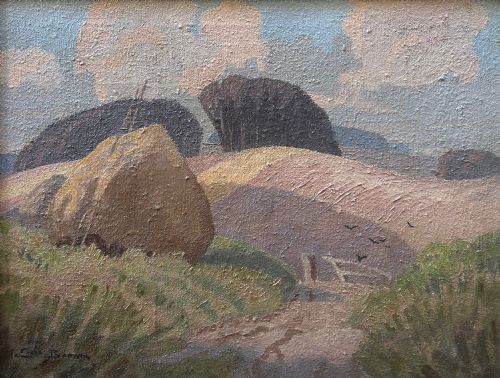


Impressionist Rural Farm Scene
An impressionist rural farm scene brings the quiet labour and open fields of the countryside directly onto the wall.
Impressionist Rural Farm Scene
When you search for an impressionist rural farm scene, you encounter works that capture agricultural life, livestock and pastoral landscapes through loose brushwork and atmospheric light. These paintings record working farms, harvest fields and farmyards from the nineteenth century into the interwar decades.
The version you are most likely to meet on this page is an oil painting on canvas or panel, created during the early twentieth century by British and French painters. They frequently depict specific rural locations, from Yorkshire dales and Normandy troughs to local farmsteads near northern villages.
Artists working in British Impressionism, Post-Impressionism and French Provincial styles dominate the selection. Their subjects range from heavy working horses and haystacks to farm hands and quiet ponds.
How they were made
Painters applied oil paint directly to canvas, wood panels or board, using visible brushstrokes to catch shifting daylight across fields and farm buildings. Watercolour on paper also appears, offering a lighter medium for capturing rural atmospheres and open skies.
Canvases are often housed in period frames that complement the painting style, whilst wooden panels provide a rigid support favoured by artists working outdoors.
Impressionist Rural Farm Scene Retail Price Guide 2026
Typical asking prices for impressionist rural farm scene among the pieces listed under this phrase on Sellingantiques today, from the lower quarter to the upper quarter. They describe what is for sale here now, not the wider market.
Listings feature oil paint, canvas, wood and paper across British and French regional styles from the nineteenth and early twentieth centuries.
What varies in quality
Quality rests in the confidence of the brushwork and the artist's ability to render light and movement within a working landscape. The strongest pieces balance atmospheric depth with a convincing sense of place and agricultural activity.
Works by established regional painters or those exhibited in major movements carry greater art-historical weight, whilst secondary pieces offer simpler compositions with less developed tonal variation.
Raimond Louis Lecourt·Herbert Royle·Ernest Pile Bucknall·George Soper·Florence Hess·Arthur Winter Shaw·Robert Russell MacNee·Owen Bowen·Rowland Henry Hill·Frederick William Jackson·Ernest Higgins Rigg·T.B. Garvie·John Falconar Slater·William Greaves·Kershaw Schofield·James William Booth
The Impressionist Rural Farm Scene Glossary
- Impressionism
- A style of painting that uses loose brushstrokes and small, thin brush marks to depict accurate shifting light and ordinary subject matter.
- Post-Impressionist
- An artistic movement following Impressionism that extends its use of vivid colours and thick application of paint while exploring broader emotional and structural forms.
- Panel
- A rigid support for a painting, commonly made of wood, used frequently instead of canvas in certain periods.
- Watercolour
- A paint consisting of pigment suspended in a water-based solution, typically applied to paper to create translucent washes of colour.
Impressionist Rural Farm Scene: Frequently Asked Questions
What periods do these paintings date from?
The works span from the nineteenth century through the Edwardian era into the nineteen-thirties. Many examples emerge from the nineteen-tens and nineteen-twenties.
This timeframe captures the transition from traditional pastoral painting towards broader impressionist and post-impressionist interpretations of rural subjects.
What subjects typically appear in these scenes?
Common subjects include haystacks, working horses at troughs, farmhands, harvest fields, and agricultural buildings such as barns and cart sheds.
Artists frequently recorded specific named farms and regional landscapes, ranging from Yorkshire dales to Normandy pastures.
How should I hang a rural oil painting?
These works suit traditional living spaces, studies, or dining rooms where natural light can illuminate the texture of the oil paint and canvas.
Ensure the painting is kept away from direct sunlight and excessive moisture to protect both the pigmented surface and the wooden stretcher or panel.
How do I distinguish between oil and watercolour works?
Oil paintings feature thicker, textured paint layers applied to canvas, wood or board, often displaying visible brush relief. Watercolours are executed on paper under glass, presenting a flatter, more translucent appearance.
Examining the surface under glancing light reveals the raised impasto typical of oils compared to the smooth paper surface of watercolours.