

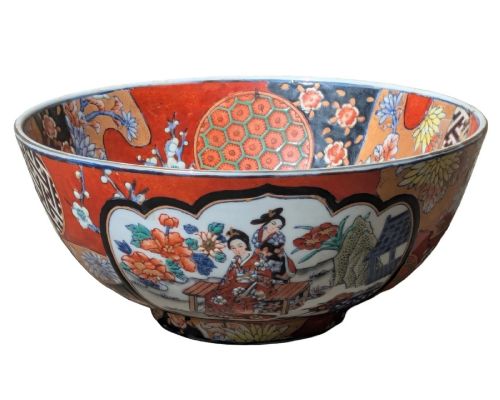




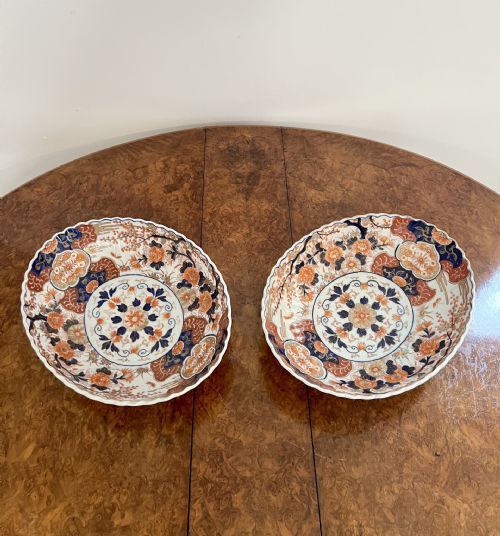


Imari Porcelain Charger Bowl
These imari porcelain charger bowl pieces bring heavy cobalt blue and iron red enamel decoration to any room.
Imari Porcelain Charger Bowl
When you search for an imari porcelain charger bowl, you find wide decorative dishes and deep vessels originating from Japan. The selection centres heavily on pieces from the 19th century and the Meiji period, alongside earlier examples from the 17th century.
Most items appearing here take the form of scalloped edge bowls, decorative plates, and large shallow dishes. Makers produced these wares primarily for display, utilising distinct traditional palettes that combine underglaze blue with overglaze red and gold.
The assortment bridges several distinct eras, spanning from late Edo period Arita wares up to early 20th century Showa and Edwardian examples. Buyers encounter everything from large scalloped display dishes to fluted bowls suited for cabinet placement.
How they were made
Potters shaped these objects from ceramic and porcelain body clay before applying cobalt blue pigment under the glaze. Artisans then fired the pieces at high temperatures to set the durable base blue tones.
Painters added subsequent layers of enamel and gold leaf or gilding over the fired glaze. A final lower-temperature fixative firing bonded these polychrome details and metallic accents to the surface.
Listings feature porcelain pieces spanning from the 17th century through the Meiji period and into the 20th century.
What varies in quality
The crispness of the hand painted brushwork separates ordinary production from superior examples. Master painters achieved fine control over floral and geometric motifs, whereas lesser items show hurried lines.
The richness and survival of the gilt and enamel layers determine the visual power of a charger. Pieces retaining bright gold leaf and intact cobalt tones demonstrate careful preservation and superior original pigments.
The Imari Porcelain Charger Bowl Glossary
- Arita
- The Japanese town and surrounding region where the clay and kilns originated for this ceramic tradition. Arita production spans multiple centuries of master kiln operation.
- Meiji Period
- The era in Japanese history lasting from 1868 to 1912, associated with vibrant decorative arts exported worldwide. Many bowls and plates on this page date from these decades.
- Edo Period
- The period of Japanese history running from 1603 to 1867, encompassing early Arita manufacturing. Pieces from this time represent the earlier roots of the tradition.
- Scallop Edge
- A decorative curved rim shaping formed on plates and bowls to create a wave-like border. This shaping appears frequently on large display dishes.
Imari Porcelain Charger Bowl: Frequently Asked Questions
How old are these imari bowls?
The pieces span from the late 17th century through the 19th century and into the early 20th century. Most examples date from the Meiji period and the decades around 1900.
Earlier items connect to the Edo period and Arita production centres. Dating relies on stylistic traits, potting thickness, and enamel characteristics.
Were these made for daily use?
These large bowls and plates served primarily as decorative display items rather than utilitarian tableware. Their intricate enamel and gold leaf decoration was meant for visual impact in reception rooms.
Owners typically exhibited them on sideboards or hung them on walls. Today, collectors continue to use them for display rather than serving food.
How do I spot Meiji period pieces?
Meiji period items often display dense, confident brushwork and bright polychrome enamels combined with gilding. They frequently take the form of large scalloped bowls or shallow decorative dishes.
Potters during this era produced heavily for export markets while maintaining traditional Japanese ceramic techniques. Their output bridges traditional Arita forms with late 19th-century aesthetics.
What is the difference between Arita and Imari?
Arita refers to the Japanese production town where the ceramic body and kilns were located. Imari is the name of the shipping port through which these finished wares left Japan.
Over time, collectors adopted Imari as a style descriptor for the distinct blue, red, and gold palette. Both terms frequently apply to the same category of antique porcelain.
How should I care for an imari charger?
Keep these porcelain pieces out of direct sunlight to protect the surface enamel and gold leaf highlights. Dust them gently with a soft, dry cloth rather than using wet cleaners.
Avoid placing them in high-traffic areas where they might suffer impact. Proper placement ensures the delicate overglaze decoration remains stable.