


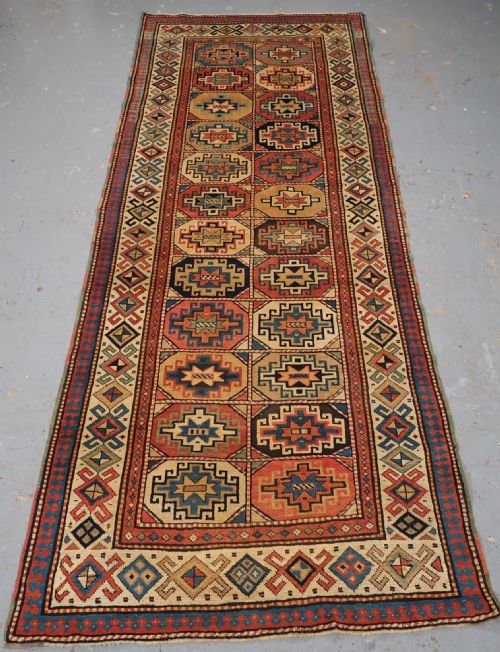


Hooked Medallion Wool Runner
These hooked medallion wool runner examples bring striking geometric patterns and rich natural textures directly into your hallway.
Hooked Medallion Wool Runner
A hooked medallion wool runner displays bold tribal motifs arranged linearly along a narrow format, ideal for corridors and landings. These floor coverings bridge nomadic weaving traditions and practical domestic use.
The pieces on this page originate primarily from the Caucasian and Kurdish regions, dating from the late nineteenth century to the early twentieth century. You will frequently encounter Kazak, Moghan, and Dagestan attributions featuring latch hook designs.
How they were made
Weavers utilised local wool spun by hand, occasionally incorporating camel hair for the ground colour to add natural warmth and durability. The pile is knotted densely to withstand heavy foot traffic.
Natural dye stuffs provide the rich palette seen across these runners, creating subtle tonal variations within the geometric fields over decades of use.
The listings span from 1880 to 1920, covering Caucasian and Kurdish tribal origins.
What varies in quality
The clarity and precision of the geometric medallion design set superior examples apart from standard work. Better pieces maintain crisp lines and balanced proportions along the entire length of the runner.
The condition of the wool pile and the integrity of the original wool foundation dictate the overall grade. Superior pieces exhibit even wear and retain their original selvedges and ends.
The Hooked Medallion Wool Runner Glossary
- Latch hook
- A geometric motif with small rectangular projections resembling hooks, commonly repeated within medallions.
- Medallion
- A central ornamental design element placed within the field of the rug.
- Kazak
- A style of weaving originating from the southern Caucasus, known for bold geometric patterns and primary colours.
- Ground
- The background colour or field area of the textile upon which the main motifs sit.
- Pile
- The upright surface of yarn formed by knotted wool fibres that face upward on the runner.
Hooked Medallion Wool Runner: Frequently Asked Questions
Where should I place a runner?
These narrow formats suit hallways, corridors, and bedside areas where floor space is limited. Their linear design draws the eye down the length of the space.
Ensure you use a suitable underlay to keep the textile stable on hard flooring and to reduce friction on the wool foundation.
How do I identify a Kazak piece?
Kazak examples typically display bold geometric medallions, rectilinear motifs, and a relatively thick wool pile. They often utilise striking primary colours.
Regional variations in the Caucasus produced specific sub-types like Moghan and Dagestan, each with distinct border arrangements.
What is camel hair used for?
Weavers utilised un-dyed camel hair to form a warm, durable background field within specific tribal rugs. This fibre brings a soft, natural tone to the composition.
Camel hair provides distinct resilience and ages with a subtle patina that differs from standard sheep wool.