
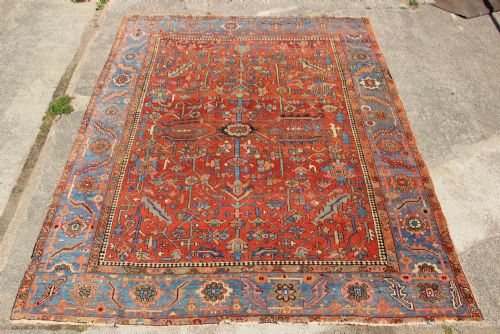
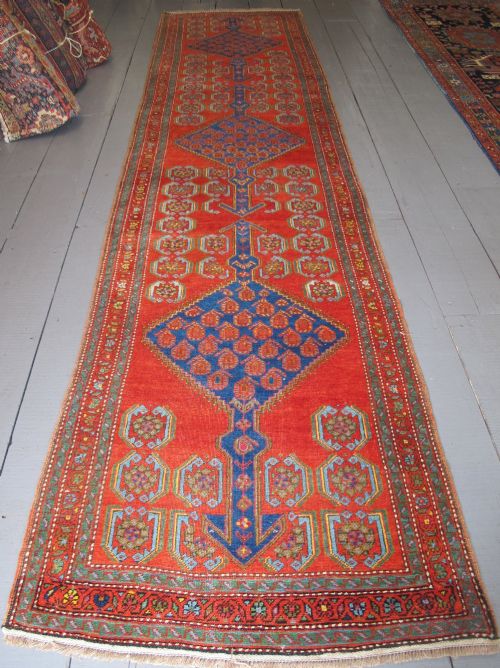


Heriz Bakshaish Rug
A heriz bakshaish rug brings bold geometric abstraction and earthy tones into a room.
Heriz Bakshaish Rug
A heriz bakshaish rug represents the village-woven carpets of Northwest Persia, created in the region surrounding Heriz. Buyers find substantial carpets, village rugs, and long runners originating from the nineteenth and early twentieth centuries.
The pieces appearing here span from the mid-nineteenth century up to around nineteen-ten. They include large room-size carpets alongside smaller village rugs and runner formats.
Stylistically, these pieces cross over between Persian tribal traditions and the broader Serapi and Heriz groupings. They offer large-scale geometric designs that differ from the curved florals of city workshops.
How they were made
Weavers constructed these rugs using wool pile knotted onto cotton foundations. The natural wool supplies a durable surface that ages with a soft sheen.
Village workshops relied on hand-spun materials and traditional dye methods. These techniques produced the varied, saturated abrasash tones seen across the field.
The weavers drew their large medallions entirely from memory, leaving charming little irregularities in the geometry.
What varies in quality
The distinction between standard village production and finer examples lies in the boldness of the drawing and the handling of the geometric medallion. Stronger pieces display a clear architectural layout with balanced proportions.
Pile condition and wool quality dictate the visual depth of the surface. Even wear across the field tells the story of age, while dense knotting preserves the sharpness of the motifs.
The Heriz Bakshaish Rug Glossary
- Bakshaish
- A village rug style from the Heriz region of Northwest Persia. These pieces are known for large geometric patterns and muted earthy palettes.
- Serapi
- A sub-category of Heriz carpets featuring spacious, bold medallion designs. They often date to the nineteenth century.
- Abrasash
- Variations in colour tone caused by changes in dye batches or hand-spun wool. This creates subtle horizontal bands of shading across the rug.
- Medallion
- The central ornamental motif dominating the field of the carpet. In Northwest Persian village weaving, these take angular, geometric forms.
- Runner
- A long, narrow carpet format designed for hallways and corridors. Examples in this style provide striking linear geometry in domestic spaces.
Heriz Bakshaish Rug: Frequently Asked Questions
How do I date a Bakshaish rug?
Dating relies on wool quality, natural dye palettes, and structural characteristics typical of nineteenth-century village weaving. Earlier pieces often feature looser knotting and softer, more nuanced colour transitions.
Comparing structural details and design evolution against documented village carpets helps narrow down the period between eighteen-fifty and nineteen-ten.
Where were these rugs made?
These carpets originate from the Northwest Persian region around Heriz, specifically the village and district of Bakshaish. Local weavers produced them in homes and small community workshops.
The regional style combines nomadic geometric motifs with the larger scale of workshop carpets.
Are these rugs suitable for high-traffic areas?
The sturdy wool pile and strong cotton foundations make these village carpets resilient for daily use. Their durable construction handles regular walking when placed over a quality underlay.
Placing them away from direct, harsh sunlight preserves the natural dyes used in the wool.
What is the difference between Heriz and Bakshaish?
Bakshaish rugs generally feature older, more abstract geometric designs and earthier palettes than later standard Heriz carpets. They often display looser, more whimsical drawing in the medallions.
Later Heriz production tended toward stiffer, more formal architectural layouts with brighter highlights.