

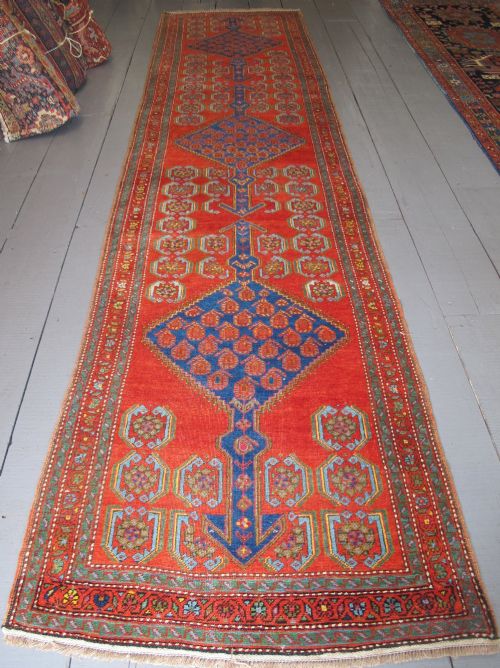
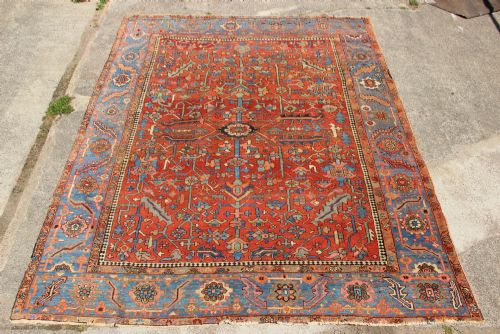


Heriz Bakshaish Carpet
A heriz bakshaish carpet brings robust Persian village artistry into a room, offering geometric designs and weathered wool that ground a grand interior.
Heriz Bakshaish Carpet
When you search for a heriz bakshaish carpet, you are looking at substantial floor coverings originating from the north-west of Persia during the nineteenth and early twentieth centuries. These pieces emerge from village and tribal traditions, distinct from city workshops through their bolder geometry and expressive, less rigid drawing.
The examples you meet on this page span from the mid-nineteenth century up to the early twentieth century, taking the form of large carpets, village rugs, and elongated runners. They carry the aesthetic hallmarks of Persian Bakshaish, Serapi, and broader tribal weaving traditions from the Northwest Persian region.
Each rug or carpet presents a unique composition where medallion structures are often rendered with idiosyncratic local interpretations. The scale ranges from compact area sizes up to expansive floor coverings measuring over four metres in length.
How they were made
The foundation of these carpets relies upon sturdy hand-spun cotton for the warps and wefts, creating a stable grid that supports the dense pile. Artisans knotted hand-carded wool directly onto this cotton armature, securing the structure with overcast side cordings.
Natural dyestuffs provided the palette, derived from local plants and minerals that mellowed gracefully over decades of use. The weavers relied on memory and traditional tribal motifs rather than precise paper cartoons, leading to charming irregularities in the final geometry.
Heriz Bakshaish Carpet Retail Price Guide 2026
Typical asking prices for heriz bakshaish carpet among the pieces listed under this phrase on Sellingantiques today, from the lower quarter to the upper quarter. They describe what is for sale here now, not the wider market.
Every village weaver made small intentional shifts in the repeating borders, leaving a quiet signature in the geometry.
What varies in quality
Quality in these carpets rests primarily on the handling of the wool and the sophistication of the primary medallion layout. Finer spinning yields a more supple handle, allowing the wool to catch the light and display the secondary geometric ornaments with greater clarity.
The strength of the overall design architecture distinguishes the upper tier of pieces, where large-scale geometric fields balance harmoniously against the border systems. Consistency in the hand-weaving and the depth of the natural colour saturation elevate certain village rugs above standard production.
The Heriz Bakshaish Carpet Glossary
- Bakshaish
- A specific style of village weaving from north-west Persia known for large-scale geometric designs and earthy palettes. These carpets often display abstracted motifs rather than precise floral curves.
- Serapi
- A sub-category associated with the Heriz region, denoting carpets with particularly bold, spacious medallions and exceptional artistic clarity. They represent a high point in nineteenth-century Persian village weaving.
- Warp
- The vertical cotton threads stretched tightly on the loom that form the structural skeleton of the carpet. The visible fringes at either end of the rug are simply the extension of these warps.
- Weft
- The horizontal threads passed back and forth between the warps after each row of knots to bind the structure firmly together. In these rugs, the weft is typically constructed from hand-spun cotton.
- Pile
- The soft, upright surface of knotted wool that provides the texture and colour of the carpet. The height and density of this wool layer determine how the rug responds to foot traffic over time.
Heriz Bakshaish Carpet: Frequently Asked Questions
How do I clean a bakshaish carpet?
Regular gentle vacuuming without a rotating brush roll keeps dust from settling deep into the cotton foundation. Professional textile cleaning tailored to antique vegetable-dyed wool is necessary for deeper maintenance.
Water and harsh chemical detergents must be avoided to prevent the natural dyes from bleeding. Prompt attention by a specialist handles accidental spills safely.
Are these rugs durable enough for daily use?
The sturdy construction of hand-spun wool knotted onto a cotton grid makes these carpets remarkably resilient for living spaces. Generations of domestic life have proven their structural capacity.
Placing a quality underlay beneath the carpet cushions the wool and prevents sliding. This simple addition significantly reduces friction against hard floors.
What periods do these antique carpets come from?
The listings on this page span from the mid-nineteenth century through to the early decades of the twentieth century. The majority cluster around the late nineteenth century.
Exact dating relies on stylistic traits, structural analysis, and the chemical composition of the natural dyes. Each decade imparts specific characteristics to the wear and patination of the wool.