
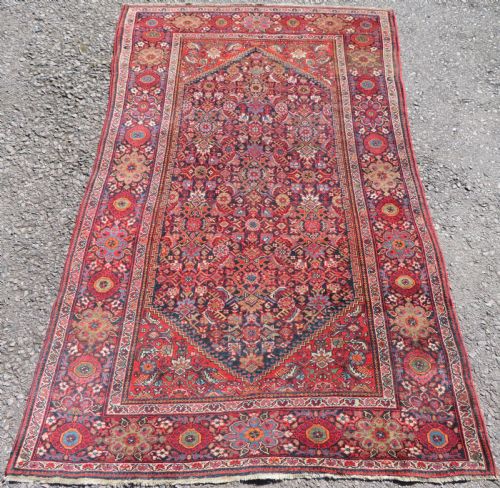


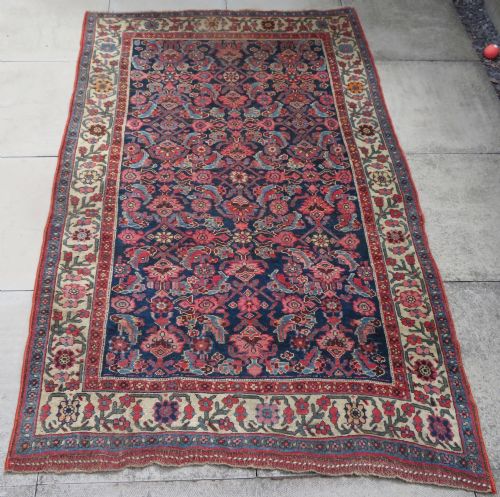

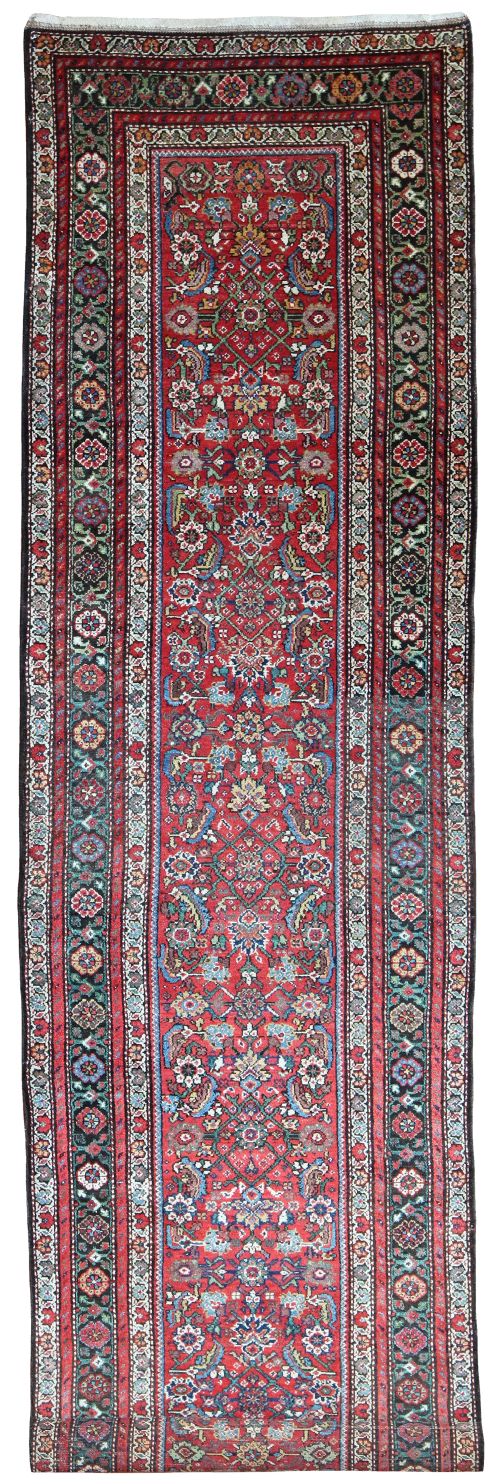


Herati Pattern Runner Carpet
These herati pattern runner carpet examples bring enduring Persian village craftsmanship into long narrow corridors with intricate repeating floral motifs.
Herati Pattern Runner Carpet
A herati pattern runner carpet presents a distinct linear format tailored for hallways and galleries, carrying motifs rooted in Persian village and tribal weaving traditions. These textiles emerge from nineteenth and early twentieth-century workshops across regions such as Malayer, Bidjar, Seneh, Ferahan, and Afshar.
The format typically stretches into long runner proportions, accommodating narrow architectural spaces while displaying intricate lattice or all-over repeat compositions. Buyers encounter pieces originating from the eighteen fifties through to nineteen twenty, showcasing traditional Persian design vocabulary.
Village weavers constructed these elongated carpets to withstand heavy domestic traffic whilst serving as decorative centrepieces in corridors and landings. Each runner reflects the specific regional interpretation of the classic herati motif, combining geometric discipline with botanical abstraction.
Determining quality in older runners
Quality rests upon the crispness of the knotting and the fineness of the botanical detail within the repeating herati lattice. Tightly packed knots yield a firmer handle and sharper graphic clarity across the entire field.
The integrity of the foundation and the uniformity of the wool pile dictate the longevity of the runner. Superior examples display balanced proportions in narrow formats and retain rich, saturated tones from natural dye sources.
Nomadic weavers occasionally embedded tiny intentional asymmetries into repeating borders to ward off envious spirits.
Bidjar Kurdish tribes·Seneh workshop weavers·Afshar tribal weavers
The Herati Pattern Runner Carpet Glossary
- Herati pattern
- A repeating ornamental design composed of a central rosette framed by four acanthus leaves or fish-like motifs, frequently arranged in a continuous lattice across the field. This classic Persian motif forms the primary visual element of these runner carpets.
- Kelleh
- A distinctive rectangular carpet format that is longer than a standard rug but broader than a typical corridor runner. These room-size pieces often share the design vocabulary of smaller village weaves.
- Kilim
- A flat-woven carpet produced without a pile by tightly interweaving warp and weft threads. These lightweight textiles offer crisp geometric interpretations of traditional motifs.
- Pile
- The upright yarn surface of a carpet formed by individual knots tied to the warp threads. The density and height of this wool layer determine the physical weight and tactile quality of the piece.
- Warp
- The vertical foundation threads stretched tightly on the loom before knotting begins. Cotton warps provide dimensional stability to elongated runner formats.
Herati Pattern Runner Carpet: Frequently Asked Questions
Where should I place a long runner?
These elongated carpets suit narrow corridors, hallways, and gallery spaces where linear dimensions complement architectural proportions.
The repeating herati design draws the eye along the length of the floor, adding visual warmth and structure to transitional areas.
How do I care for wool pile?
Routine maintenance involves gentle vacuuming without a rotating brush head to protect the hand-knotted wool surface.
Professional cleaning tailored for antique textiles preserves the natural lanolin within the wool and maintains dye stability.
What defines the herati design?
The motif consists of a central floral diamond surrounded by curved leaf forms that resemble swimming fish.
This continuous lattice arrangement creates an optical rhythm that unifies the entire field of the runner.
How do I identify village origins?
Regional characteristics appear in the density of the weave, the handling of the cotton foundation, and subtle shifts in colour palettes.
Kurdish village pieces from Bidjar exhibit heavier structures, whereas Seneh and Ferahan examples often display finer knot counts.