
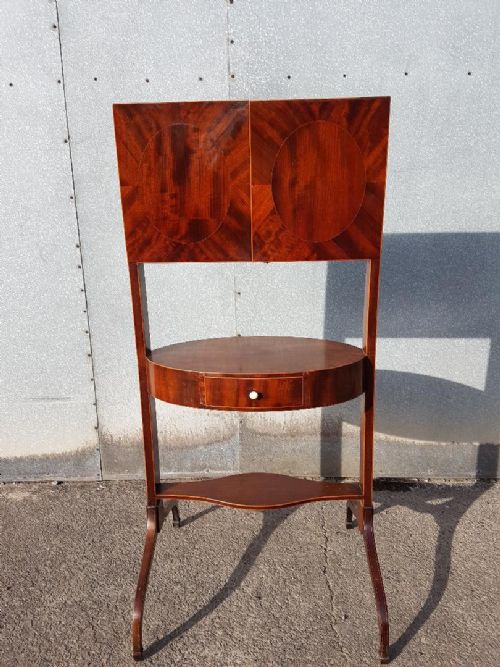


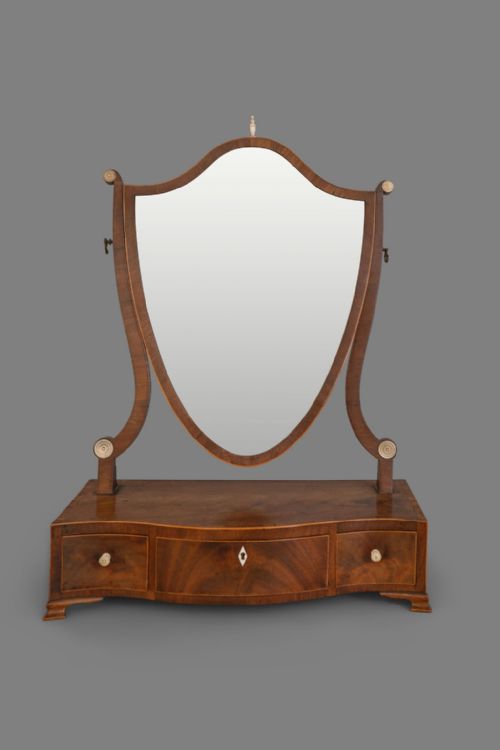


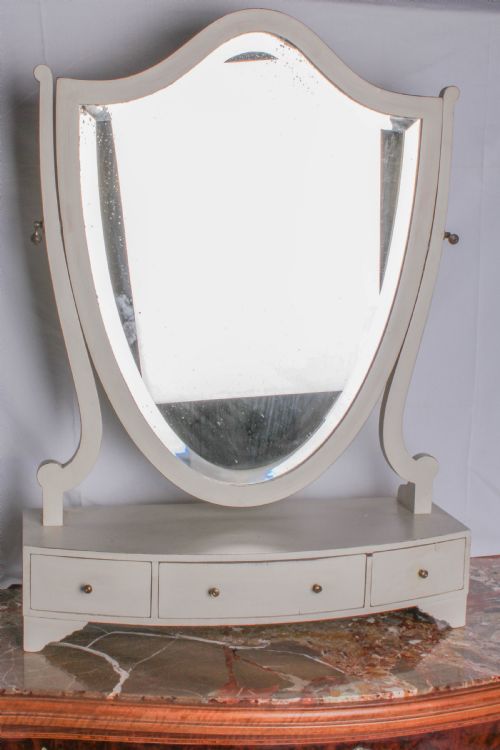

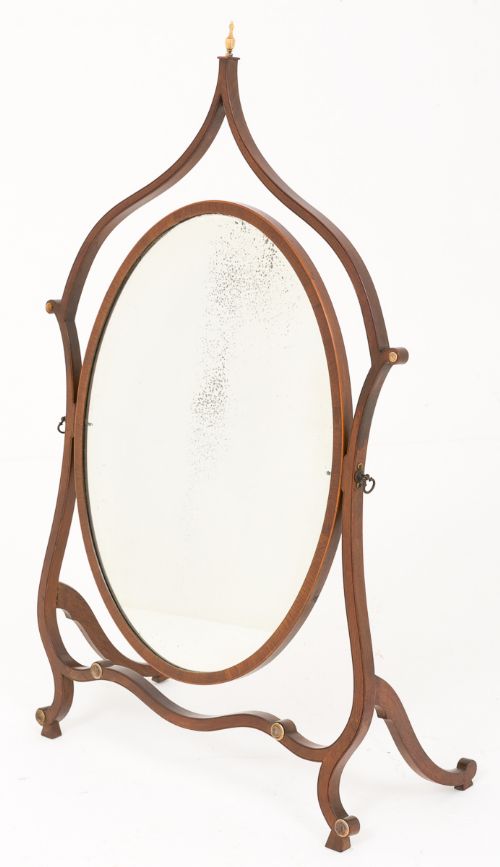


Hepplewhite Toilet Mirror
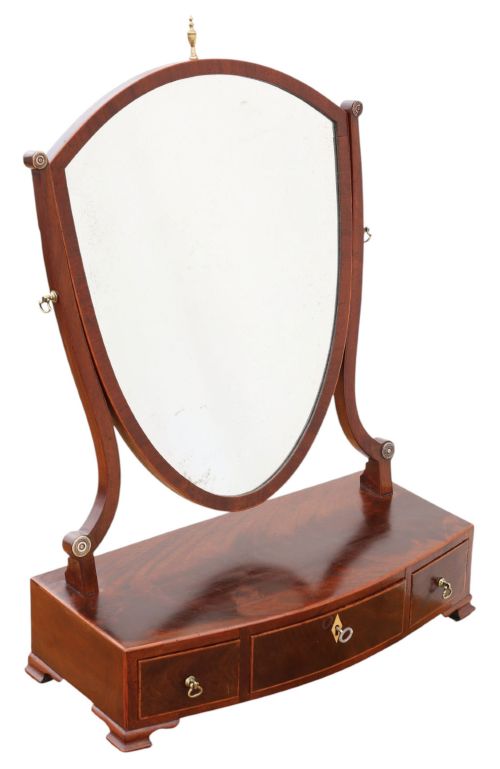
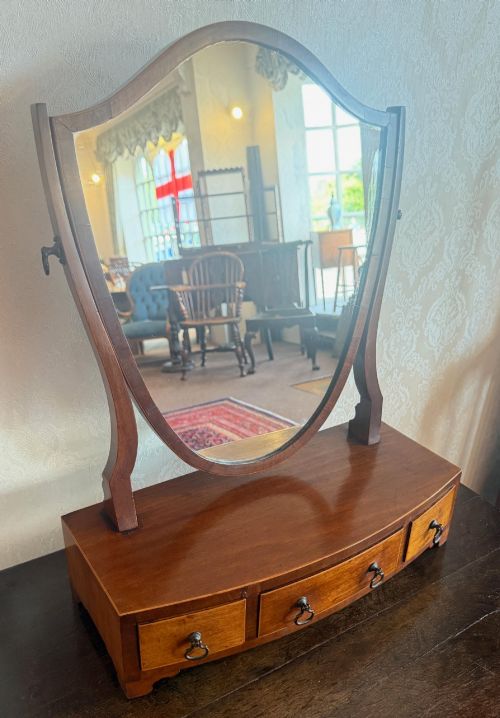
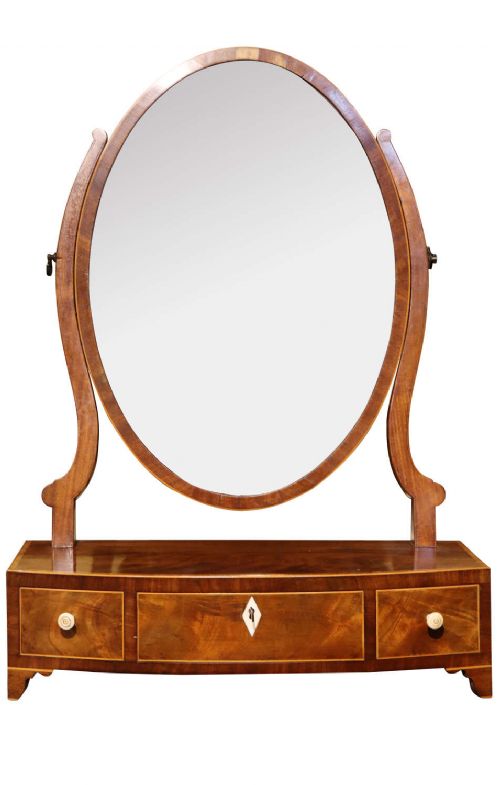
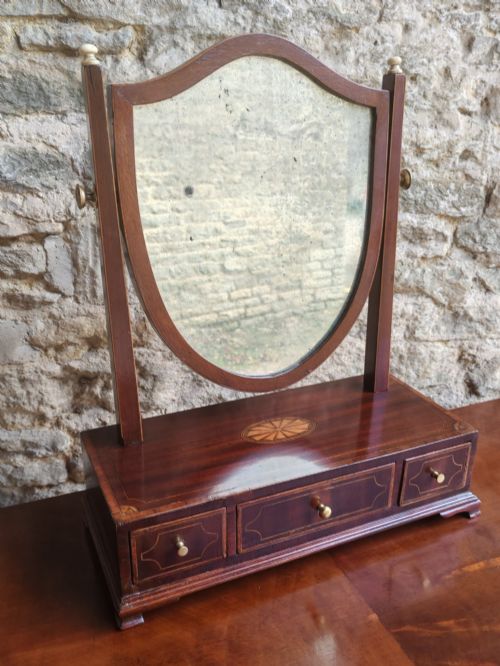
These hepplewhite toilet mirror examples bring Georgian elegance to a dresser, offering adjustable swing glass framed in rich timber.
Hepplewhite Toilet Mirror
A hepplewhite toilet mirror is a small table-standing glass designed for personal grooming, featuring a swinging frame mounted on upright arms above a small base fitted with drawers. When you search for this phrase, you find pieces intended to sit atop a larger chest or dressing table rather than hang on a wall.
The versions you are most likely to meet on this page date from the Georgian period and the 18th century, constructed primarily in mahogany with shield or oval plates. These items combine practical function with delicate cabinet work, often incorporating serpentine fronts and small brass fittings.
Later revivals from the 19th century and Edwardian eras also appear, echoing the earlier Georgian style with painted details or boxwood inlay. Each piece relies on pivot screws or wooden peg joints to tilt the glass angle to the user's preference.
How they were made
Makers built these mirrors using solid timber and fine veneers, selecting mahogany as the principal wood for its stability and grain. Crossbanding in contrasting timbers and delicate boxwood inlay often framed the edges of the mirror plates and drawer fronts.
The glass plate itself was held within a shaped wooden frame, frequently cut into an oval or shield silhouette, which hung between upright support arms rising from the base. Small brass or bone knobs fitted the miniature drawers, while internal linings and secondary woods completed the structural boxes.
Listings feature mahogany as the dominant timber, accompanied by brass fittings, boxwood inlay, and occasional harewood details across Georgian and Edwardian periods.
What varies in quality
Quality rests in the precision of the cabinetwork and the harmony of the proportions, particularly in the curve of the shield frame and the sweep of the serpentine drawer base. Finer examples display meticulous crossbanding and tight dovetail joints in the small drawers rather than simpler butt construction.
The choice of secondary woods and the retention of original mirror glass and brass hardware elevate a piece, whereas replacements or heavy restoration alter the character. The crispness of the inlaid details and the balance between the upright supports and the base distinguish superior workshops from later revival pieces.
The Hepplewhite Toilet Mirror Glossary
- Shield-plate
- A mirror glass cut into the shape of a heraldic shield. This silhouette defines the classic Hepplewhite aesthetic.
- Serpentine front
- A furniture front shaped with a convex centre flanked by concave curves. It adds visual depth to the small base drawers.
- Crossbanding
- A strip of veneer laid across the grain of the primary wood to form a decorative border. It often frames the edges of the mirror frame or base.
- Harewood
- Sycamore that has been stained to a greyish brown tone. It appears in select high-status Georgian dressing pieces.
- Triplate
- A mirror assembly comprising three separate glass panels, typically with a larger centre plate and two smaller pivoting wings.
Hepplewhite Toilet Mirror: Frequently Asked Questions
Where did people place these mirrors?
These mirrors sat atop dressing tables, chests of drawers, or dedicated washstands in bedrooms and dressing rooms. Their compact base meant they required minimal surface area while providing a usable reflection for shaving or styling hair.
Because they were portable, owners could move them around the room to catch the best natural daylight from a nearby window before artificial lighting became common.
How do I know if the mirror plate is original?
Original mirror glass often shows subtle distortion, tiny dark spots, or minor silvering loss behind the glass due to age. Modern replacement glass tends to be perfectly flat and exceptionally clear.
Examining the backing boards and the way the glass is secured into the wooden frame can also reveal whether the plate has been changed over the decades.
What is the difference between George III and Edwardian versions?
George III pieces date from the 18th century, featuring hand-cut dovetails, dense mahogany timbers, and period-appropriate brass hardware. They rely on traditional cabinetmaking methods of the era.
Edwardian interpretations date from the early 20th century, sometimes incorporating painted decorations, lighter satinwood or boxwood details, and machine-cut elements that reflect a revival of the earlier style.
How do the swing mechanisms work?
The mirror frame hangs between two vertical posts using threaded metal pivot screws or wooden pegs inserted through the uprights into the frame sides. Tightening these screws holds the glass at the desired tilt.
Over time, these pivots can loosen or require adjustment to ensure the mirror stays in place rather than flopping forward under its own weight.