

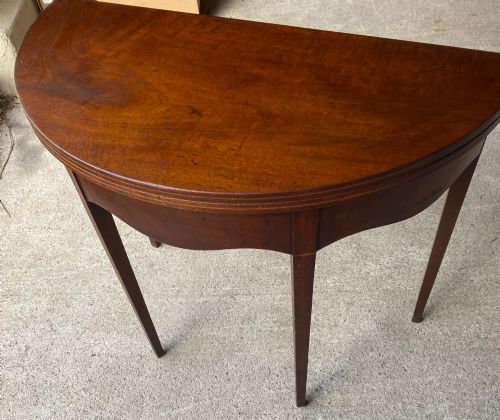
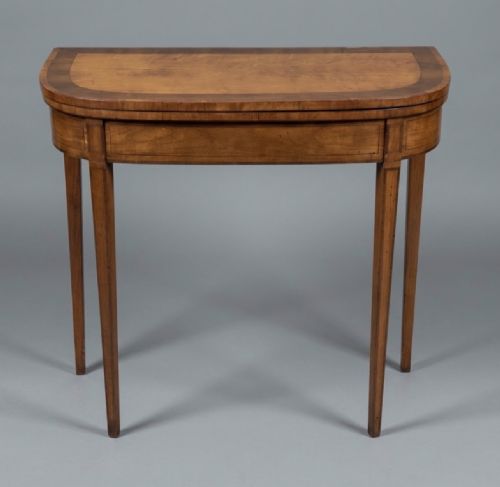
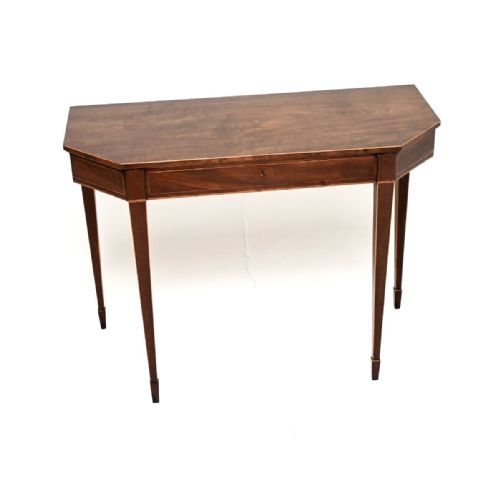
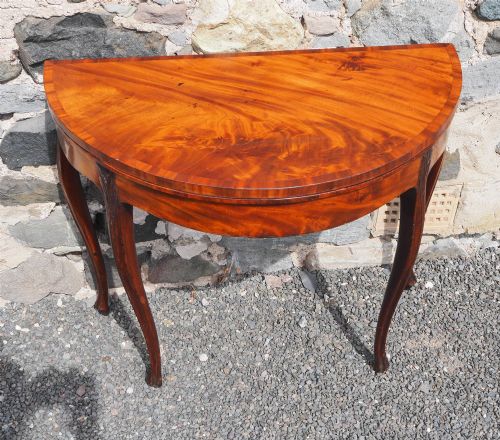
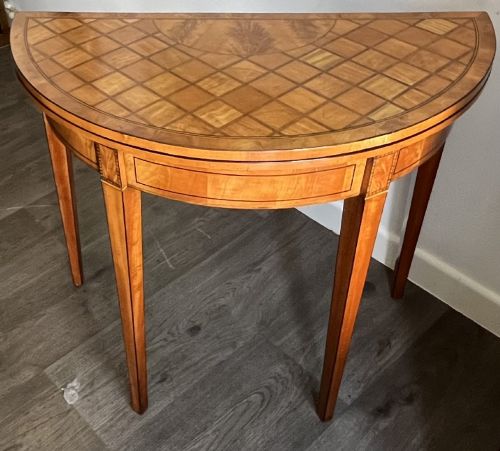
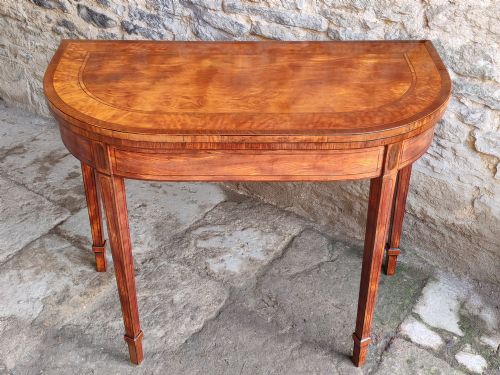
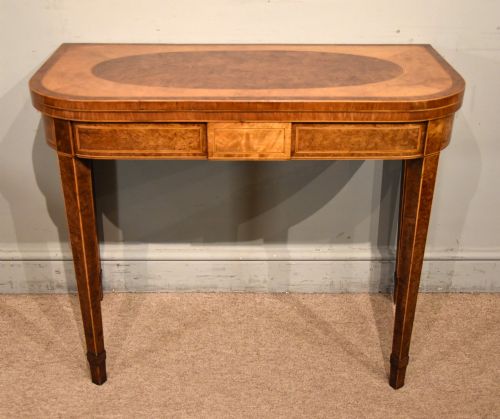
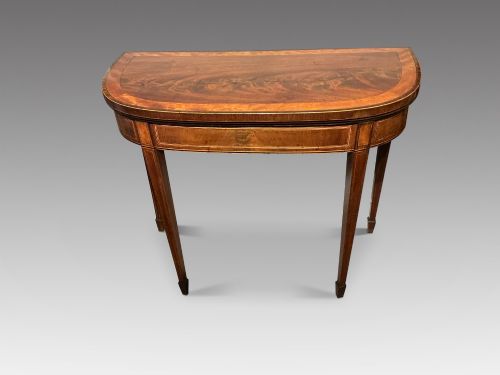
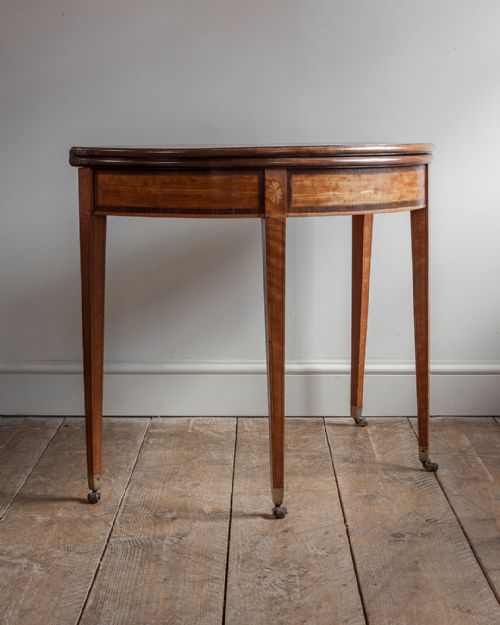

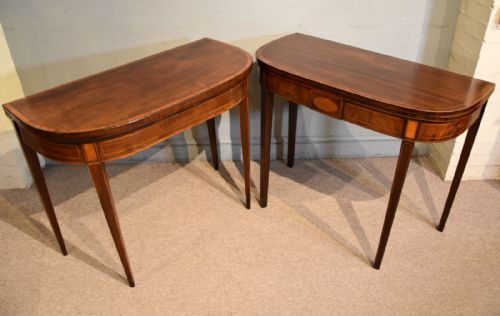


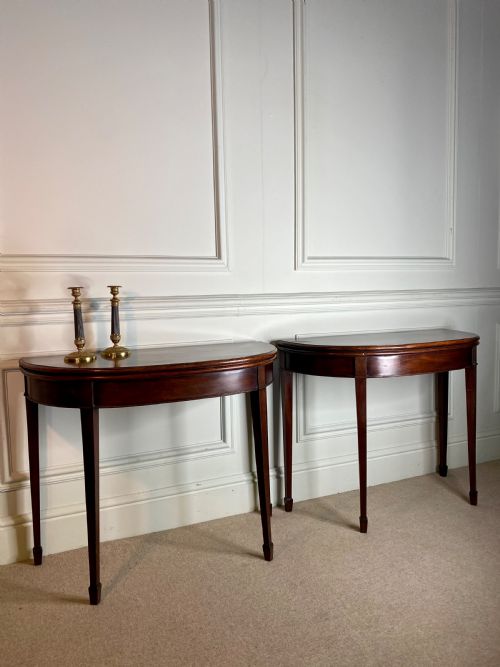


Hepplewhite Demilune Console
These hepplewhite demilune console tables offer elegant semi-circular forms and refined neoclassical lines that elevate any classical hallway or drawing room.
Hepplewhite Demilune Console
A hepplewhite demilune console table presents a distinctive half-moon profile designed to sit flat against a wall, frequently doubling as a fold-over card or tea table through a hinged top. When buyers search for this phrase, they encounter pieces spanning genuine 18th-century Georgian origins as well as later revival interpretations from the Edwardian era and the 1930s.
The selection ranges from simple mahogany side tables to elaborate satinwood examples adorned with boxwood inlay, crossbanding, and hand-painted details. Card tables, tea tables, and occasional sideboards dominate the forms, reflecting the multifunctional nature of domestic furniture during the Georgian period and its subsequent revivals.
Materials and Construction Techniques
Cabinet makers relied primarily on rich timbers such as mahogany, walnut, and rosewood for the structural frames and primary surfaces, often employing fine satinwood veneers to create luminous top panels. These woods were skillfully combined with contrasting boxwood inlay and intricate crossbanding to define the characteristic curved borders.
Joinery techniques focused on stability and precision, allowing folding leaves on card and tea tables to operate smoothly upon pivoting rear legs. Brass hinges and fittings were integrated carefully to support the weight of the fold-over tops without disrupting the clean neoclassical silhouette.
Hepplewhite Demilune Console Retail Price Guide 2026
Typical asking prices for hepplewhite demilune console among the pieces listed under this phrase on Sellingantiques today, from the lower quarter to the upper quarter. They describe what is for sale here now, not the wider market.
Several tables cleverly hide card-playing secrets beneath folding leaves, ready to transform a polite hallway console into an impromptu gaming den.
Markers of Superior Quality
Quality rests in the precision of the timber selection and the sharpness of the inlay work, where tight figuration in the mahogany or satinwood indicates a more considered choice of material by the maker. Subtle hand-painted motifs and balanced proportions separate ambitious workshop production from simpler commercial output.
The integrity of the pivoting mechanism on fold-over surfaces and the crispness of edge banding reveal the underlying skill of the construction. Pieces that retain harmonious proportions across their curved aprons and tapered legs demonstrate superior craftsmanship.
The Hepplewhite Demilune Console Glossary
- Demilune
- Having a half-moon shape with a flat back edge designed to stand flush against a wall. This profile defines the classic console and card table forms.
- Crossbanding
- A strip of veneer applied to the border of a tabletop with the grain running perpendicular to the central panel. It creates a neat framing effect common in Georgian furniture.
- Inlay
- Contrasting wood or other materials set into the surface of a piece to form decorative patterns. Boxwood is frequently utilised for this purpose on satinwood grounds.
- Fold-over
- A hinged tabletop design that opens to double its surface area for games or tea. It often conceals a shallow well for storage beneath the leaf.
- Neoclassical
- A style drawing inspiration from classical antiquity, characterised by symmetry, straight tapered legs, and restrained ornamentation.
Hepplewhite Demilune Console: Frequently Asked Questions
What is a demilune table used for?
These tables served primarily as decorative console surfaces in halls or drawing rooms, often featuring folding tops to accommodate card games or tea service when entertaining guests.
Their compact half-moon footprint allowed them to occupy minimal floor space while still providing a functional surface for lamps or ornaments.
How do I date a Georgian console table?
Dating relies on examining the timber species, veneer thickness, secondary woods used in the frame, and the style of inlay work. Genuine 18th-century examples display hand-cut joinery and period-appropriate patination.
Later Edwardian and 1930s revivals often exhibit machine-prepared timber characteristics and slightly different construction tolerances beneath the polished surfaces.
Are these tables sturdy enough for daily use?
Most surviving examples have endured centuries of domestic life because they were constructed by skilled cabinet makers using dense hardwoods like mahogany and rosewood. The swing leg mechanism on fold-over variants requires gentle handling when opening the top.
Placing them away from direct heat sources helps preserve the delicate veneers and prevents timber movement in the curved aprons.
What distinguishes Hepplewhite style furniture?
The style is defined by light graceful proportions, contrasting veneers, and slender tapered legs that depart from earlier heavier aesthetic traditions. It draws heavily on classical architectural motifs adapted for domestic interior decoration.
Subtle curves and inlaid fan details frequently appear on tabletops and aprons characteristic of this design vocabulary.