
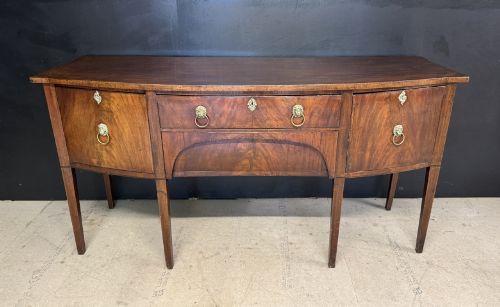

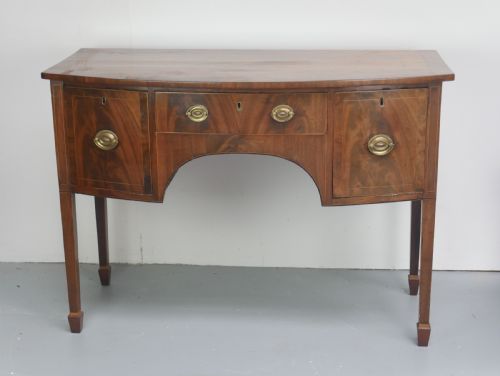
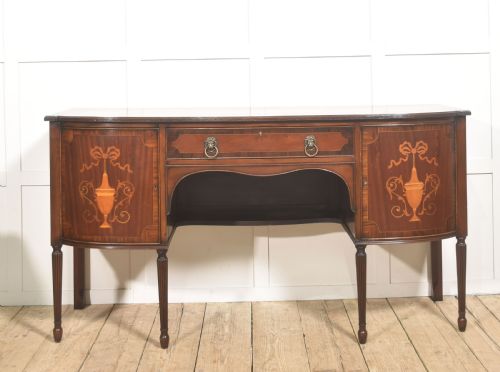


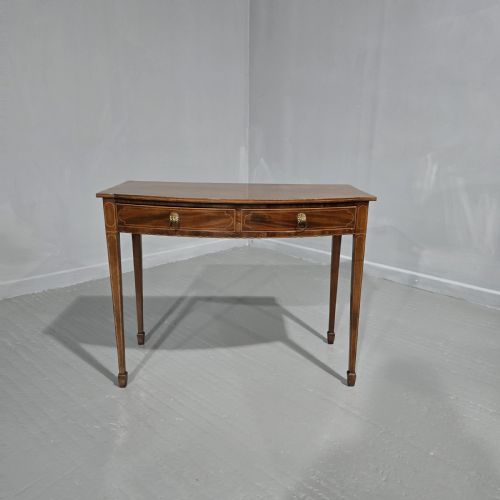


Hepplewhite Bowfront Server
A hepplewhite bowfront server offers the curved line and graceful proportions characteristic of late eighteenth-century dining rooms.

Hepplewhite Bowfront Server
A hepplewhite bowfront server is typically encountered as a Georgian mahogany sideboard or side table exhibiting the signature convex curve. These pieces originate primarily from the eighteenth and nineteenth centuries, alongside later revival interpretations.
The form encompasses sideboards, side tables, and dressers shaped to the distinctive bow front. Most examples span the Georgian and George III periods, featuring structured cabinetry designed for the dining room.
Materials and Construction
Cabinetmakers built these servers principally in solid mahogany and flame mahogany, often selecting timber with rich grain patterns for the primary surfaces. Structural elements utilised durable hardwoods to support the sweeping curves of the frame.
Decoration relied heavily on contrasting timber details, incorporating boxwood and satinwood inlay to accentuate the edges and drawer fronts. Original brass hardware completed the construction, fastened securely to the cabinetry.
Several servers hide deep side cellaret drawers once lined with lead to chill wine bottles for Georgian dinner guests.
Judging Quality and Craftsmanship
The refinement of the bow curve and the crispness of the boxwood or satinwood inlay define the upper tier of these servers. Superior pieces display thoughtful timber selection, where flame mahogany veneers are matched symmetrically across the front.
Proportion and scale distinguish finer examples from standard production. Cabinetmakers who achieved harmonious drawer arrangements and neat structural joins produced servers that maintain their integrity over centuries.
George Hepplewhite
The Hepplewhite Bowfront Server Glossary
- Bowfront
- A convex curved furniture front that swells outward in the centre. This shape softens the room's geometry.
- Inlay
- Contrasting woods such as boxwood and satinwood fitted into recessed channels in the mahogany surface. This technique creates delicate linear decoration.
- Flame mahogany
- Timber cut from the branch junction of the mahogany tree, showing a distinctive flickering grain pattern. Cabinetmakers reserved this veneer for prominent drawer fronts.
- Georgian
- The period spanning the reigns of the first four British monarchs named George, known for refined classical furniture designs. Pieces from this era often utilise high-grade mahogany.
Hepplewhite Bowfront Server: Frequently Asked Questions
What is a bowfront server?
A bowfront server is a long dining room cabinet featuring a convex curved front that projects outward. These pieces were designed to hold porcelain, silver, and serving dishes.
Most surviving examples date from the Georgian period and are constructed from mahogany with delicate wood inlay.
How do I date a sideboard?
Dating a sideboard involves examining the secondary timbers, construction methods, and hardware fixings. Eighteenth-century pieces typically show hand-cut dovetails and native woods inside the drawers.
Stylistic markers like boxwood stringing and the sharpness of the bow front also indicate whether a piece is Georgian or a later nineteenth-century revival.
Where were these servers used?
These servers stood in formal dining rooms against the wall to assist with meal service. They held food and utensils before and after the meal.
Their elegant mahogany surfaces and inlaid details also allowed them to function as decorative display furniture in grand houses.
How do I care for mahogany?
Mahogany requires stable room humidity and protection from direct sunlight to prevent the timber and veneers from drying out. Periodic application of natural wax helps maintain the lustre of the wood.
Avoid placing hot serving dishes directly on the top surface without protective mats to safeguard the polished finish.