
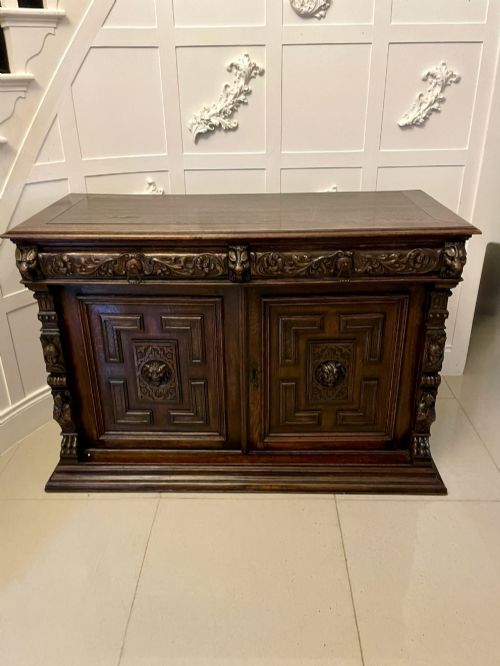
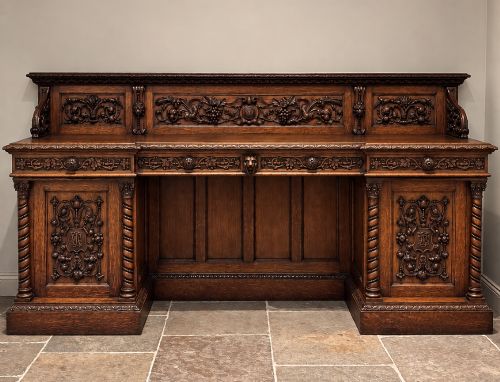
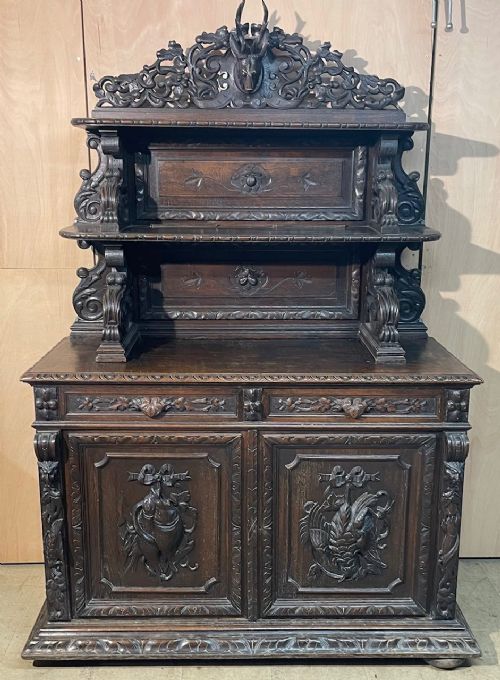
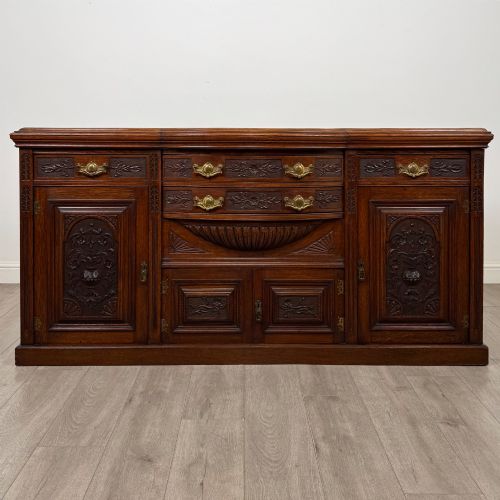
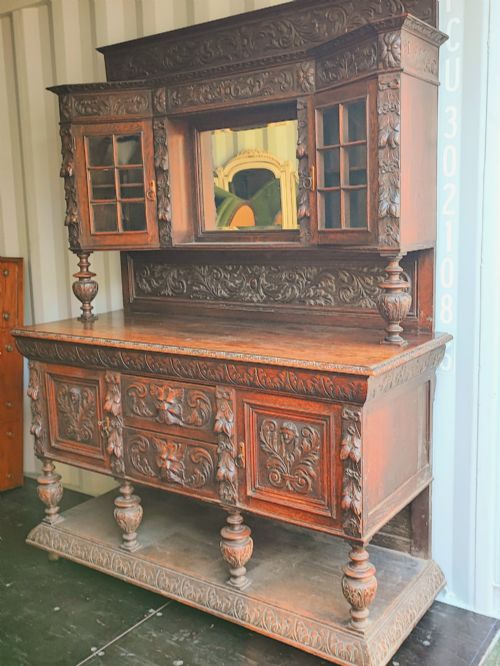
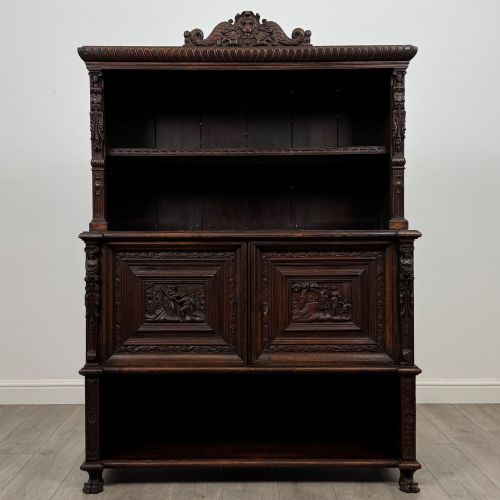


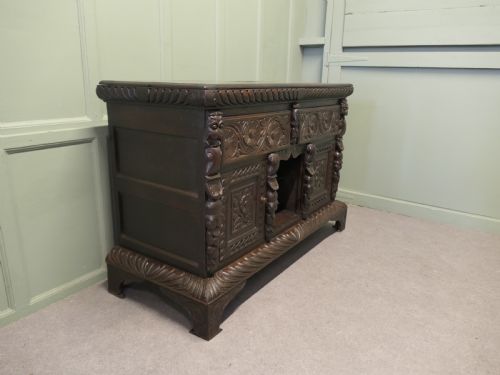


Heavy Carved Oak Sideboard
A heavy carved oak sideboard brings substantial presence to a dining room, offering deep storage and robust joinery rooted in nineteenth-century revival styles.
Heavy Carved Oak Sideboard
A heavy carved oak sideboard is a substantial dining room or hallway piece designed for storage and display, frequently appearing in nineteenth-century revivals. Buyers seeking this form encounter robust cupboards, buffet cabinets, and mirror-backed servers defined by deep architectural mouldings.
The pieces listed on this page span the Victorian era, the nineteenth century generally, and the early twentieth century. Examples range from Jacobean and Gothic revival designs to French hunting cabinets and Flemish Baroque influences.
Most variations take the form of large sideboards and cupboards featuring panelled doors, drawers, and occasionally raised mirror backs or glazed sections. Oak remains the consistent timber across all periods, often paired with brass hardware and bevelled glass.
Materials and construction methods
These items are constructed predominantly from solid oak, occasionally utilising pollard oak for distinct grain patterns, alongside brass handles, iron hinges, and glass or mirror inserts. Timbers are joined using traditional frame-and-panel methods to accommodate natural wood movement in large case pieces.
Carving is executed directly into the solid oak, displaying high relief motifs such as Green Man masks, scrolling foliage, and geometric strapwork. Surfaces are finished to enhance the natural grain and colour of the timber, supported by internal secondary woods and structural metalwork where required.
Distinctions in craftsmanship and design
Quality in these case pieces rests on the depth and crispness of the hand-carving and the selection of the timber. Superior examples exhibit tightly grained oak, deeply undercut relief work, and well-balanced proportions that integrate massive cornices and heavy plinths without clumsiness.
Internal construction and hardware further separate standard production from exceptional examples. Better pieces feature solid oak drawer linings, dovetailed joints, original brass or iron fittings, and heavy mirror glass securely bevelled and set into panelled frames.
The Heavy Carved Oak Sideboard Glossary
- Green Man
- A decorative architectural motif representing a human face entwined with leaves, vines, or branches. It frequently appears carved onto nineteenth-century oak furniture panels.
- Court cupboard
- A traditional type of short, two-stage open or enclosed cupboard used for storing food and displaying plate. The form is often revived in Victorian and early twentieth-century oak.
- Pollard oak
- Timber taken from trees that have been pollarded, producing a highly figured, mottled grain pattern. This specialty wood is utilised on select drawer fronts and door panels for visual contrast.
- Renaissance Revival
- A nineteenth-century architectural and decorative style drawing inspiration from fifteenth and sixteenth-century Italian and French design. Pieces in this mode display heavy classical cornices, pilasters, and robust relief carving.
- Buffet
- A sideboard or serving table designed for holding food and tableware. Examples in this inventory often incorporate heavy cupboards and raised upper shelves.
Heavy Carved Oak Sideboard: Frequently Asked Questions
Where should I place a heavy oak sideboard?
These pieces require substantial wall space and a structurally sound floor to support their considerable weight and mass.
They sit well in large dining rooms, halls, or living spaces where their deep proportions and detailed carving become a central focus.
How do I care for antique oak furniture?
Maintain the timber by keeping it away from direct heat sources and sudden humidity changes that cause wood to split.
Apply a traditional beeswax polish occasionally to nourish the grain and protect the surface from everyday wear.
What is a mirror back sideboard?
A mirror back sideboard incorporates an upright superstructure containing a large bevelled glass mirror flanked by shelves or carved panels.
This addition reflects light into the room and provides a dedicated display area for ceramics or glassware above the main serving surface.
How do I identify a Gothic revival piece?
Gothic revival items display architectural elements borrowed from medieval cathedrals, including pointed arches, tracery, and stiff-leaf foliage.
In this selection, they appear as dark oak cupboards and cabinets with rigorous vertical lines and iron strap hinges.