
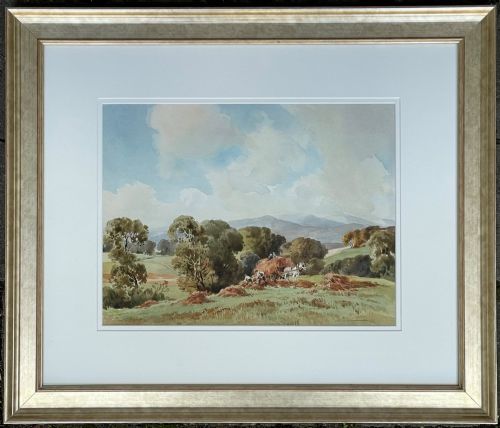


Haymaking Landscape Painting
A haymaking landscape painting captures the seasonal rhythm of the rural harvest through oil on canvas or delicate watercolour.
Haymaking Landscape Painting
A haymaking landscape painting depicts rural agricultural scenes focused on the harvest of grass, capturing figures at work in fields during the nineteenth and early twentieth centuries. These works span the Victorian, Edwardian, and British Impressionist movements, reflecting changing rural landscapes across various British counties.
The most common examples on this page are oil paintings on canvas and watercolour paintings on paper, often signed by the artist. These pieces range in date from the 1870s through to the 1920s, showing agricultural labour under open skies.
The subjects centre on the seasonal rhythm of hay cutting, gathering, and carting, presented through the lens of traditional British and Impressionist realisms. Such works offer a record of rural life before mechanisation altered the countryside.
Assessing quality and execution
Quality rests in the handling of light and atmospheric perspective across the open fields, distinguishing expressive works from formulaic studio output. Skilled brushwork brings vitality to the depiction of figures and working animals.
Compositional strength and the convincing capture of seasonal weather conditions separate superior examples from simpler topographical watercolours. The integration of labourers into the landscape reveals the artist's observational capability.
Artists braved swarms of harvest flies just to paint a bloke resting on a hay bale.
Percy Lancaster·Henry Bailey·Herbert Royle·John Atkinson·James William Booth·Arthur Walker Redgate·Frederick J Knowles·William Greaves·George Graham·John Clayton Adams·George Anderson Short·Robert Thorne Waite·George Oyston·David Cox·David A Baxter·William Josiah Redworth·Karl Adam Heinisch
The Haymaking Landscape Painting Glossary
- Watercolour
- A painting method where fine pigment is suspended in water-based solution on paper. This medium provides translucent washes suited to bright pastoral scenes.
- Oil on canvas
- Pigment bound in drying oil applied to a stretched woven fabric support. This combination allows for rich colour saturation and textured brushwork.
- British Impressionism
- A late nineteenth and early twentieth century painting style focusing on light and everyday subjects. Practitioners often worked out of doors to capture natural illumination.
- Victorian Rural Naturalism
- An art movement depicting honest scenes of agricultural labour and country life. These works emphasised the realities of rural employment.
- Impasto
- Paint laid on an area of the surface in very thick layers. This technique stands out from the canvas and catches physical light.
Haymaking Landscape Painting: Frequently Asked Questions
What periods do these paintings date from?
The works originate largely from the late nineteenth century through to the 1920s, encompassing the Victorian and Edwardian eras. This period spans traditional realism and early British Impressionism.
Dates are established through artist signatures, stylistic markers, and period framing techniques common to these decades.
How do I distinguish watercolours from oil paintings?
Watercolour paintings use thin, translucent washes on paper and require protective glass within their frames. Oil paintings utilise thick pigments on canvas and remain unglazed.
Surface texture also separates the two mediums, with oils showing raised brushstrokes and canvas weave.
Where were these rural scenes typically painted?
Artists painted across various British rural locations, including Yorkshire, Essex, and the Thames valley. These areas provided active agricultural landscapes for plein air observation.
Titles often record specific regional places or local river valleys where haymaking took place.
How should I display an antique watercolour?
Watercolours on paper require placement away from direct sunlight to prevent fading of the pigments. Framing behind glass protects the paper surface from environmental moisture.
Maintaining stable indoor humidity preserves both the paper support and the traditional wooden frame.