


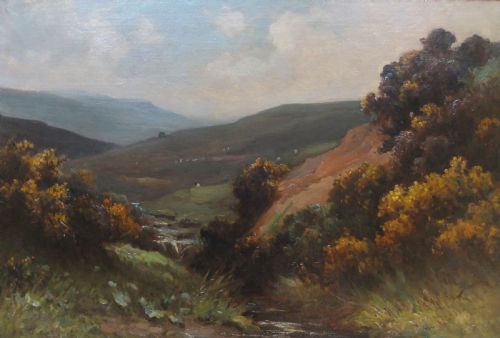


Earthy Green Oil Painting
An earthy green oil painting captures quiet pastoral moods through subdued palettes, bringing historic landscapes and still lifes directly onto the wall.
Earthy Green Oil Painting
An earthy green oil painting draws on the muted tones of nineteenth and twentieth century British and European landscapes. Buyers encounter works depicting woodland scenes, Yorkshire farms, Scottish highlands, and riverbanks executed across multiple decades.
The selection ranges from Victorian pastoral views to mid twentieth century studies on canvas and board. These paintings ground a room in natural greens and browns, reflecting historic traditions of regional landscape observation.
Materials and construction
Artists painted primarily with oil pigments applied to stretched canvas, wooden panels, or rigid boards. The medium allowed for slow blending of deep green and earth tones to capture atmospheric light in rural settings.
Supports varied according to period and artist preference, with traditional canvas used alongside wood panels for smaller plein air studies. Pigments relied on earth colours to achieve durable, stable woodland and moorland scenes.
Several rustic farmyard scenes include remarkably stubborn-looking sheep and cattle that seem entirely unimpressed by the artist.
Evaluating quality
Quality rests in the handling of brushwork and the management of tonal depth within the landscape. Superior works demonstrate confident spatial composition and subtle layering of green pigments rather than flat application.
The distinction between standard academic exercises and finer paintings lies in the artist's ability to render light and atmosphere convincingly. Provenance and exhibition history further elevate specific works within regional schools.
William H Myers·Tom Campbell·William JB Jenkins·Reginald Grange Brundrit·Thomas Creswick·Owen Bowen·William Traies·Ernest Higgins Rigg·Alfred Banner·Benjamin Williams Leader
The Earthy Green Oil Painting Glossary
- Canvas
- A heavy woven fabric stretched across a wooden frame to serve as a painting surface. It provides texture and flexibility for oil applications.
- Wood Panel
- A rigid wooden support used by artists for stability. Panels often preceded canvas standardisation in earlier landscape traditions.
- Plein Air
- Painting outdoors directly from nature to capture immediate light conditions. This method defined much of the landscape work produced across the nineteenth century.
- Stretcher
- The internal wooden framework that keeps a canvas taut. Inscriptions or signatures on this wooden structure frequently aid attribution.
Earthy Green Oil Painting: Frequently Asked Questions
What periods do these paintings cover?
The available selection spans from the nineteenth century through the mid twentieth century, encompassing Victorian, Edwardian, and later regional schools.
Most works cluster around the early decades of the twentieth century, reflecting traditional landscape painting methods across Britain and France.
How should I clean an old oil painting?
Dust accumulation should be gently removed with a very soft, dry brush without applying pressure to the pigment surface.
Professional conservation is required for deep cleaning or varnish removal to prevent accidental damage to the original oil layers.
Where were these landscape scenes painted?
Locations range widely across British rural settings such as Yorkshire, Cumberland, and Dartmoor, alongside French provincial views.
Artists frequently worked outdoors in specific agricultural or pastoral areas to record local topography and atmospheric conditions.
How do I identify a wood panel backing?
Wood panels consist of solid timber boards used directly as a painting support instead of woven fabric.
They offer a rigid surface that often shows distinct grain patterns and age-related darkening on the reverse side.