
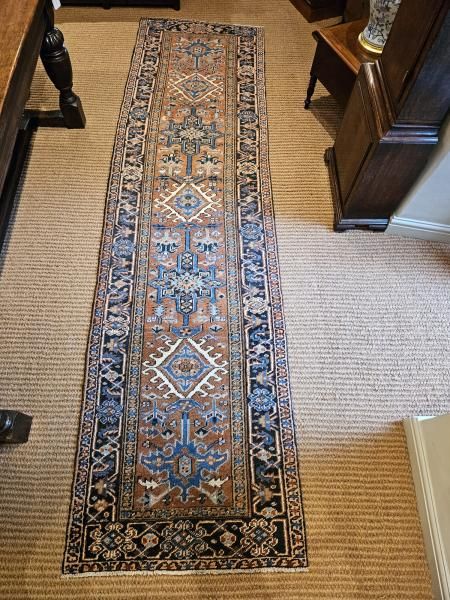
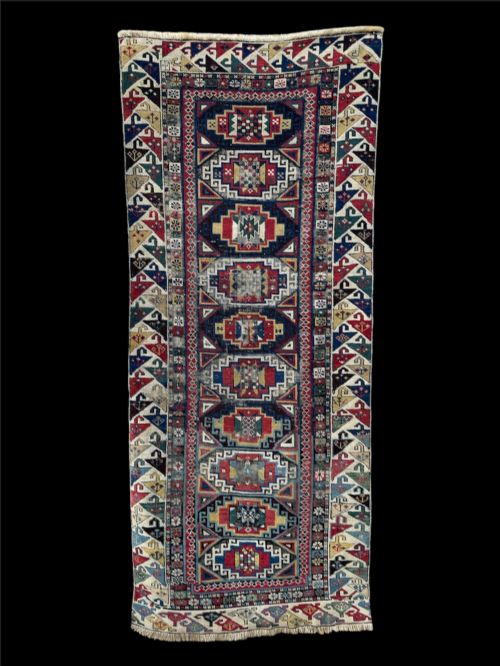
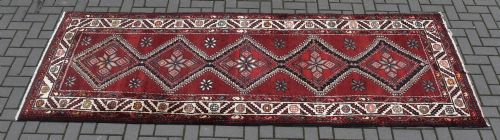


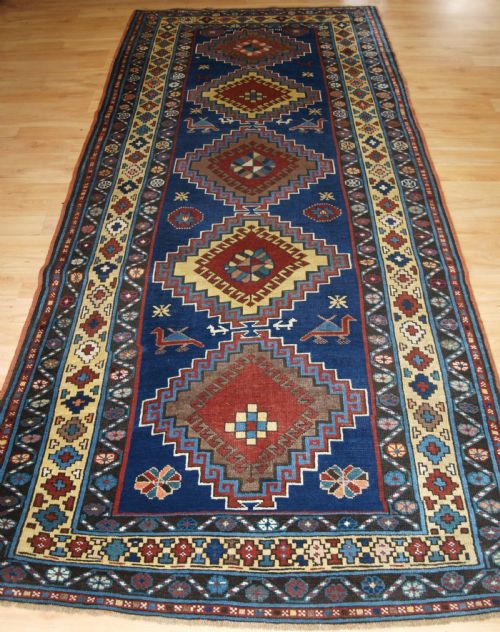
Handwoven Caucasian Long Rug
A handwoven caucasian long rug brings tribal geometry and saturated colour to a hallway.
Handwoven Caucasian Long Rug
A handwoven caucasian long rug is an elongated tribal textile designed for narrow spaces, corridors and long rooms. These pieces combine geometric medallions, diagonal stripes and niche motifs in bold native arrangements.
You are most likely to meet nineteenth-century and early twentieth-century examples on this page, stretching from eighteen seventy up to nineteen twenty. They appear under various descriptions including runner rugs, hallway runners and long village carpets.
Originating from mountain regions and tribal workshops, these runners feature distinct regional weaving traditions such as Shirvan, Gendje, Kazak, Kuba and Karaja. Their narrow proportions and striking repeat designs make them practical for modern corridors while retaining authentic folk character.
How they were made
These textiles are built upon natural foundations using wool for the pile and often cotton for the structural foundation threads. Weavers knotted individual tufts by hand across the length of the warp and weft to create a dense, resilient floor covering.
The wool used in these village and tribal pieces is dyed with rich pigments that age gracefully over decades of use. Skilled artisans tied each knot firmly, resulting in a flat-lying runner capable of enduring heavy foot traffic in a hallway.
The listings on this page span several decades, featuring materials such as wool and cotton across diverse nineteenth and twentieth-century tribal styles.
What varies in quality
The distinction between standard village production and superior weaving lies in the crispness of the geometric drawing and the density of the knotting. Finer examples display tightly packed piles that keep diagonal lines and medallion edges sharp.
Palette saturation and the complexity of the tribal motifs also divide the ordinary from the exceptional. A superior piece exhibits harmonious colour balance and careful proportion across an extended narrow format.
The Handwoven Caucasian Long Rug Glossary
- Warp
- The vertical foundation threads stretched lengthwise on the loom before knotting begins. These strong threads carry the structural tension of the rug.
- Weft
- The horizontal threads passed across the warp strands after each row of knots is tied. They bind the structure together firmly.
- Pile
- The upright woolen surface formed by the ends of the knotted yarn. This surface absorbs wear and displays the pattern.
- Niche
- An architectural prayer arch motif found at one or both ends of certain tribal rugs. It represents a sacred threshold or doorway.
- Medallion
- A central ornamental motif dominating the field of the rug. These geometric shapes anchor the repeat patterns.
Handwoven Caucasian Long Rug: Frequently Asked Questions
Where should I place a long runner?
These narrow formats suit hallways, corridors and galley kitchens where floor space is restricted. Their length guides the eye along an architectural path while protecting wooden floorboards.
They also work well alongside long beds or narrow entrance halls where standard rectangular carpets fail to fit properly.
How do I clean a wool runner?
Gentle surface brushing and regular light vacuuming without a rotating beater bar remove everyday dust from the wool pile. Professional rug cleaning is necessary for deep washing to protect the natural dyes.
Avoid chemical spot treatments or soaking the cotton foundation, as excess moisture weakens the structural integrity of older textiles.
Are these rugs durable for hallways?
Traditional village weaving uses sturdy wool pile designed to withstand generations of domestic use. The dense knotting provides natural resilience against heavy foot traffic in busy thoroughfares.
Using an appropriate underlay prevents slipping and cushions the foundation against hard stone or timber floors.
How can I tell a Shirvan from a Kazak?
Shirvan runners tend to feature narrower formats with precise, intricate geometric patterns and balanced neutral or saturated fields. Their drawing is often finer and more restrained.
Kazak pieces display bolder, larger-scale medallions and brighter primary colours with a more robust tribal aesthetic. The wool texture and secondary borders also help indicate the specific regional workshop.