


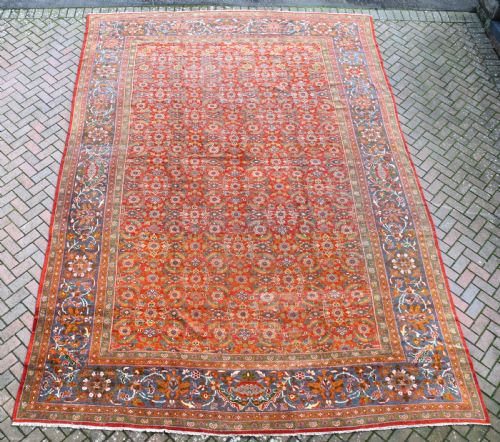


Hand Woven Ziegler Carpet
A hand woven ziegler carpet brings room-anchoring scale and muted, balanced palette work into a home through late nineteenth-century Persian weaving traditions.
Hand Woven Ziegler Carpet
A hand woven ziegler carpet represents large-format floor coverings produced in Persia during the late nineteenth century, specifically spanning the eighteen-eighties, eighteen-nineties, and nineteen-hundreds. These pieces frequently appear under designations such as Sultanabad, Mahal, and Ziegler, reflecting their regional origins and commercial commissioning.
Buyers encounter substantial room-sized formats alongside expansive area carpets, designed with generous proportions like the examples measuring over four metres in length. The prevalent aesthetic relies on softer, more subdued colour palettes and large-scale floral motifs tailored originally for Western export tastes.
How they were made
Construction relies on hand-knotted wool pile secured onto sturdy cotton foundations, providing both plush underfoot comfort and structural durability. This combination of materials allows the dense pile to withstand generations of domestic use while retaining flexibility.
Weavers utilised traditional upright looms and hand-tied knots to execute expansive botanical and trellis designs, requiring meticulous coordination across large dimensions. Natural dyeing techniques yielded the characteristic muted tones that define this group of Persian carpets.
Listings span the period from eighteen-eighty to nineteen-hundred, featuring wool and cotton construction across Persian Sultanabad and Ziegler styles.
What varies in quality
The standard of a hand woven ziegler carpet depends on the precision of knot density and the crispness of the drawn floral design across its expansive field. Finer execution maintains structural integrity and allows complex medallion or all-over trellis patterns to read with clarity.
Preservation of the original wool pile depth and the condition of the cotton foundation margins determine the overall integrity of the piece. Uniform wear and balanced colour mellowing distinguish superior examples from those with uneven fading or heavy restoration.
The Hand Woven Ziegler Carpet Glossary
- Sultanabad
- A regional Persian designation for carpets produced in and around the town of Sultanabad, known for bold floral designs and large room formats. These pieces formed the backbone of late nineteenth-century commercial carpet export.
- Ziegler
- A reference to Ziegler and Co., the Manchester-based firm that established workshops in Persia to commission carpets specifically for Western markets. Their designs favoured softer palettes and open fields.
- Mahal
- A term often applied to carpets originating from the smaller villages surrounding Sultanabad, sharing stylistic traits with larger workshop productions. They typically exhibit slightly simpler village-level interpretations of formal patterns.
- Pile
- The upright wool loops forming the functional surface of the carpet, knotted onto the foundation warps and wefts. The height and density of this layer dictate the tactile feel and durability of the rug.
- Warp
- The vertical cotton threads stretched taut on the loom that form the skeletal grid of the carpet. Fringe ends originate directly from these structural threads.
Hand Woven Ziegler Carpet: Frequently Asked Questions
What is a hand woven ziegler carpet?
A hand woven ziegler carpet is a large-format Persian floor covering produced during the late nineteenth century, typically featuring room-scale dimensions and muted botanical designs commissioned for Western tastes.
These pieces bridge traditional Persian workshop methods with the aesthetic demands of Victorian homes, resulting in spacious fields and balanced, understated colour schemes.
How do I date these carpets?
Dating relies on stylistic attributes, structural analysis, and historical production records pointing to the late nineteenth century, specifically between eighteen-eighty and nineteen-hundred. Specific workshop labels and design nuances help narrow the period of origin.
Comparing knot structure and wool characteristics against known examples from this era confirms the approximate decade of manufacture.
Where were these carpets made?
These carpets were woven in Persia, primarily in and around the district of Sultanabad, under the direction of commercial manufacturing firms such as Ziegler and Co. Local artisans executed designs tailored for export to European and American markets.
The regional workshops combined indigenous Persian weaving skills with foreign design supervision to produce these distinctive large-scale carpets.
How do I live with a large carpet?
Living with a room-sized carpet requires placing it in a low-to-moderate traffic area of the home to preserve the historic wool pile. Using a quality underlay provides cushioning and prevents slipping on hard floors.
Regular, gentle vacuuming without a rotating brush roll keeps dust from settling into the cotton foundation while protecting the delicate hand-knotted surface.
What distinguishes Ziegler from Sultanabad?
Ziegler carpets specifically denote pieces commissioned or handled by the Ziegler firm, which often featured refined, subdued palettes and expansive floral motifs. Sultanabad serves as the broader geographical term for carpets originating from that same manufacturing region.
While all Ziegler carpets share roots in the Sultanabad area, not all Sultanabad pieces carry the specific commercial design signatures associated with the Manchester firm.