
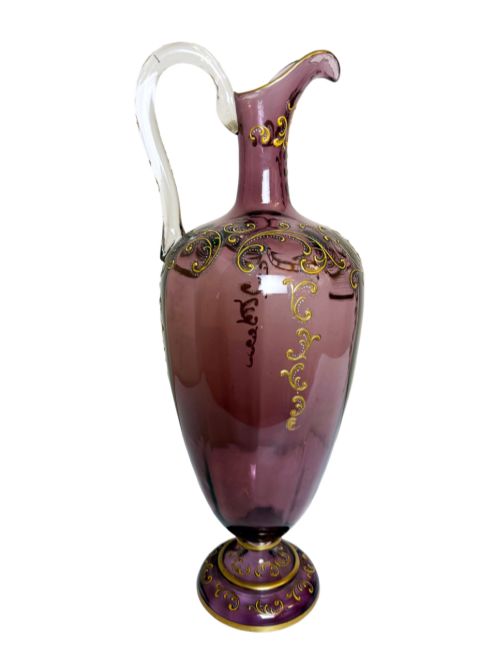
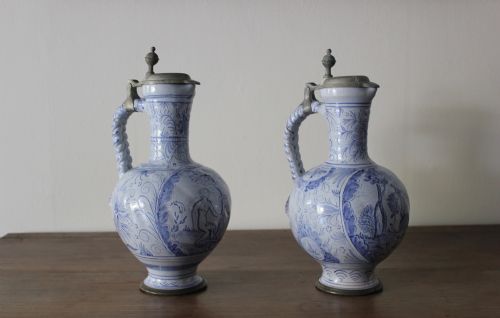


Hand Painted Ewer
A hand painted ewer brings classical form and painterly detail to a room, drawing the eye with its curved handle and decorated body.
Hand Painted Ewer
When you search for a hand painted ewer, you find vessel forms ranging from classical water carriers adapted for display to decorative table jugs and cream boats. These objects trace their lineage through Georgian, Victorian and Edwardian periods, often taking the shape of pedestal ewers, cleft jugs and bulbous vases with spouted lips.
The pieces on this page lean heavily towards late nineteenth and early twentieth century porcelain, alongside earthenware and blown glass examples. You will frequently encounter forms bearing floral panels, oriental scenes and gilding produced by major factories and smaller potteries alike.
How they were made
Potters shaped these vessels using porcelain, earthenware or ceramic bodies, occasionally turning to blown glass or enamel for alternative forms. Artisans then applied pigments by hand before firing, often building up motifs in layers.
Makers added finishing touches through gold leaf, gilding and gilt appliques, highlighting handles, rims and painted panels to catch the light.
Listings span the eighteenth, nineteenth and early twentieth centuries, featuring porcelain, earthenware and glass across Georgian and Victorian styles.
What varies in quality
The distinction between standard production and top tier output lies in the crispness of the hand painting and the precision of the gilding. Fine examples display delicate brushwork on floral panels or figural scenes rather than stencilled outlines.
Weight, balance and the handling of porcelain bodies also set pieces apart, with superior works showing confident moulding on complex handles and spouts.
Royal Worcester·Minton·Coalport·Doulton Burslem·Staffordshire
The Hand Painted Ewer Glossary
- Ewer
- A large jug with a wide spout and curved handle, historically used for pouring water but valued here for display. These forms often feature pedestals or decorative handles.
- Blush Ivory
- A specialised ceramic finish developed by Victorian potteries to create a soft, matte cream ground. It serves as a subtle backdrop for hand painted florals.
- Gilding
- The application of gold leaf or powdered gold to ceramic surfaces. It accentuates rims, handles and panels.
- Rococo Revival
- A nineteenth century decorative style marked by ornate scrolling, asymmetry and naturalistic motifs. Ewers from this period often display lavish curves and floral encrustations.
Hand Painted Ewer: Frequently Asked Questions
What is a hand painted ewer?
A hand painted ewer is a decorative vessel featuring a spout, handle and painted artistic details applied directly to ceramic, porcelain or glass.
These pieces were made for display on sideboards and mantlepieces rather than daily domestic service.
How do I date an antique ewer?
Dating relies on factory marks stamped or painted on the base, stylistic clues such as Victorian revival curves, and the material composition.
Factory archives and registry numbers often narrow down the year of production.
Were ewers used for water?
While originally designed as water jugs for washing or table service, many surviving antique examples served purely decorative purposes as part of matching garniture sets.
Smaller versions functioned as cream boats or scent bottles.
How do I clean a painted ewer?
Dust ceramic and porcelain surfaces gently with a soft dry cloth to protect fragile overglaze enamel and gold leaf.
Avoid submerging pieces in water or using chemical cleaners that might lift the hand painted decoration.