

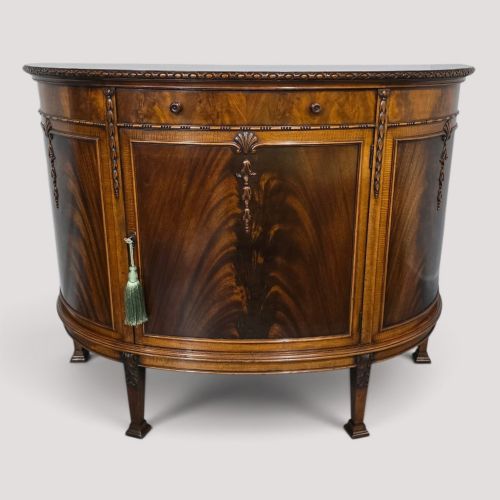
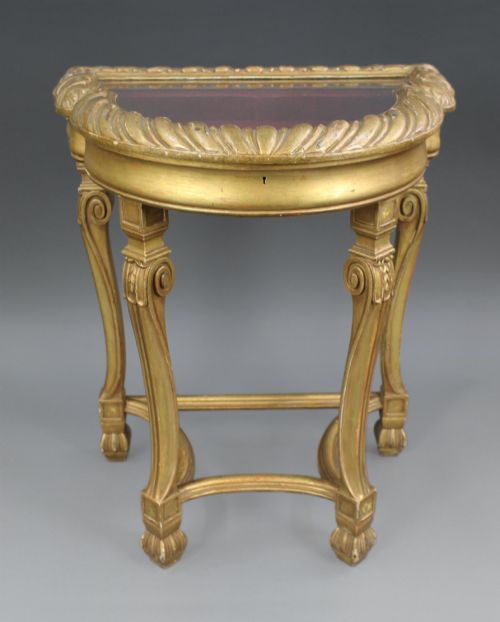
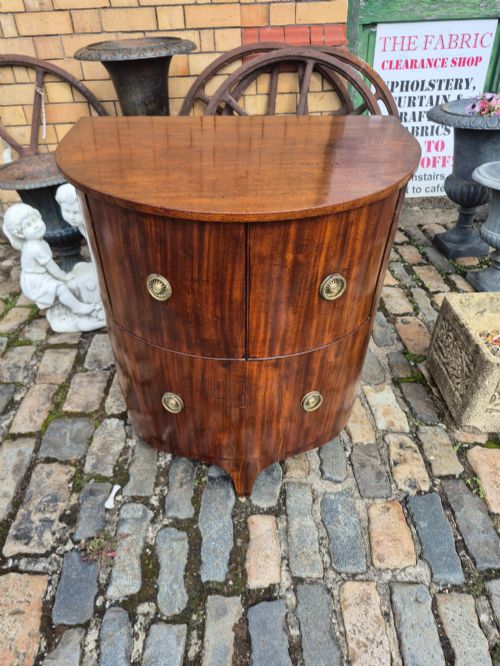
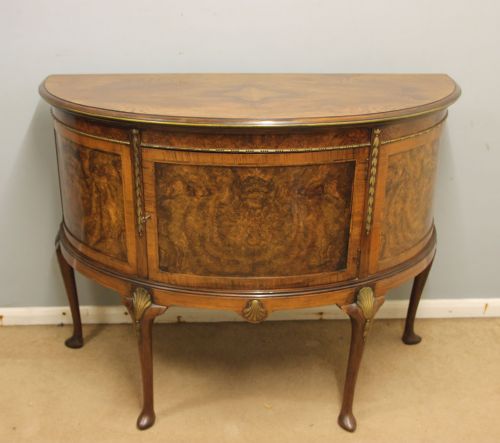
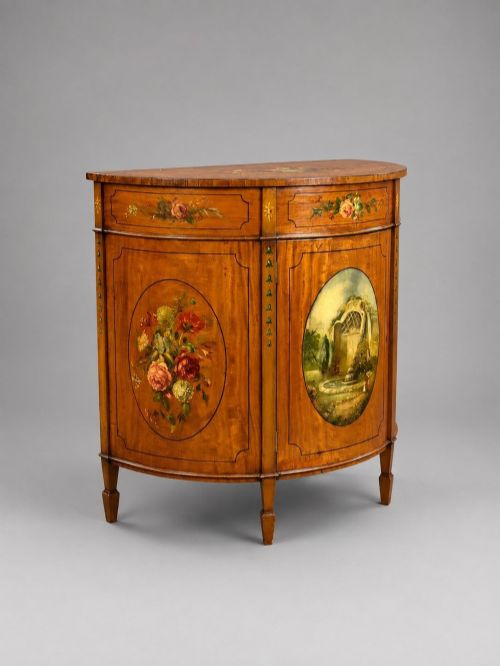
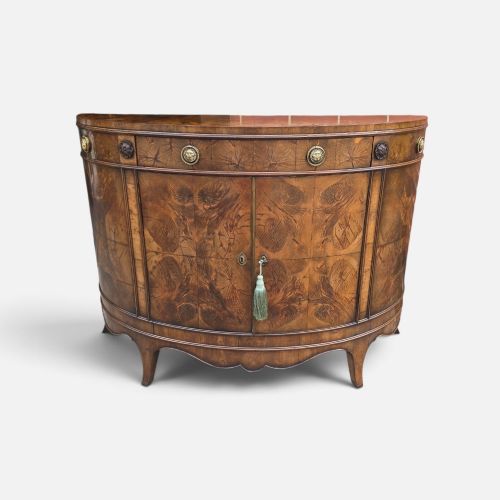
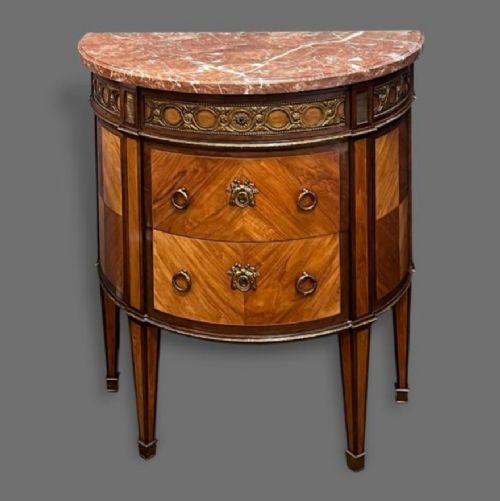


Half Moon Side Cabinet
These half moon side cabinet pieces bring refined curved fronts and compact proportions to hallways and drawing rooms.

Half Moon Side Cabinet
When you search for a half moon side cabinet, you are looking at semicircular furniture designed to fit flush against a wall while saving floor space. The form includes demilune commodes, console tables, and side cabinets originating from periods such as the 18th century, the Victorian era, and the early 20th century.
You are most likely to meet satinwood and mahogany examples finished with marquetry or painted panels, alongside French and English iterations built in the Sheraton Revival and Neoclassical styles. These items function equally well as storage units and display surfaces for lamps and decorative objects.
How they were made
Cabinetmakers utilised timber such as mahogany, walnut, satinwood, and yew, often laying down complex marquetry patterns across curved surfaces. The construction required precise bending of wood to form the characteristic semicircular frame.
Many pieces incorporate details like inset marble tops, brass mounts, and painted decorations. Tambour doors and fitted drawers demonstrate the joinery skills employed in these compact forms.
Half Moon Side Cabinet Retail Price Guide 2026
Typical asking prices for half moon side cabinet among the pieces listed under this phrase on Sellingantiques today, from the lower quarter to the upper quarter. They describe what is for sale here now, not the wider market.
The listings show pieces spanning the 18th century through the 1930s, featuring satinwood, mahogany, walnut, and marble.
What varies in quality
The standard of timber selection and marquetry detail separates standard items from exceptional ones. Finer pieces display carefully matched grain veneers and hand-painted panels rather than simpler printed or stamped decorations.
The integration of heavy materials like marble tops and the crispness of brass hardware indicate the level of craftsmanship invested in the construction. Structural integrity in the curved joints remains essential for longevity.
Pietro Ferrario·Kaufman
The Half Moon Side Cabinet Glossary
- Demi-lune
- A half-moon shape used to describe tables, commodes, and cabinets with a semicircular front and a flat back. This form became popular in the 18th century and returned in later revival periods.
- Marquetry
- The art of applying pieces of veneer to a structure to form decorative patterns and pictures. Craftsmen used various woods to create contrasting tones on cabinet doors and tops.
- Satinwood
- A durable wood with a lustrous, satin-like sheen, frequently employed in fine 18th-century and revival furniture. It provides a pale, golden background for painted designs and darker inlay.
- Commode
- A low chest of drawers or cabinet with doors, often standing on slender legs. In a half-moon shape, it serves as a decorative focal point in a room.
- Tambour
- Slender strips of wood glued to a canvas backing to form a flexible sliding door. This technique allows cabinets to open smoothly around curved corners.
Half Moon Side Cabinet: Frequently Asked Questions
Where should I place a half moon side cabinet?
These cabinets suit hallways, landings, and reception rooms where floor space is limited. Their flat backs allow them to sit flush against walls without projecting too far into a walkway.
They also function effectively in dining rooms or bedrooms as serving surfaces or small storage units beneath a mirror or painting.
How do I identify a Georgian piece?
Georgian examples often feature solid mahogany or carefully figured satinwood construction with restrained inlay work. The proportions tend to be rigorous, reflecting the classical design rules of the 18th century.
Look for hand-cut dovetails in the drawers and traditional timber preparation that predates industrial manufacturing methods.
What is the difference between a commode and a side cabinet?
A commode typically refers to a low chest with drawers or cupboard doors designed for formal rooms. A side cabinet may encompass a broader range of storage furniture including console tables with lower shelves.
In half-moon shapes, the terms frequently overlap depending on whether the piece contains enclosed shelving or pull-out drawers.
Are marble tops original to these cabinets?
Marble tops appear frequently on French and continental pieces from the 19th century onwards. They provided a durable, cool surface for drinks and display items.
English cabinetmakers more commonly used polished timber tops, though marble inserts do appear on specific neoclassical revival designs.