
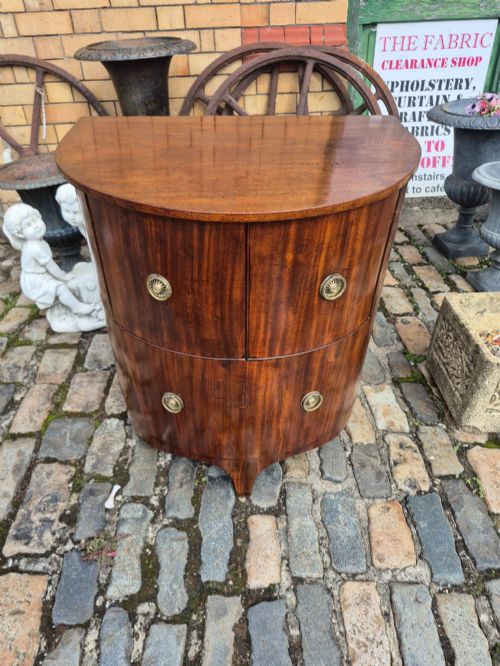
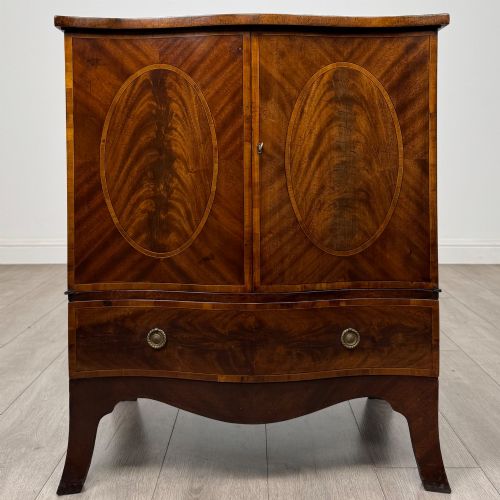
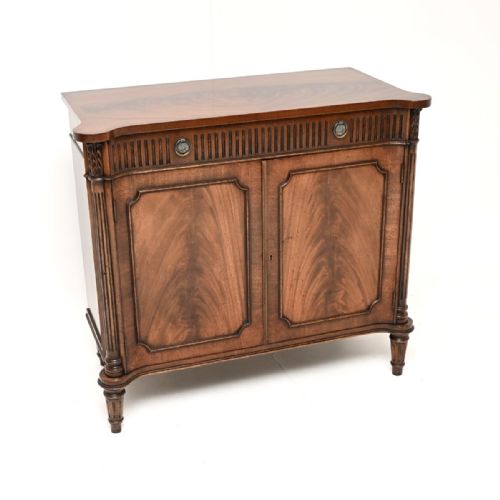
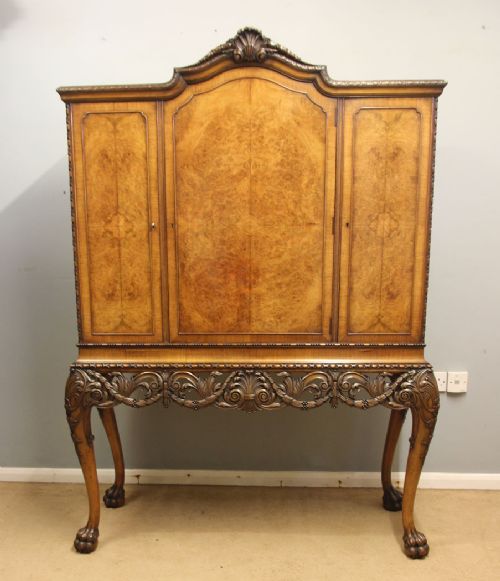
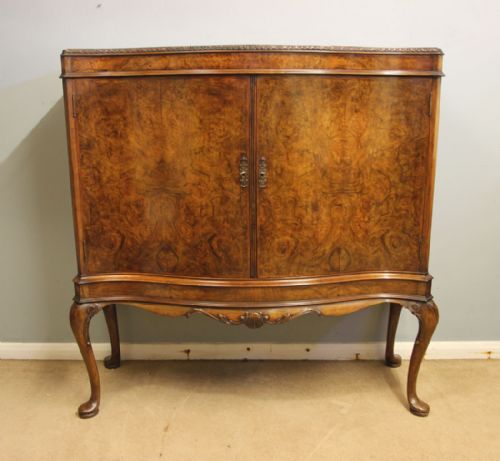


Georgian Style Drinks Cabinet
These georgian style drinks cabinet pieces offer period proportion and refined timber work for modern entertaining.
Georgian Style Drinks Cabinet
When you search for a georgian style drinks cabinet, you encounter side cabinets, wine coolers, cellarettes, and buffets spanning the nineteenth and early twentieth centuries. These items draw on Georgian Revival, Edwardian, Sheraton Revival, and Grand Regency aesthetics to provide formal storage for bottles and glassware.
How they were made
Cabinet makers constructed these pieces primarily from solid mahogany and walnut, frequently applying burr walnut veneer to create rich, figured surfaces. Decorative contrast comes from boxwood inlay and delicate satinwood, while marquetry details add intricate ornamentation to the timber bodies.
Hardware relies on cast brass for handles, feet, and hinges, providing functional contrast to the dark woods. Joinery follows traditional cabinet-making methods, ensuring that curved fronts, such as serpentine and bow designs, maintain structural integrity.
Materials recorded across the inventory include mahogany, walnut, burr walnut veneer, satinwood, and brass hardware.
What varies in quality
The distinction between standard production and exhibition grade work lies in the selection of timbers and the precision of decorative inlay. Pieces bearing workshop attributions often display superior grain matching in burr walnut veneer and finer boxwood stringing.
Proportion and execution of revival styles dictate the overall standard of each cabinet. Refined handling of serpentine or demi-lune shapes separates exceptional storage forms from simpler utilitarian cupboards.
Whytock & Reid
The Georgian Style Drinks Cabinet Glossary
- Cellarette
- A freestanding box or cabinet designed to hold bottles of wine, often lined for temperature control. These vessels sit on legs or directly on the floor depending on the period.
- Burr Walnut
- Timber taken from the abnormal growth of a walnut tree, yielding highly figured grain patterns. Cabinet makers prized this wood for decorative veneers on prominent surfaces.
- Boxwood Inlay
- Narrow strips of pale boxwood inserted into contrasting dark woods to create geometric lines or borders. This technique highlights the edges of drawers and cabinet doors.
- Demi-Lune
- A half-moon shape used for the footprint and top of small side cabinets. This curved form allows the furniture to fit snugly against walls while offering surface area.
- Serpentine
- A furniture front featuring a concave centre flanked by convex ends, creating a gentle wave motion. Craftsmen used this contour to add visual depth to sideboards and cupboards.
Georgian Style Drinks Cabinet: Frequently Asked Questions
What is a cellarette?
A cellarette is a specialised container built to store bottles securely within a dining room or parlour setting. They appear in various forms on this page, including paired standing units.
Historically, servants used these compartments to keep wine ready for the table without requiring constant trips to the cellar. Today, collectors utilise them as compact drinks cabinets.
How do I date a revival cabinet?
Dating relies on examining the timber preparation, secondary woods, and hardware construction methods alongside the listed period. Revival pieces often borrow eighteenth-century aesthetics while utilising nineteenth or twentieth-century workshop techniques.
Checking for machine-cut versus hand-finished elements helps distinguish Edwardian and 1920s interpretations from actual Georgian originals.
Where were these cabinets used?
These side cabinets and buffets originated in formal dining rooms, drawing rooms, and halls of large residences. They provided discrete storage for glassware, decanters, and bottled reserves.
In contemporary interiors, they function well in living spaces or dining areas as dedicated cocktail stations.
What distinguishes satinwood furniture?
Satinwood is a hard, pale yellow timber with a natural sheen that reflects light in a distinct manner. Makers used it for coolers and decorative accents to contrast against darker mahogany.
Its bright appearance brings visual lightness to Edwardian and late nineteenth-century interiors.