

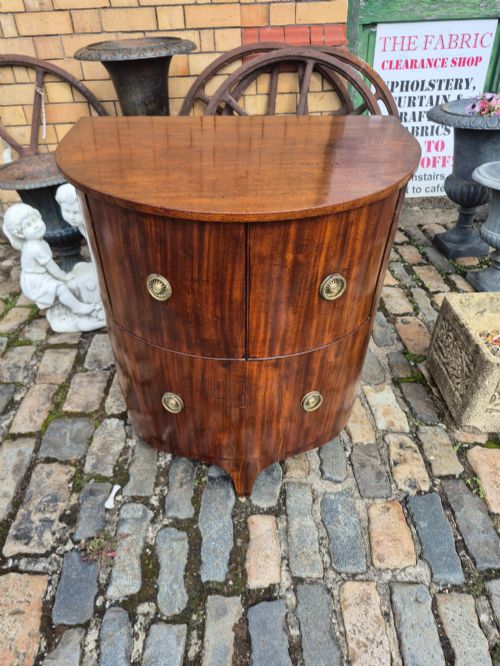
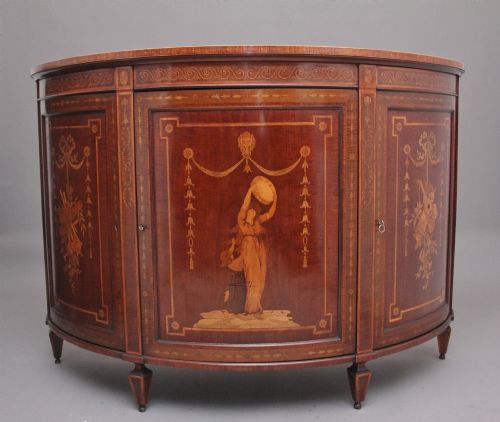


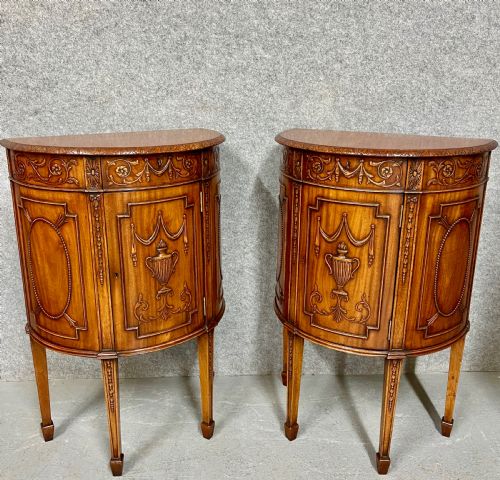

Demilune Mahogany Cabinet
A demilune mahogany cabinet brings a neat semicircular profile to a hallway or drawing room, offering subtle curves where flat furniture feels too heavy.
Demilune Mahogany Cabinet
A demilune mahogany cabinet sits flush against the wall while providing a curved front that softens room layouts. These semicircular forms appear across the eighteenth and nineteenth centuries, taking the shape of side cabinets, display cases, console cabinets, and commodes.
The versions met most often on this page date from the Georgian and Regency periods through to Edwardian interpretations of Adam and Louis XVI styles. They combine timber frames with glass panels, painted panels, or marble tops depending on whether their origin is British or continental.
Makers utilised the half-round footprint to save space in tighter corners while retaining surface area for ornaments or lamps. Selecting one means balancing the proportions of the semicircular top against the depth of the cabinet beneath.
How they were made
Cabinetmakers constructed the curved carcase of a demilune mahogany cabinet using bent timber or segmented framing to achieve the smooth semicircle. Solid mahogany forms the structural core, overlaid with finely figured veneers on the curved doors and drawer fronts.
Inlaid details in boxwood and satinwood create contrasting borders, swags, and classical motifs across the surface. Ormolu mounts, brass handles, and marble tops finish the continental and revival pieces, while glass doors define the display cabinets.
Demilune Mahogany Cabinet Retail Price Guide 2026
Typical asking prices for demilune mahogany cabinet among the pieces listed under this phrase on Sellingantiques today, from the lower quarter to the upper quarter. They describe what is for sale here now, not the wider market.
The furniture forms span side cabinets, display cabinets, console cabinets, commodes, and sideboards.
What varies in quality
The refinement of the timber figure defines the upper tier of pieces, where matched mahogany veneers flow uninterrupted around the curved front. Lesser examples rely on plain timber boards or mismatched grain patterns that break the visual sweep of the semicircle.
The intricacy of the inlay and the crispness of the bronze or ormolu mounts indicate the workshop standard. Hand-cut boxwood stringing and well-fitted doors distinguish finer cabinetmaking from mass-produced revival pieces.
Paul Somani
The Demilune Mahogany Cabinet Glossary
- Demilune
- Half-moon or semicircular in shape. This profile allows furniture to sit neatly against a wall while projecting a curved front into the room.
- Ormolu
- Gilded bronze used for decorative mounts and feet. It adds metallic contrast to the dark mahogany surfaces of French and revival pieces.
- Satinwood
- A pale, lustrous timber used for contrasting inlay and banding. It provides a bright visual border against darker mahogany veneers.
- Commode
- A low decorative cabinet or chest of drawers. These pieces often feature marble tops and fine marquetry work.
- Marquetry
- The art of applying pieces of veneer to a structure to form decorative patterns. Craftsmen use woods like boxwood and satinwood to create floral or classical motifs.
Demilune Mahogany Cabinet: Frequently Asked Questions
Where does a demilune cabinet fit best?
The semicircular footprint allows these cabinets to sit against flat walls in narrow hallways, landings, or drawing rooms without obstructing walkways. Their curved fronts soften the rigid angles of a room while providing useful surface and storage space.
Placing one in an alcove or beneath a mirror highlights the architectural symmetry of the half-round design. They work particularly well where a standard rectangular cabinet would project too far into the floor plan.
How do I tell a Georgian piece from a later revival?
Georgian pieces rely on subtle proportions, timber quality, and restrained mahogany grain patterns to achieve elegance. Edwardian and nineteenth-century revival pieces often display heavier ormolu mounts, bolder marquetry, and machine-cut elements.
Examining the secondary timbers inside the carcase and the construction of the drawers helps confirm the period of manufacture. Revival pieces frequently copy Adam or Louis XVI styles with exaggerated symmetry.
What is the difference between a commode and a side cabinet?
A commode typically refers to a low, chest-like cabinet often topped with marble and associated with French or continental design. Side cabinets generally offer shelving or glass display doors suited to British interiors.
Both share the demilune footprint, but their internal fittings reflect their original domestic functions. Commodes focus on drawer storage, whereas side cabinets accommodate books, china, or curiosities.