





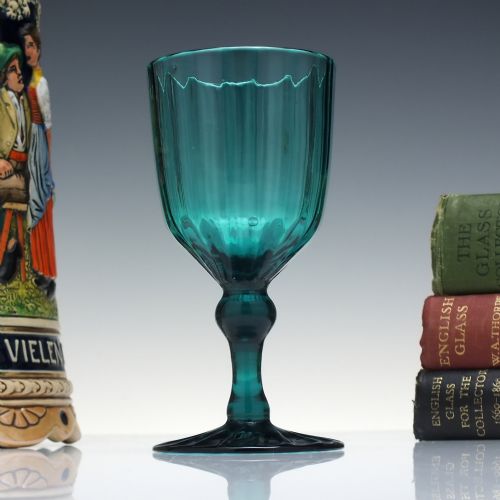


Green Stemmed Wine Glass
These green stemmed wine glass pieces bring rich colour and historic character to the table, offering a vibrant alternative to plain crystal.
Green Stemmed Wine Glass
A green stemmed wine glass search leads to historical drinking vessels spanning the Georgian, Victorian, and Edwardian eras. The selection ranges from robust roemers with hollow stems to delicate dessert wine glasses and tall goblets.
Most examples you encounter date from the nineteenth and early twentieth centuries, featuring distinct shades from pale green and aqua to deep emerald and turquoise. Sets of six appear frequently alongside pairs and individual statement goblets.
Origin points vary across England, Bohemia, and continental Europe, showing diverse regional tastes in table glass. Forms include traditional wine glasses, hock glasses, and liquor glasses.
How they were made
These items rely on blown glass and lead glass techniques, often shaped in rib moulds to create texture along the bowl or stem. Master glassmakers utilised metallic oxides in the batch to achieve the characteristic green and turquoise hues.
Decoration includes polychrome enamel work and applied gold leaf, particularly on pieces originating from Bohemian workshops. Skilled artisans also employed wheel-cutting methods to carve facets into the coloured glass.
Green Stemmed Wine Glass Retail Price Guide 2026
Typical asking prices for green stemmed wine glass among the pieces listed under this phrase on Sellingantiques today, from the lower quarter to the upper quarter. They describe what is for sale here now, not the wider market.
Some nineteenth-century drinkers apparently enjoyed their dessert wine through enough aqua tint to make the world look perpetually springlike.
What varies in quality
Quality rests upon the depth and clarity of the coloured glass and the precision of the form. Hand-blown pieces with balanced proportions and crisp rib moulding stand apart from heavier, unrefined examples.
The sophistication of the surface decoration dictates value, distinguishing simple tinted vessels from those adorned with detailed enamel florals and gilt accents. Intricate wheel-cutting also marks out superior craftsmanship.
Thereisenthal·Frits Hechert
The Green Stemmed Wine Glass Glossary
- Roemer
- A traditional Germanic drinking vessel featuring a large spherical bowl atop a cylindrical hollow stem studded with prunts. This form was widely produced in green glass across European glasshouses.
- Lead glass
- Glass containing lead oxide rather than calcium, producing a heavier weight and a brighter refractive index. It allows for deeper cutting and sharper detail.
- Rib mould
- A tool used in glassblowing to impress vertical or spiral ribs into the molten gather before expansion. It adds both structural rigidity and visual texture to the finished piece.
- Enamel
- Opaque vitreous paint fused to the glass surface through firing. It permits colourful floral and geometric ornamentation on historical glassware.
Green Stemmed Wine Glass: Frequently Asked Questions
What are green stemmed wine glasses?
These are historical drinking vessels featuring coloured stems or entirely green glass bodies, produced across the Georgian, Victorian, and Edwardian periods. They were designed for serving various wines and cordials on formal dining tables.
Collectors prize them for their rich colour palette and traditional craftsmanship, which includes hand-blown forms and enamelled decoration from English and European makers.
How do I date an old wine glass?
Dating involves examining the manufacturing technique, pontil mark on the base, and stylistic traits of the period. Georgian pieces often display rough pontil scars and heavier lead metal, while Victorian and Edwardian examples show greater uniformity.
Comparing the shade of the green glass and the presence of enamel or cut decoration also helps place the piece within its specific decade.
Can I use antique wine glasses?
Many people choose to use these historical glasses for special occasions, treating them with careful hand washing. The sturdy lead glass and robust roemer forms remain structurally sound for gentle dining use.
Avoiding extreme temperature changes prevents thermal shock to the old glass material, preserving both the vessel and any delicate enamel work.
What is a roemer glass?
A roemer is a historical continental goblet style defined by a large rounded bowl and a wide, hollow stem decorated with applied prunts. These glasses were traditionally made in green forest glass for serving Rhine wines.
Their distinctive shape provides a secure grip and showcases the deep green tones characteristic of traditional European glasshouse production.