


Green Patterned Settee
A green patterned settee brings rich English country house character into a room, offering deep seating wrapped in historic textiles.

Green Patterned Settee
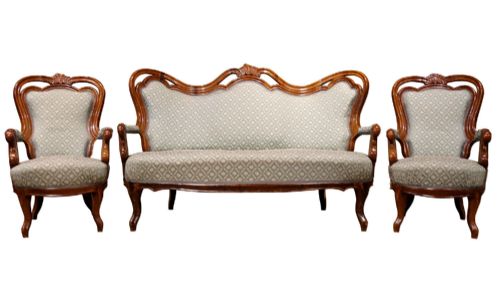
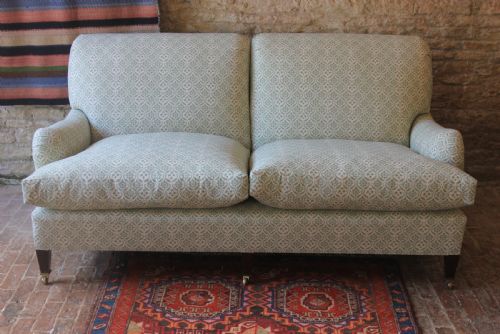
When you search for a green patterned settee, you are looking at upholstered seating spanning the eighteenth century through to later twentieth-century productions. These pieces encompass everything from grand Victorian mahogany framed settees and ornate Rococo Revival salon suites to relaxed Edwardian and later twentieth-century sofas.
The versions most commonly met on this page range from early twentieth-century pieces upholstered in Colefax and Fowler prints to substantial salon suites and library sofas. Makers such as Howard and Sons also appear, alongside English country house pieces that lean into traditional patterned textiles.
Forms vary from two-seater and three-seat sofas to extensive three-piece salon suites and lyre-shaped Regency designs. Periods represented stretch across George III, Regency, Victorian, Edwardian, and Queen Anne styles, offering considerable variety in silhouette and scale.
Materials and construction
Frames are constructed from sturdy timbers including mahogany, walnut, and general wood, providing the structural skeleton for these substantial seats. Decorative elements often incorporate brass details, while woodwork reflects cabinet-making traditions from the eighteenth century onwards.
Upholstery relies on textiles, fabric, and tapestry fabric to deliver both pattern and texture. Covering materials range from historic printed cottons by houses like Colefax and Fowler to heavy tapestries, fixed over traditional sprung or stuffed seat foundations.
Listings span periods from the eighteenth century up to the late twentieth century, utilising walnut, mahogany, and brass.
Judging quality in historic seating
Quality rests primarily in the integrity of the timber frame and the authenticity of its period construction. Pieces with substantial mahogany or walnut framing show superior joinery compared to simpler timber carcasses.
The sophistication of the upholstery textiles also dictates standing, with specialist printed fabrics and heavy tapestry weaves marking out finer productions. Retaining original maker attribution, particularly from workshops such as Howard and Sons, elevates a piece significantly.
Howard and sons
The Green Patterned Settee Glossary
- Salon suite
- A matching set of upholstered seating comprising a settee and matching chairs designed for formal reception rooms. These suites often share identical wood framing and upholstery patterns.
- Library sofa
- A traditional upholstered seating form intended for reading rooms, characterised by supportive arms and deep proportions. They frequently appear in Regency or later revival styles.
- Tapestry fabric
- A heavy, thick textile woven with pictorial or geometric patterns on a loom, commonly used for durable historic upholstery. It adds both weight and intricate surface design to a settee.
- Lyre-shaped
- A decorative furniture motif shaped like an ancient Greek lyre, frequently seen in the arm supports or framing of Regency designs. This classical scrollwork defines the silhouette of the piece.
- Queen Anne style
- A furniture design movement originating in the early eighteenth century, noted for graceful cabriole legs and understated curved lines. Later revivals continued to employ these distinctive proportions.
Green Patterned Settee: Frequently Asked Questions
What is a green patterned settee?
A green patterned settee is an upholstered sofa or salon seat featuring textile coverings in shades of green, often adorned with traditional prints or woven designs. These pieces span multiple centuries of British and continental furniture making.
They serve as both functional seating and strong decorative focal points, reflecting periods from George III to the mid-twentieth century.
How do I date an antique settee?
Dating relies on examining the timber frame, upholstery style, and construction methods used beneath the fabric. Cabinet-making details, such as mahogany or walnut framing, typically point to specific stylistic eras like Victorian or Regency.
Comparing the silhouette and foot design against established furniture periods helps narrow down the decade of manufacture.
Are these settees comfortable for daily use?
Most historic settees offer generous proportions and deep seating designed for relaxed living spaces. Their comfort depends on the internal springing and padding used during their original creation or subsequent reupholstery.
Pieces originating from the twentieth century often provide a softer sit closer to modern expectations, while older examples may feel firmer.
Where should I place a salon suite?
A salon suite works best in a spacious drawing room, formal sitting room, or large hallway where multiple matching seats can be arranged together. Their unified upholstery and timber frames create a cohesive visual impact in larger interiors.
Placing them away from direct sunlight helps protect delicate textile patterns and natural wood finishes from fading.