



Victorian Conversation Seat
A Victorian conversation seat brings people face to face for proper talk, shaped so that sitters curve around one another.
Victorian Conversation Seat
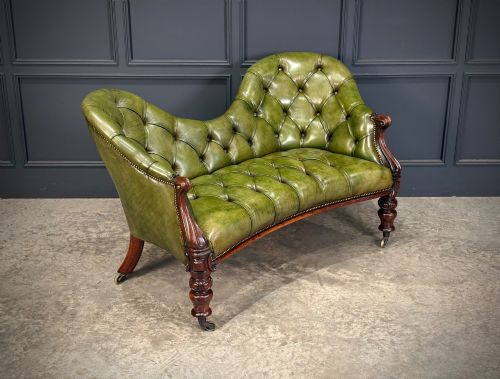
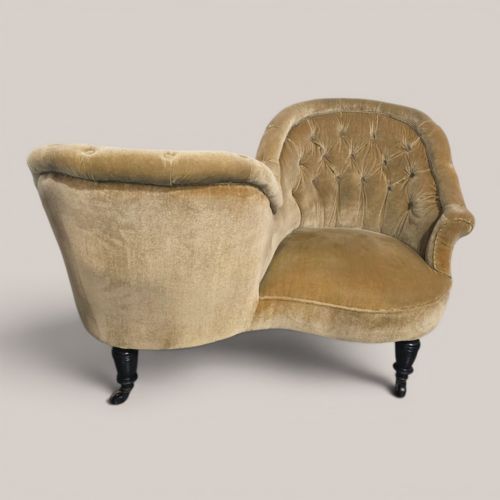
A Victorian conversation seat is a multi-person settee designed specifically for social discourse without awkward turning or craning of the neck. The pieces seen here span the nineteenth century, including Early Victorian examples, later variants up to nineteen hundred, and distinct revivals.
The most common form is a padded circular or figure-eight frame allowing three or four sitters to face outwards in opposite directions. Variations include double-end settees, love seats, and more unusual configurations such as ebonised frames or Moorish Islamic designs.
Makers shaped these for drawing rooms and large country house interiors where polite society gathered to converse in comfort. Walnut and rosewood dominate the structural woods, paired with generous upholstery intended for extended sitting.
Materials and construction
Frames rely on dense timbers like walnut, rosewood, and mahogany, chosen for strength when supporting complex curved shapes and carved details. Joinery often incorporates shaped back rails and barley twist supports.
Upholstery defines the character of the piece, utilising deep buttoning, leather, velvet, and various fabrics stretched over sprung foundations. Woodwork frequently shows hand-carved ornamentation, showwood showpieces, and occasional ebonised finishes.
Victorian Conversation Seat Retail Price Guide 2026
Typical asking prices for victorian conversation seat among the pieces listed under this phrase on Sellingantiques today, from the lower quarter to the upper quarter. They describe what is for sale here now, not the wider market.
Styles span from Early Victorian and Rococo Revival through to Moorish Islamic interpretations.
Assessing quality and finish
The sophistication of the timber carving sets superior examples apart, particularly where walnut or rosewood shows crisp execution on shaped backs and frames. Well-defined upholstery work, such as precise deep buttoning and quality leather or velvet, elevates the piece.
Structural complexity also dictates worth, distinguishing standard double-end settees from elaborate multi-seat conversation sofas or those with revolving tub armchairs and unusual stylistic revivals.
The Victorian Conversation Seat Glossary
- Conversation seat
- A multi-person upholstered seating form designed so sitters face outward in different directions. These pieces facilitate social interaction while maintaining polite distance.
- Love seat
- A compact two-seater settee often grouped alongside larger conversation furniture. They share the intimate scale and upholstery style of standard conversation seats.
- Spoon-back
- A padded chair or sofa back carved in the concave contour of a spoon. This nineteenth-century shape provides ergonomic support for the spine.
- Buttoned
- An upholstery technique where indentations are formed by pulling twine through the padding and securing it with buttons. This creates a tufted surface that keeps stuffing evenly distributed.
- Barley twist
- A decorative turning technique resembling a twisted rope. It appears frequently on the structural wooden legs and supports of Victorian seating.
Victorian Conversation Seat: Frequently Asked Questions
How were conversation seats used?
These seats sat in the middle of large drawing rooms or parlours rather than against walls. They allowed multiple guests to converse comfortably without having to turn their chairs around.
The layout naturally broke larger groups into smaller circles for polite discussion during evening receptions and social calls.
What is a double end settee?
A double end settee is an elongated sofa form featuring raised backs or scrolled ends at both sides. It permits sitters to recline or sit facing opposite directions.
This variant offers a more traditional linear profile while retaining the social flexibility of standard conversation furniture.
How do I spot an early piece?
Early examples often display dense rosewood frames, restrained carving, and proportions typical of the mid-nineteenth century. They tend to lack the heavier ebonising or eclectic revival influences seen later.
Inspect the timber choice and the style of the showwood frame to gauge where the piece sits within the Victorian timeline.
Will a conversation seat fit a modern room?
Circular conversation seats require open floor space since they are meant to be viewed and accessed from all sides. Measuring your room carefully ensures the piece does not crowd walkways.
Placed centrally in a living space, they make a striking focal point that functions much as it did in a nineteenth-century interior.