



Green Marble Console
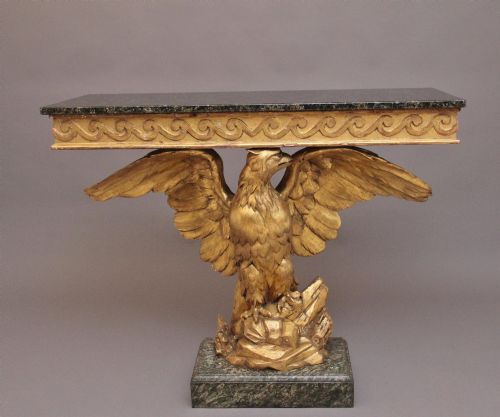
A green marble console brings a heavy, polished slab of mineral into a room on a carved and gilded frame.
Green Marble Console
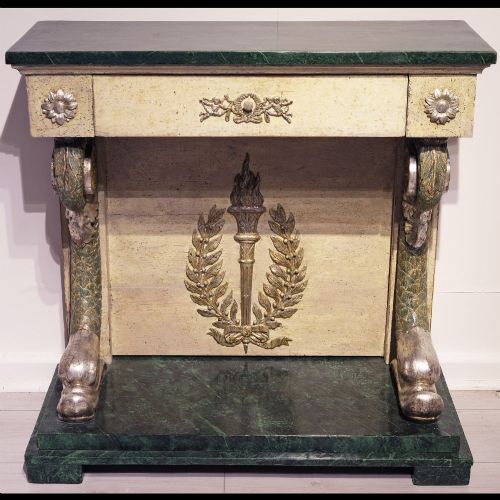
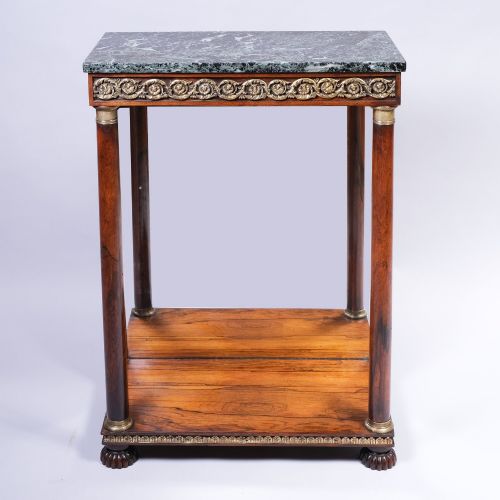
A green marble console sits flat against a wall or stands central to a room, carrying a heavy stone top over a carved wooden frame. When you search for a green marble console, you encounter forms ranging from severe eighteenth-century neoclassical tables to gilded Italian revivals and painted Edwardian pieces.
The heavy stone slab defines the surface, usually supported by console tables, side cabinets, or centre tables with carved legs. Most examples on this page date from the eighteenth century through to the early twentieth century, drawing on French, Italian, and English design traditions.
Materials and construction
Carvers shaped frames from timber such as mahogany, oak, walnut, and rosewood, applying gesso and layers of gold leaf or paint to the wood. Joinery relied on traditional methods to bear the considerable weight of the stone above.
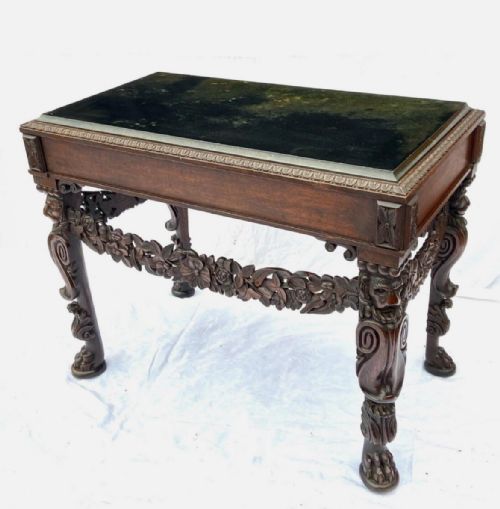
Masons cut and polished the marble tops into rectangular, serpentine, or demi-lune shapes to fit the wooden bases precisely. Artisans added decorative brass mounts, carved lion masks, or gilded gesso details to finish the framework.
The listings span from the eighteenth century to the early twentieth century, featuring materials such as marble, giltwood, mahogany, and gesso.
Quality variations
The crispness of the hand-carving on the wooden frame separates ambitious workshop production from simpler output. Deeply undercut foliage, sharp gilding, and well-proportioned paw feet or cabriole legs show superior craftsmanship.
The quality of the stone surface matters greatly, particularly whether the marble is an integral early part of the piece or a later replacement. Dense, richly figured green mineral slabs with smooth, bevelled edges elevate the status of the entire table.
The Green Marble Console Glossary
- Console
- A table designed to stand against a wall, traditionally supported by brackets or scroll legs rather than four independent vertical posts. Many examples rely on wall fixings for stability due to their heavy stone tops.
- Giltwood
- Timber coated with a thin layer of gold leaf over a prepared gesso ground. This finish catches the light and defines the carved ornamentation of formal furniture.
- Serpentine
- A curved line that bends outward in the centre and inward at the sides, creating a flowing undulating front edge. This shape appears frequently on eighteenth and nineteenth-century Italian and French tables.
- Demi-lune
- A half-moon shape with a flat back designed to sit flush against a wall. It is a common format for side tables and cabinets carrying heavy stone tops.
Green Marble Console: Frequently Asked Questions
Are green marble console tables heavy?
The dense stone slab creates significant weight at the top of the structure. Most of these tables rely on solid timber frames and sometimes require wall anchoring to remain stable.
Moving or positioning them requires two people to lift the marble separately from the wooden base where possible.
How do I care for the marble top?
The polished mineral surface requires gentle cleaning with a damp cloth and mild soap. Acidic liquids like wine or citrus can etch the polish if left on the stone.
Applying a specialist stone wax helps protect the surface from marks and maintains the deep green lustre.
Were these tables made to stand against walls?
Traditional console tables were engineered specifically to stand flat against a wall, often featuring unfinishing back edges or iron wall ties. Centre tables, by contrast, are finished on all four sides for placement in the middle of a room.
Checking the back edge of the frame reveals whether the piece was designed for perimeter display or central placement.
How do I tell an 18th century table from a later revival?
Early pieces show tool marks from hand-chiselling on the timber framing and distinct wear patterns on the gilding or paint. Revival pieces from the late nineteenth and early twentieth centuries often display more uniform machine sawing and crisper, less worn gesso.
Examining the underside of the top and the joint construction provides clear evidence of the manufacturing period.