






Green Man Carved Desk
A green man carved desk brings heavy nineteenth century oak and foliate foliage straight into a study.
Green Man Carved Desk
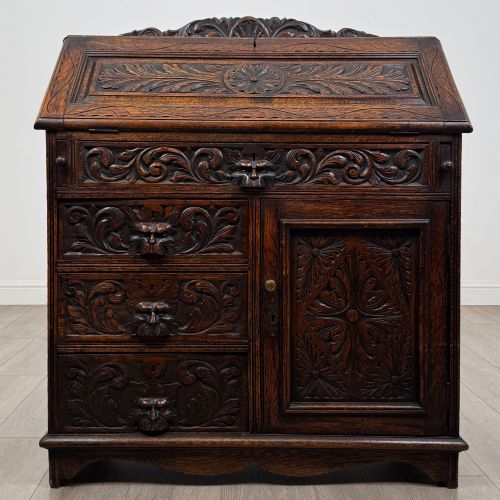
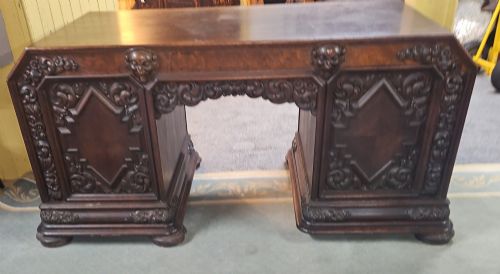
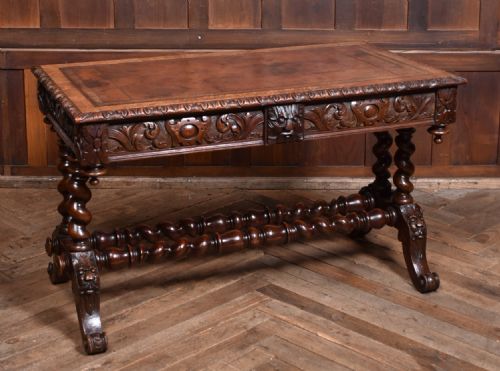
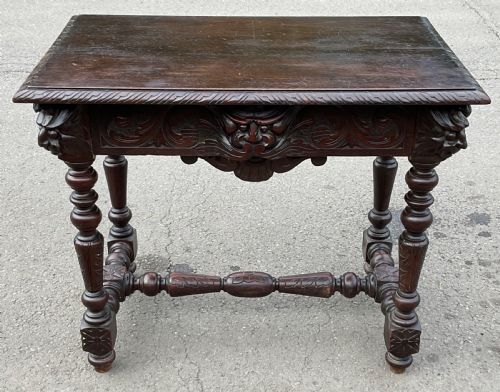
A green man carved desk is a nineteenth century writing surface defined by the foliate mask carved into its timber. These pieces emerge chiefly during the Victorian period, manifesting as pedestal desks, writing tables, and bureaux constructed predominantly in oak. The most common iteration met here is the twin pedestal desk, where deep relief carvings of leafy faces peer from drawers and cupboard doors.
Makers and cabinet makers of the era drew heavily on Gothic Revival and Jacobean styles to frame the mask motif. Alongside grand partners desks, smaller Davenport desks and slope-front bureaux appear in the record. The integration of brass hardware and leather inserts completes the standard arrangement of these nineteenth century workspace pieces.
Assessing quality and execution
The choice of timber and the structural integrity of pedestals, drawers, and writing surfaces determine the standing of a piece. Finer desks combine robust oak construction with well-executed secondary details such as brass handles and secondary wood framing.
Listings show these desks appearing almost exclusively in oak, paired with styles ranging from plain Victorian to ornate Gothic Revival.
Edwards and Roberts
The Green Man Carved Desk Glossary
- Green man
- A sculptural mask of a human face sprouting foliage from the mouth or hair. This ancient architectural motif found widespread favour on Victorian Gothic Revival furniture.
- Pedestal desk
- A heavy freestanding writing table supported by two banks of drawers. These units form the structural backbone of large nineteenth century studies.
- Partners desk
- A large double-sided writing table designed for two people to work opposite each other. They frequently incorporate cupboards and drawers on both faces.
- Bureau
- A sloping desk with a hinged writing flap that conceals small compartments and pigeonholes. Victorian iterations often feature carved oak facades.
- Gothic Revival
- An architectural and decorative style drawing inspiration from medieval design. It manifests in pointed arches, heavy tracery, and carved foliage.
Green Man Carved Desk: Frequently Asked Questions
What is a green man carved desk?
A green man carved desk is a nineteenth century writing table decorated with a foliate mask motif.
These pieces typically date to the Victorian era and use solid oak as their primary material.
How do I date a green man desk?
Dating relies on stylistic clues and construction methods pointing to the nineteenth century, particularly the Victorian period.
Revival styles such as Gothic and Jacobean dominate the archive records for these items.
What materials are used in these desks?
Solid oak serves as the main structural and decorative timber across the listings.
Additional materials include brass hardware, leather writing inserts, and occasional mahogany.
Are these desks suitable for daily use?
Many examples function well as heavy study desks or writing tables in modern settings.
Pedestal and partners configurations offer substantial storage capacity within their drawer banks.