


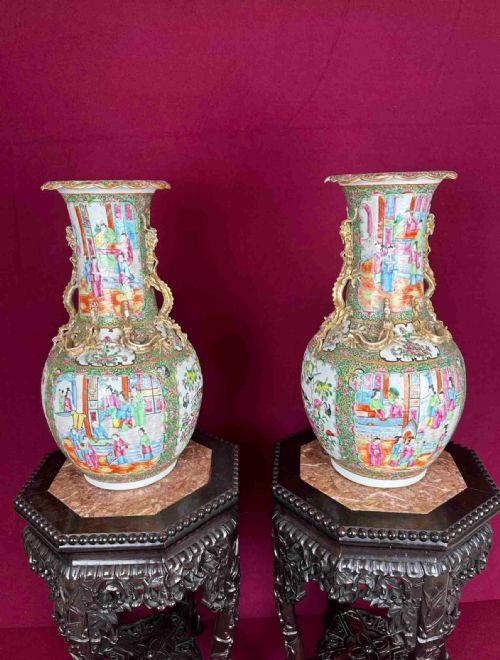


Green Enamel Urns
Green enamel urns bring rich nineteenth-century colour and metalwork into a room, offering striking decorative presence for any mantel or side table.
Green Enamel Urns
When you search for green enamel urns, you encounter a selection of nineteenth-century decorative vessels, jars and vases from European and Asian workshops. These pieces span the Regency, Victorian, Meiji and Qing periods, showing diverse cultural traditions in metalwork and ceramics.
The objects most frequently met on this page include large cloisonné palace vases, champlevé enamel centrepieces and earthenware or porcelain jars. Many incorporate rich green tones alongside bronze, gold leaf, brass or glass elements.
The forms range from monumental temple water dispensers to balanced pairs of baluster vases and shaped decorative vessels. Each piece reflects the distinct aesthetic priorities of its nineteenth-century origin, whether French, Chinese or Japanese.
How They Were Made
The creation of these pieces relies on combining vitreous enamel with metal bases such as copper, brass or gilt bronze. Techniques like cloisonné and champlevé involve soldering delicate metal wires or carving cells to hold coloured enamel pastes before firing.
Porcelain and earthenware versions utilise hand-painted glazes, often incorporating famille rose, famille verte or doucai palettes alongside gold leaf details. Glass variants employ overlay methods and applied portraits to achieve their finished appearance.
Several dragon motifs appear alongside mythical Ho-o birds, guarding nineteenth-century vessels made for temples and palaces.
What Varies in Quality
Quality in these vessels rests upon the precision of the metal wirework, the consistency of the enamel surface, and the clarity of the hand-painted details. Finer examples display meticulous control in their multi-fired enamels and sharply cast or chased bronze and brass mounts.
The overall proportion, the balance of the decorative motifs such as dragons or phoenixes, and the preservation of the original gilding distinguish superior works from standard production pieces.
Flight Barr and Barr
The Green Enamel Urns Glossary
- Cloisonné
- A metalwork technique where fine wires are soldered to a base to form compartments filled with enamel paste. This method creates intricate patterns defined by delicate metal lines.
- Champlevé
- A technique where troughs or cells are hollowed out of a metal surface and filled with enamel before firing. The surrounding metal remains visible as part of the design.
- Garniture
- A set of matching vases or urns designed to be displayed together on a mantelpiece or sideboard. These matched groups are characteristic of nineteenth-century interior decoration.
- Baluster
- A vase shape with a rounded lower body that tapers towards the neck, resembling an architectural column. This form provides a stable base for detailed surface ornamentation.
- Totai Shippo
- Japanese wire-free cloisonné where enamel is applied directly to a ceramic, glass or porcelain body. This technique produces distinct textures without visible cell walls.
Green Enamel Urns: Frequently Asked Questions
What are green enamel urns?
These pieces are nineteenth-century decorative vessels, jars and vases created across European and Asian workshops. They incorporate vitreous enamel, porcelain and metalwork to serve as ornamental focal points.
Examples range from French champlevé centrepieces to large Japanese cloisonné palace vases and Chinese baluster jars.
How were these urns used?
Nineteenth-century households displayed these vessels on mantelpieces, side tables and pedestals as symbols of wealth and artistic taste. Many formed part of larger garniture sets or served as centrepieces for formal rooms.
Some large examples functioned as temple water dispensers or palace ornaments rather than domestic flower holders.
How do I live with them?
Place these vessels on sturdy surfaces away from direct sunlight and high humidity to protect the enamel and gilding. Their strong green tones and metallic details anchor a room when paired with neutral backgrounds.
Keep them away from busy patterns to let the detailed wirework and hand-painted motifs stand out clearly.
How do I tell periods apart?
European pieces from the Regency and Victorian eras often utilise gilt bronze, green onyx and Bohemian glass alongside champlevé techniques. Asian pieces from the Meiji and Qing periods frequently feature intricate cloisonné, Totai Shippo, or famille rose porcelain.
Stylistic motifs such as dragons, phoenixes, and topographical scenes help connect individual items to their specific nineteenth-century origins.