


Grand Tour Watercolour
A grand tour watercolour brings the architecture and sunlight of nineteenth-century Italy straight into your room.
Grand tour watercolour
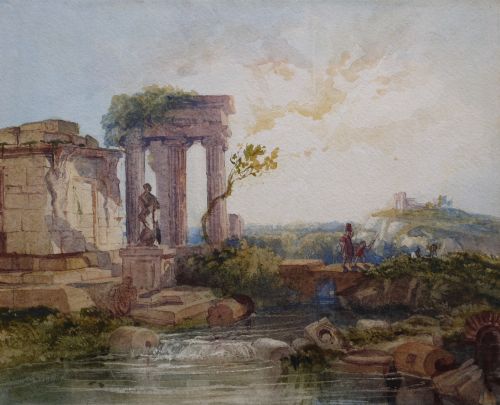
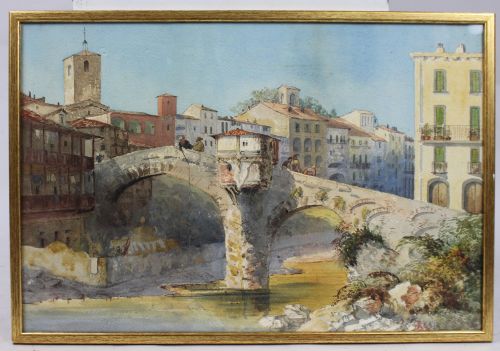
These works record the classical ruins, sun-bleached arches and Italian vistas that nineteenth-century travellers crossed Europe to witness. You will most frequently encounter nineteenth-century pieces, including specific views around Rome and Tivoli executed by named artists and anonymous hands alike.
The subjects range from the Spanish Steps and the Roman Campagna to oriental palaces and Italian landscapes. They capture the romantic fascination with classical antiquity that defined the period.
Compositions appear in various states, from highly finished signed paintings to rapid grisaille sketches. Framed Italian views form the core of what turns up here, offering a direct window into nineteenth-century travel.
Materials and technique
Artists worked watercolour pigments onto paper, often employing delicate washes to capture the intense southern light and atmospheric ruins. Some sheets remain unframed, while others are presented behind glass in wood and gilt or gold leaf frames.
Techniques vary from detailed architectural representation to loose sketching in grisaille. The interaction of pigment and paper gives these nineteenth-century sheets their characteristic luminous quality.
Retail Price Guide 2026
Typical UK retail prices for grand tour watercolour, calculated from the Sellingantiques database of over a million retail prices indexed since 2003. This retail price guide relies exclusively on Sellingantiques data; no external sources or auction records are used, so the figures do not describe the wider market.
Listings feature paper, glass, wood, gold leaf and watercolour pigments across nineteenth-century styles including Victorian Classical and Orientalism.
Evaluating quality
The distinction between ordinary and exceptional pieces lies in the sureness of the brushwork and the precision of the perspective. Master hands like Franz Knebel or Richard Principal Leitch achieve a depth of light and topographical accuracy that lesser or anonymous sketches simply miss.
Condition and presentation also set the better examples apart. Works with strong, stable pigment, clear signatures and period framing carry greater visual authority than faded, unsigned sheets.
Richard Principal Leitch·Franz Knebel·Ettore Ascenzi·William Crouch
The Grand Tour Watercolour Glossary
- Grisaille
- A painting executed entirely in shades of grey or neutral monochrome. This technique was frequently used for preparatory sketches and classical studies during the nineteenth century.
- Campagna
- The countryside surrounding Rome, dotted with ancient ruins and aqueducts. It remains one of the most recurring subjects in nineteenth-century Italian watercolours.
- Gilt
- A thin layer of gold applied to wood framing. It provides the traditional nineteenth-century setting for works on paper.
- Provenance
- The documented history of a painting's ownership. Signatures and dates on the mount or reverse help anchor these works to specific artists.
Frequently Asked Questions
What is a grand tour watercolour?
These are nineteenth-century paintings depicting Italian landscapes, classical ruins and architectural monuments. Travellers bought them abroad as visual records of their European journeys.
They capture the scenery of Rome, Tivoli and the Campagna using watercolour pigments on paper.
How should I frame these paintings?
Keep watercolours behind glass to protect the pigment from dust and moisture. Traditional wood and gilt frames suit the nineteenth-century aesthetic of these pieces.
Ensure conservation-grade mounts prevent the paper from touching the glass directly.
Are these watercolours signed?
Some sheets bear signatures and dates from artists such as Franz Knebel or Ettore Ascenzi. Others remain entirely anonymous.
Unsigned works were often produced in quantity for the nineteenth-century travel market without losing their decorative appeal.
Where were these subjects painted?
Artists focused heavily on iconic Italian locations, including the Spanish Steps and the Roman Campagna. Some pieces also explore orientalist themes and palace architecture.
Every scene reflects the visual vocabulary of the nineteenth-century traveller.