
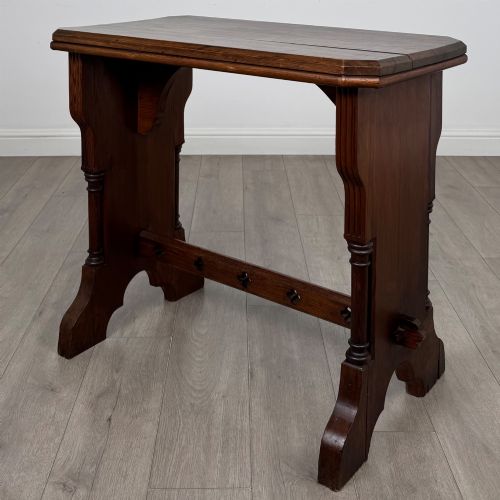
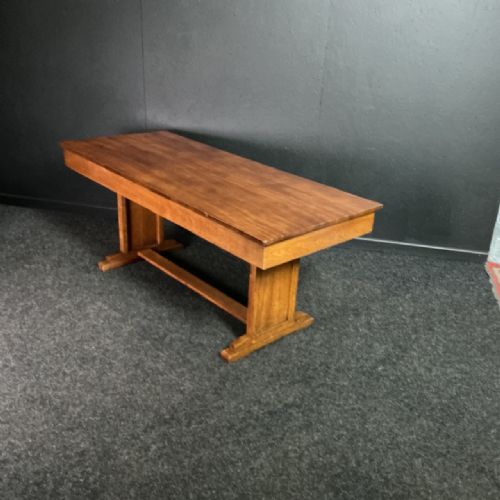


Gothic Revival Trestle Table
A gothic revival trestle table brings medieval character to an interior through robust framing and ecclesiastical woods.

Gothic Revival Trestle Table
A gothic revival trestle table draws on medieval architecture and monastic refectories, appearing across the nineteenth century into the early twentieth century. Buyers seeking this phrase encounter dining tables, refectory pieces, writing desks, and side tables in forms designed for public and domestic spaces.
The materials and styles span Victorian interpretations, Arts and Crafts workshops, and Flemish Renaissance revival pieces. Pieces range from substantial kitchen and monastery dining tables to narrow hall and console formats.
Materials and construction
Construction relies heavily on solid oak, pitch pine, and walnut, frequently joined with exposed pegged joints and substantial underframes. Secondary materials include mahogany, ebonised wood, hardwood, iron hardware, and occasional leather inserts.
Makers utilised heavy timber planks for tops, supported by trestle ends, X-frame stretchers, and gothic underframes. Carved details incorporate green man motifs, tracery, and architectural mouldings executed in the manner of notable designers.
Listings feature oak and pitch pine almost exclusively, alongside walnut and mahogany across nineteenth and early twentieth century dates.
Distinctions in standard
Quality separates through the integrity of the timber selection and the depth of architectural carving. Pieces showing hand-planed surfaces, dense grain in the oak or pitch pine, and robust structural joinery stand apart from simpler utility items.
The sophistication of the design dictates value, with bespoke workshop pieces displaying considered proportions and period-appropriate hardware rather than plain commercial assembly.
AW Pugin·Charles Bevan·Sir Robert Lorimer·Gillows
The Gothic Revival Trestle Table Glossary
- Trestle table
- A table consisting of two or more supports carrying a horizontal top. This form allows maximum legroom along the length of the surface.
- Refectory table
- A long, narrow dining table traditionally used in monastic dining halls. These pieces form a significant portion of the heavier surviving inventory.
- Pitch pine
- A resinous pine timber valued for its distinct grain pattern and durability. It frequently appears in Victorian ecclesiastical and domestic furniture.
- Green man
- A sculptural motif consisting of a face carved from or entwined with leaves and vines. It recurs on nineteenth-century carved oak panels and furniture.
Gothic Revival Trestle Table: Frequently Asked Questions
What woods are used for these tables?
Oak and pitch pine predominate across the selection, providing the heavy framing required for the style. Walnut and mahogany also appear in specific nineteenth-century library and writing tables.
Secondary woods and iron bracing appear in structural underframes to support the substantial weight of the timber tops.
How do I date a gothic table?
Dating relies on timber preparation marks, construction methods, and stylistic cues from the Victorian period through the Arts and Crafts movement. Early pieces often feature hand-planed surfaces and pegged joinery.
Later twentieth-century examples integrate cleaner lines while retaining the historical underframe architecture.
Where were these tables used?
Original placements included public school libraries, ecclesiastical settings, monasteries, and large country houses. Domestic variations served as kitchen, hall, and dining room furnishings.
Narrower formats functioned as writing desks, console tables, and side tables in reception rooms.
Are these tables suitable for daily dining?
The robust construction and solid timber tops make them durable for regular use in contemporary kitchens and dining rooms. Trestle ends provide stability across long seating configurations.
Care should be taken to protect antique wood finishes from excessive moisture and heat.