
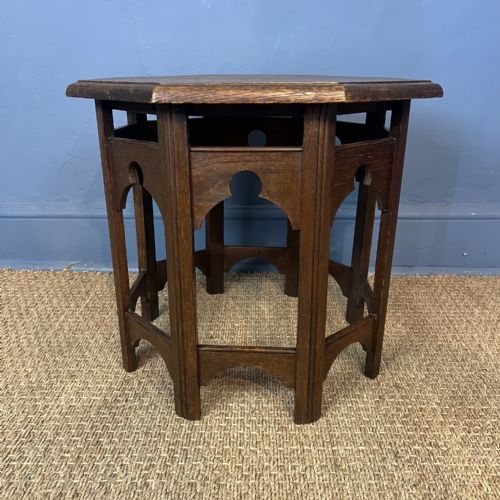


Gothic Arch Side Table
These gothic arch side table pieces bring ecclesiastical timberwork into domestic rooms, offering pointed forms and sturdy joins that anchor a period interior.

Gothic Arch Side Table
When you search for a gothic arch side table, you are looking at small tables and occasional stands that borrow architectural motifs from medieval stone windows and church furnishings. The examples seen here range from hexagonal tables and octagonal stands to low stools and library pieces, built to serve domestic spaces while retaining pointed arches and traceried framing.
The versions you are most likely to meet on this page span the Victorian and Edwardian eras, with oak and mahogany providing the primary timber foundations. Makers worked within Gothic Revival, Arts and Crafts, Gothic Reform, and Victorian Gothic styles, producing occasional furniture that functions as a side table, lamp table, or hall stand.
How they were made
Cabinet makers constructed these pieces primarily from solid oak and mahogany, occasionally employing flame mahogany veneer for decorative surface grain on top panels. Pitch pine also appears in utility and ecclesiastical contexts, offering a paler, resinous alternative to denser hardwoods.
Joinery relied on traditional framing techniques to support the heavy geometric loads demanded by pointed arches and underframes. Tables incorporate chamfered edges, pegged joints, and carved architectural details directly into the structural timber rather than applying superficial ornamentation.
Several pieces owe their existence directly to the Victorian enthusiasm for turning domestic hallways into miniature cathedrals.
What varies in quality
The distinction between a standard utility piece and a finer workshop production lies in the depth of the carving and the precision of the architectural joinery. Tables featuring sharply defined cusps, pierced tracery, and well-balanced proportions demonstrate a higher level of cabinet making than plain versions with painted or stuck-on motifs.
Timber selection dictates the visual weight and longevity of the object, with dense quarter-sawn oak and figured mahogany holding an edge and polish far better than softer secondary woods. The integration of the gothic underframe into the primary leg structure separates disciplined period design from later, looser adaptations.
The Gothic Arch Side Table Glossary
- Gothic Revival
- A design movement drawing inspiration from medieval architecture, particularly pointed arches, rose windows, and ribbed vaulting. It gained prominence in architecture and furniture during the nineteenth century.
- Tracery
- Openwork stonework or woodwork ornamentation, typically consisting of interlocking ribs that form geometric patterns in windows and paneling. In furniture, it defines the pierced arches beneath table tops.
- Underframe
- The structural arrangement of stretchers and rails connecting the legs beneath a table top. In these pieces, it frequently incorporates pointed arches and ecclesiastical bracing.
- Quarter-sawn
- A method of milling logs radially to produce timber with straight growth lines and enhanced dimensional stability. This cut reveals attractive medullary rays in oak.
Gothic Arch Side Table: Frequently Asked Questions
What is a gothic arch side table?
A small occasional table incorporating pointed arches, traceried panels, and architectural motifs derived from medieval buildings. These pieces were adapted from church furnishings and larger library tables for domestic use.
They function as lamp tables, hall stands, or bedside surfaces while introducing strong vertical lines and dark timbers to a room.
How do I date a gothic table?
Dating relies on identifying timber species, construction methods, and stylistic movements such as Gothic Reform or Arts and Crafts. Mid-nineteenth-century examples often display heavy mahogany or pitch pine with deep ecclesiastical carvings, whereas later pieces show simpler oak framing.
Examining the underside and joinery reveals whether pegs, machine-cut screws, or hand-cut dovetails were utilised during construction.
Are these tables sturdy enough for daily use?
Most of these pieces were built from dense hardwoods like oak and mahogany to withstand heavy church or domestic service. Their robust underframes and pegged joints provide exceptional stability for everyday placement.
Care should be taken with veneered surfaces and protruding carved arches when moving them across uneven floors.
How do I style one at home?
These tables pair well with neutral walls, leather upholstery, and antique brass accessories that complement their dark timber tones. Their architectural presence allows them to stand alone in a hallway or anchor a seating group as a lamp table.
Avoid overcrowding the top surface so the carved tracery and wood grain remain visible.