

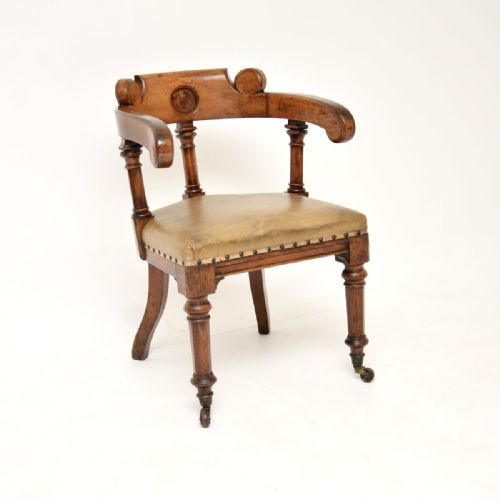


Gothic Revival Office Chair
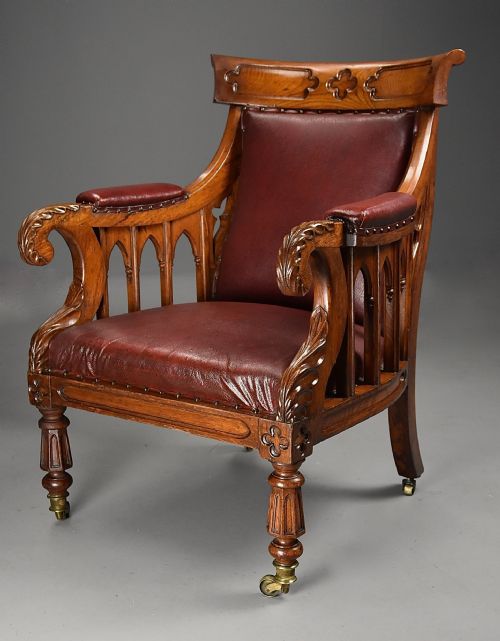
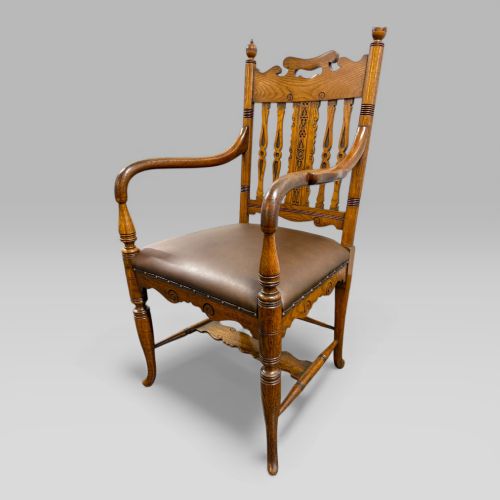
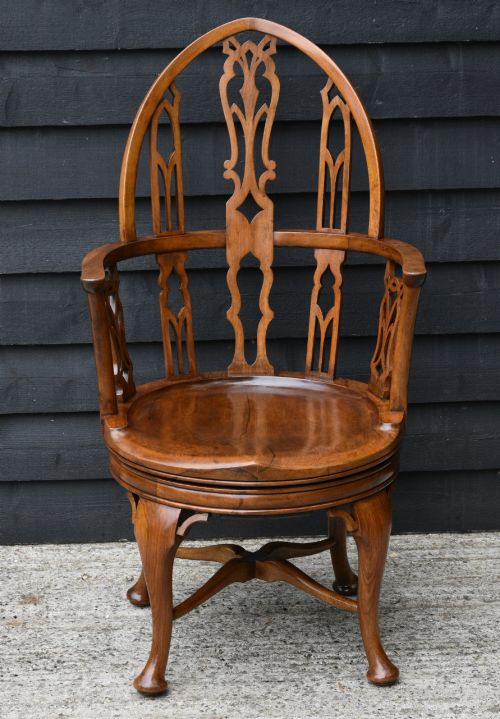
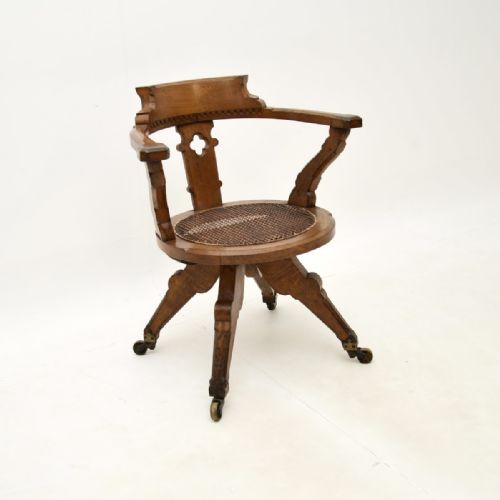
These heavy oak gothic revival office chair examples bring serious architectural presence to a workspace through pointed arches and sturdy construction.
Gothic Revival Office Chair
A gothic revival office chair combines ecclesiastical architecture with nineteenth-century workspace utility, offering heavy timber construction and imposing vertical lines. These seating pieces serve as functional deskside furniture while displaying distinct medieval motifs such as trefoils and pointed arches.
Most examples found here date from the Victorian period, specifically emerging across the later decades of the nineteenth century. Makers adapted traditional church architecture into practical seating for libraries and private studies.
The forms divide primarily between standard desk chairs, swivel mechanisms, and revolving armchairs. Oak remains the predominant timber used to construct these substantial items.
How they were made
Cabinet makers utilised solid oak and golden oak, often selecting timber with prominent grain to enhance the medieval aesthetic. Frames feature deep carving and robust joinery designed to withstand daily use in nineteenth-century offices.
Metal components such as brass and iron appear in swivel mechanisms and structural brackets, allowing these heavy chairs to rotate and tilt. Upholstery materials include leather, fabric, and cane inserted into supportive wooden frames.
Gothic Revival Office Chair Retail Price Guide 2026
Typical asking prices for gothic revival office chair among the pieces listed under this phrase on Sellingantiques today, from the lower quarter to the upper quarter. They describe what is for sale here now, not the wider market.
Listings demonstrate a strong preference for solid oak timber, frequently incorporating iron and brass hardware for nineteenth-century swivel desk chairs.
What varies in quality
The depth and crispness of the carving dictate the artistic merit of each piece, ranging from simple incised lines to heavily carved architectural tracery. Maker attribution also influences standing, particularly when associated with notable nineteenth-century design figures or respected cabinet makers.
Mechanical complexity separates standard desk chairs from fully rotating swivel versions fitted with functional iron and brass hardware. The choice of timber, such as selected golden oak or figured walnut, further distinguishes finer workshop output.
Gillows·Bruce James Talbert
The Gothic Revival Office Chair Glossary
- Gothic Revival
- An architectural and decorative style drawing inspiration from medieval design, featuring pointed arches, trefoils, and heavy vertical proportions. This movement heavily influenced nineteenth-century domestic furniture.
- Swivel mechanism
- The under-seat hardware allowing the chair to rotate fully on a central axis, often constructed from iron and brass. These rotating systems became increasingly common in late Victorian offices.
- Tracery
- Openwork ornamental stone or woodwork based on intersecting ribwork, commonly translated into carved chair backs. This architectural detail defines the visual style of these seating pieces.
- X-framed
- A structural furniture form where the base legs cross in an X shape to support the seat. This configuration provides distinct stability for heavy office seating.
- Puginesque
- A design style reflecting the architectural theories of Augustus Pugin, champion of the true Gothic revival. Pieces bearing this descriptor display strict adherence to medieval structural forms.
Gothic Revival Office Chair: Frequently Asked Questions
Are these chairs comfortable for daily work?
These pieces provide solid upright support suited for traditional desk work, though they lack the ergonomic adjustments of modern seating. Generous proportions and upholstered elements offer adequate comfort for study use.
Working with an antique timber chair requires balancing historical authenticity against modern seating preferences. Many users add a matching loose cushion to soften the heavy wooden seat.
How do I operate the swivel mechanism?
Nineteenth-century revolving chairs typically utilise a central wooden or iron threaded spindle that allows the upper seat to turn. Users should test the rotation gently to understand the specific mechanical limits of each antique screw system.
Applying appropriate lubrication to the metal iron and brass components helps preserve the rotating action. Avoid forcing any stuck swivel screw to prevent damage to the historic timber.
How do I date a Victorian desk chair?
Dating relies on examining the construction methods, timber selection, and specific stylistic crossover between Gothic revival and Aesthetic or Arts and Crafts movements. Pieces marked with dates or attributed to known makers offer clearer chronological placement.
Hardware components such as cast iron swivel brackets also provide clues to the manufacturing decade during the nineteenth century. Comparing carved motifs against known design catalogues helps refine the period.
Will an oak desk chair fit modern desks?
These nineteenth-century seats often feature fixed heights that may sit slightly lower or higher than standard contemporary office desks. Checking the clearance under the desk drawer is essential before placing the chair.
The generous arm proportions of certain library armchairs can also restrict how far the seat pushes under a modern desk surface. Measuring both the desk aperture and the chair arm height prevents placement issues.