
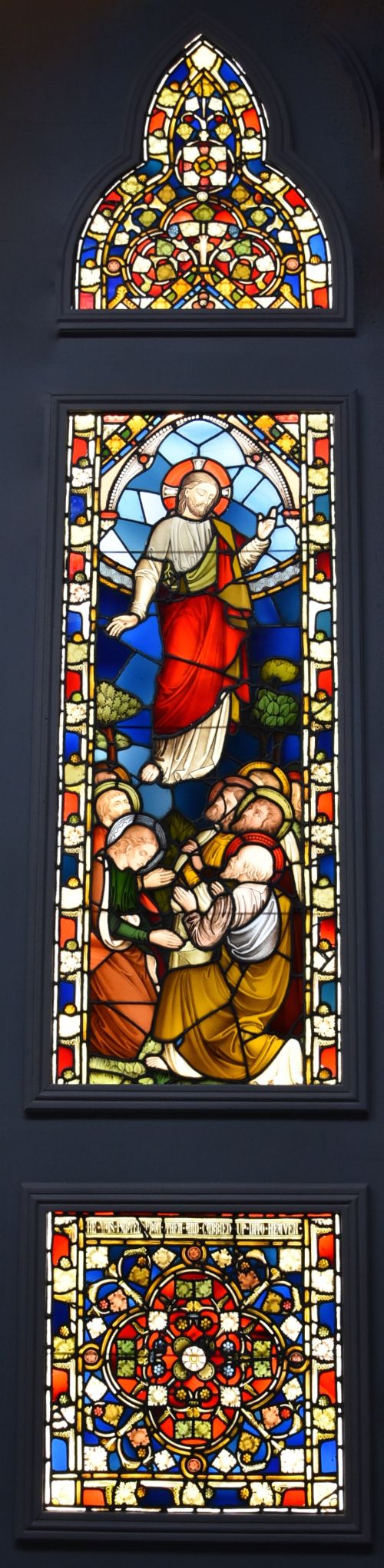


Gothic Revival Glass Panel
These gothic revival glass panel examples bring rich medieval motifs into nineteenth-century interiors through deep colour and leaded lines.
Gothic Revival Glass Panel
When you search for a gothic revival glass panel, you find pieces shaped by nineteenth-century romanticism and religious architecture. These works draw directly upon medieval church aesthetics, incorporating lancet arches, heraldic designs, and ecclesiastical figures.
The versions you meet on this page span from eighteen-fifty to nineteen-hundred, originating mostly within the Victorian period. They take the form of church windows, architectural salvage, and framed triptychs intended to capture light.
Alongside the primary stained and leaded glass panels, related architectural items like oak overmantel mirrors and secretaire bookcases occasionally appear. These domestic pieces integrate brass panels and timber frames to echo the heavy Gothic style.
How they were made
Maker workshops joined pieces of coloured glass using lead cames, soldering the joints to form complex figurative and geometric patterns. Hand painting with enamel added fine facial details, drapery folds, and heraldic crests before firing.
Wooden frames, particularly oak and timber, provided structural support for heavy architectural salvage and church windows. Brass and lead served as framing and structural elements in both cabinetry and hanging panels.
One medieval knight in armour stares out intently from a nineteen-hundred leaded window, faithfully keeping watch over the modern room.
What varies in quality
The integrity of the lead network and the preservation of the original glass dictate the enduring strength of the panel. Intact triptychs and large-scale compositions demonstrate greater original importance than fragmented domestic panes.
Sir Edward Burne-Jones
The Gothic Revival Glass Panel Glossary
- Lead came
- The grooved lead strips used to hold individual pieces of glass together in a window. This flexible metal forms the dark linear network characteristic of traditional stained glass.
- Triptych
- A picture or relief carving on three panels, hinged together side by side and folded open as an altarpiece or decorative screen. In glass, this describes a tripartite window composition.
- Pre-Raphaelite
- Associated with a group of nineteenth-century artists rejecting academic rules in favour of detailed, medieval Italian art. This style influences the romantic, expressive faces found in certain panels.
- Overmantel mirror
- A large looking glass designed to hang directly above a fireplace mantel. In this context, frames incorporate Gothic revival timber and architectural details.
- Stained glass
- Glass coloured by the addition of metallic salts during its manufacture, often painted and fired in a kiln afterwards. It transforms transmitted sunlight into rich interior hues.
Gothic Revival Glass Panel: Frequently Asked Questions
How were stained glass panels used originally?
These panels primarily filled the pointed arch windows of nineteenth-century churches and chapels to diffuse daylight and illustrate religious narratives. They created a solemn devotional atmosphere through rich colours and sacred imagery.
Over time, many ecclesiastical buildings were altered or demolished, leading to the removal of these windows for architectural salvage. Domestic interiors subsequently adopted smaller panels as decorative screens or wall-hung art.
How do I hang a heavy glass panel safely?
Large stained glass panels require robust metal brackets or chains anchored directly into structural wall studs to bear the significant weight. The fragile lead and glass structure must remain fully supported across its entire base rather than hanging from the top corners alone.
Consulting a professional installer ensures the frame distributes the load evenly without twisting the lead cames. Placing the panel in front of a light box or a well-lit window maintains its translucent effect indoors.
How do I distinguish Victorian Gothic from earlier work?
Victorian Gothic revival pieces from the mid-nineteenth century onwards often display industrial precision in their lead lines alongside romantic, Pre-Raphaelite artistic influences. They imitate medieval styles but carry the characteristic technical methods of nineteenth-century glass painting.
Examining the composition reveals whether the maker drew upon established nineteenth-century pattern books or older ecclesiastical traditions. The integration of oak framing and brass fittings also points firmly to the Victorian domestic revival.
Can these panels be cleaned without damage?
Dust accumulates on both sides of leaded glass over decades, requiring gentle surface cleaning with a soft, dry cloth. Avoid harsh chemical cleaners or abrasive pads that scratch the enamel paint or weaken aged lead cames.
Professional conservators should handle any panels with loose paint or buckling lead to prevent further deterioration. Regular inspection of the wooden or metal frames keeps the glass secure within its setting.