
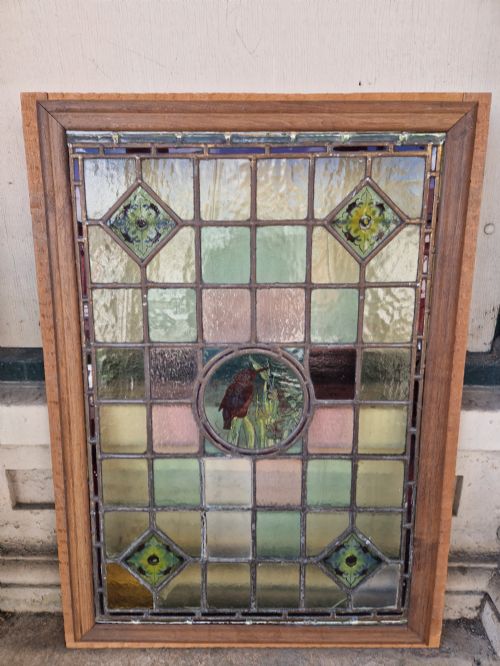


Antique Glass Window Hanging
These antique glass window hanging pieces are architectural salvage panels bringing rich colour and historic leaded craft into modern rooms.
Antique Glass Window Hanging
An antique glass window hanging brings historic architectural salvage into contemporary spaces, often taking the form of stained glass panels or framed windows. When you search for antique glass window hanging, you encounter pieces designed to be suspended in frames or hung against interior walls to catch the light.
The pieces on this page span the Victorian era, the nineteenth century, nineteen-ten, eighteen-ninety, and nineteen-twenty. You are most likely to meet Gothic Revival church windows, Victorian panels, and Edwardian Arts and Crafts designs featuring birds, amber bullseyes, and hand-painted religious motifs.
How they were made
Maker workshops constructed these panels using glass held together by lead cames, often framed in wood or pine wood. Artisans applied hand-painted details and vitreous enamel directly onto the glass before assembling the leaded matrix.
The integration of amber bullseyes and pictorial elements like birds on branches demonstrates traditional glazing methods from the nineteenth and early twentieth centuries. Structural support came from robust wooden surrounds and internal reinforcement ties within the lead.
Materials across these listings include lead, glass, wood, stained glass, pine wood, and vitreous enamel.
What varies in quality
Quality rests on the artistic ambition of the hand-painted details and the complexity of the leaded design, distinguishing simple geometric leads from pictorial works depicting birds or religious scenes. The inclusion of decorative elements like amber bullseyes adds distinct character.
Condition of the lead cames and the stability of the wood or pine wood framing also determine the integrity of the hanging. Panels with intact paintwork and robust structural joinery stand at the upper end of the range.
The Antique Glass Window Hanging Glossary
- Lead came
- The grooved lead strips used to hold individual pieces of glass together in a window. These pliable strips form the structural grid of the panel.
- Bullseye
- A small, rounded disc of glass formed by the centre of a glassblower's pontil mark. These are often used as textural accents in leaded windows.
- Vitreous enamel
- A coloured glass paste fused to the surface of window glass through firing. It allows fine, permanent details to be painted onto the panels.
- Architectural salvage
- Building elements rescued from older structures for reuse or display. These items retain their original historic fabric.
- Gothic Revival
- An architectural style reviving medieval forms, prominent in nineteenth-century ecclesiastical design. It frequently utilises pointed arches and religious iconography.
Antique Glass Window Hanging: Frequently Asked Questions
How do I hang a heavy glass window?
Support the weight from the structural wooden frame rather than the lead cames or hanging chains alone. Use robust fixings screwed directly into wall studs.
Ensure the panel is level to prevent twisting the historic lead matrix over time.
Where should I place an antique window?
Position the panel where natural daylight can pass through the glass to reveal the painted details and colours. South-facing or east-facing windows work particularly well.
You can also mount them against interior walls with a backlit light box if direct sunlight is unavailable.
How do I tell Victorian from Edwardian glass?
Victorian panels often display heavier religious motifs and Gothic Revival influences with deep, saturated colours. Edwardian and Arts and Crafts pieces tend to feature lighter motifs like birds on branches and naturalistic forms.
The lettering and painting techniques on earlier pieces also reflect nineteenth-century ecclesiastical workshops.