
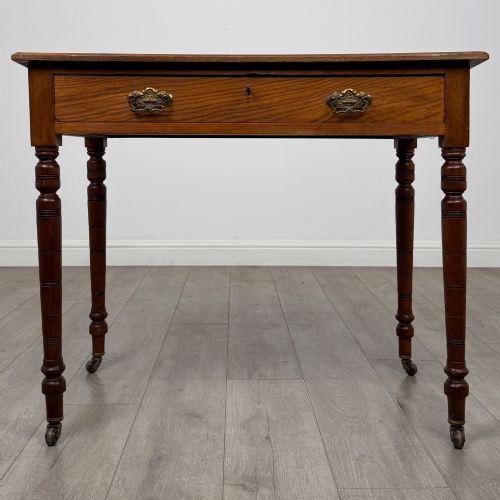
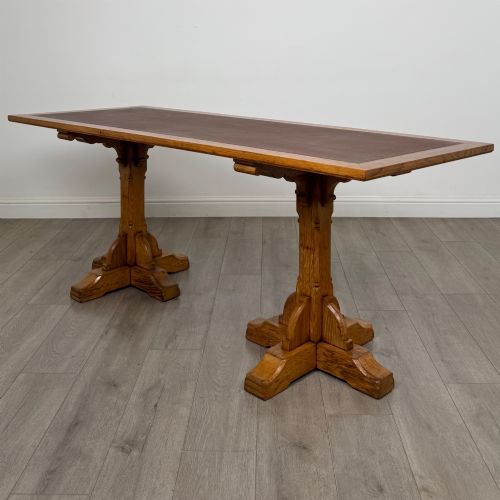
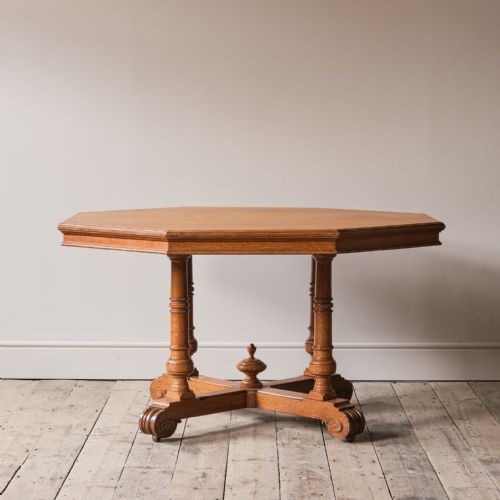


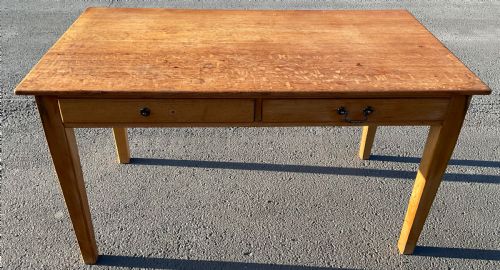

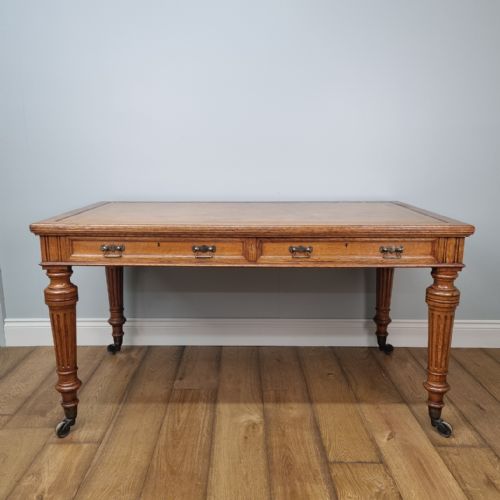

Golden Oak Library Table
A golden oak library table brings warmth and utility to a room, offering a rich timber surface designed for writing and study.
Golden Oak Library Table
A golden oak library table combines practical workspace with striking timber tones, appearing frequently across Victorian and Edwardian periods as well as earlier Regency designs. These pieces function primarily as desks, writing tables, and freestanding centre tables within domestic and institutional settings.
Origins span standard English country workshops to notable cabinet makers, reflecting diverse forms from simple two-drawer writing desks to large freestanding library tables.
How they were made
Construction relies heavily on solid oak and specialised veneers like pollard oak and burr oak, selected for dynamic grain patterns and rich figuring. Artisans incorporate inset leather writing surfaces and metal hardware such as brass handles and iron fittings.
Joinery techniques support robust freestanding use, often integrating drawers with fine dovetailed joints and stable central pedestals or turned legs.
Listings feature multiple periods including Regency, Victorian, Edwardian, and the 1920s, alongside specialist timber variants like burr oak and pollard oak.
What varies in quality
Quality rests in the choice of timber figure, where burr and pollard variations display intricate, lively grain against standard straight-grained oak. The depth of the natural golden colour and the crispness of turned or carved details elevate certain examples above standard utility furniture.
Maker attribution separates workshop production from branded pieces bearing stamps or paper labels, while the integration of secondary materials like quality leather and brass hardware marks superior craftsmanship.
Williams and Gibton of Dublin·Johnstone Jeanes and Co·Thomas Turner·Edwards and Roberts
The Golden Oak Library Table Glossary
- Golden oak
- A bright, honey-toned variety of oak timber favoured for furniture production during the nineteenth and early twentieth centuries. This tone stands apart from the darker finishes applied in earlier centuries.
- Pollard oak
- Timber taken from trees that have been pollarded, producing a dense cluster of branches that results in highly decorative, speckled grain patterns. Cabinet makers used this for drawer fronts and tabletops.
- Burr oak
- Wood harvested from a tree growth or burl, yielding swirling, knotty grain configurations prized for ornamental surfaces. It appears on high-status library tables and desks.
- Partners desk
- A large double-sided desk designed for two people to work opposite one another, featuring drawers and cupboards on both faces. These frequently incorporate leather writing inserts.
- Centre table
- A freestanding table finished on all sides intended to stand in the middle of a room rather than against a wall. Library tables often serve this function.
Golden Oak Library Table: Frequently Asked Questions
What is a golden oak library table?
A golden oak library table is a substantial freestanding wooden table utilised for reading and writing, distinguished by its warm honey-coloured oak timber.
These pieces were traditionally positioned in studies, libraries, or the centre of rooms to provide an expansive writing surface.
How do I care for the leather top?
Leather writing surfaces require gentle cleaning with a slightly damp cloth and occasional treatment with specialist leather balms to prevent drying.
Avoid placing hot cups or exposing the leather to direct sunlight, which can fade the hide and dry out the surface.
Are these tables suitable for modern offices?
These tables provide generous surface areas and sturdy construction, making them practical desks for contemporary laptops and paperwork.
Their freestanding design allows them to sit centrally in a home office rather than pushed against a wall.
How do I distinguish Victorian from Edwardian pieces?
Victorian pieces often display heavier proportions and rich carved detailing, while Edwardian designs frequently lean towards lighter Arts and Crafts influences.
Examining the construction methods, secondary timbers, and hardware styles helps clarify the likely period of manufacture.