


Gold Turquoise Necklace
A gold turquoise necklace brings together vibrant blue stones and warm yellow or rose metal across Victorian, Edwardian, and mid-century designs.
Gold Turquoise Necklace
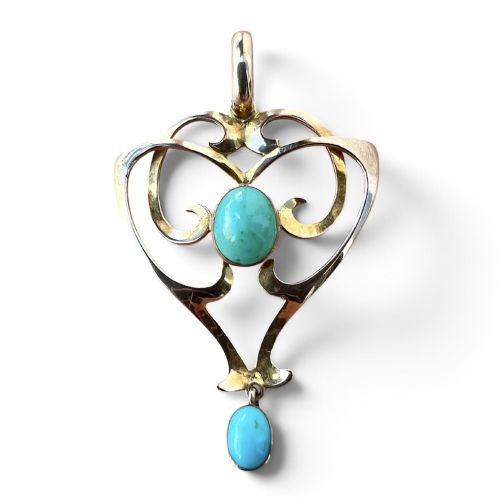
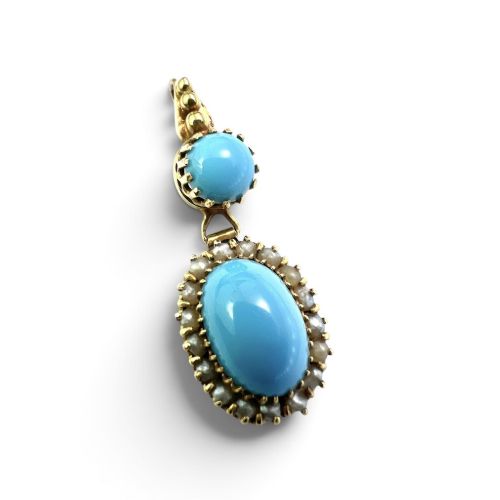
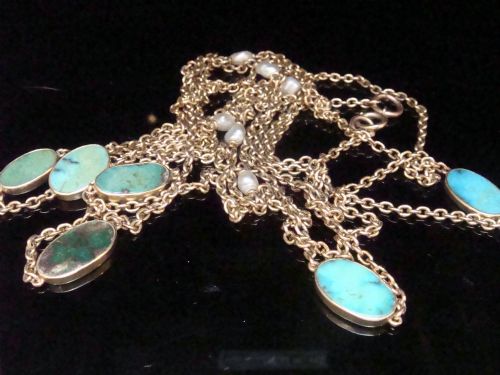
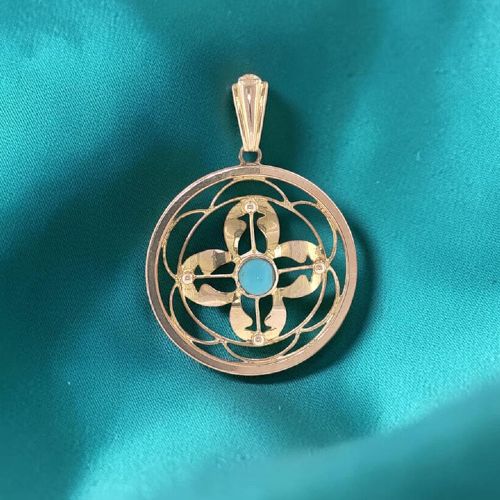
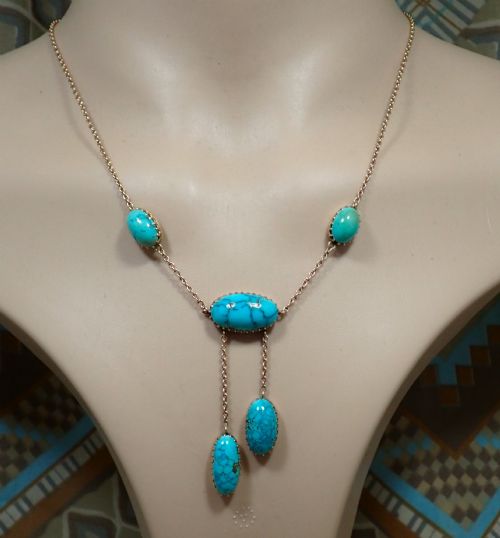
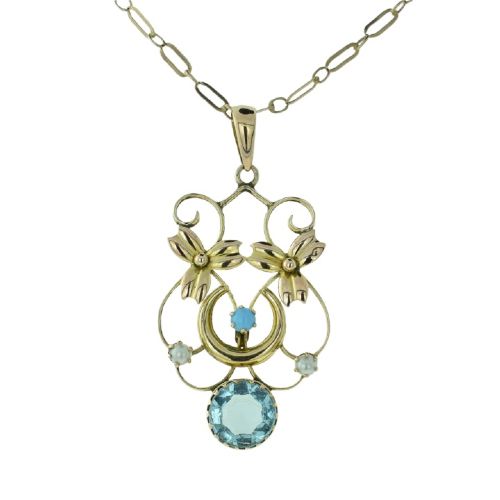
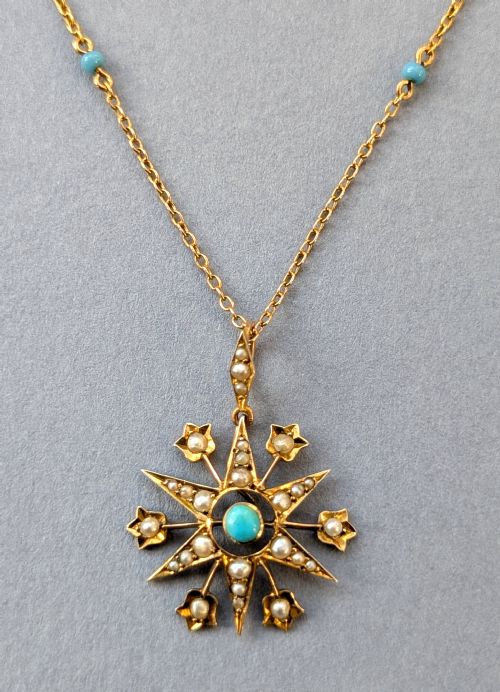
When you search for a gold turquoise necklace, you encounter pendants, longguard chains, and multi-stone necklaces spanning the Victorian and Edwardian eras. The selection ranges from delicate pendants featuring seed pearls and diamonds to long guard chains fitted with dog clips.
Pendants often incorporate floral scrolls, star motifs, or negligee designs suspended from fine gold chains. Longer guard chains appear frequently, sometimes measuring over thirty inches and utilising trombone links.
Mid-century iterations and jewellery suites also emerge among the items, alongside pieces reflecting Art Nouveau and Arts and Crafts aesthetics. These variations demonstrate how makers adapted turquoise and gold into diverse wearable formats.
Materials and construction methods
The construction of these pieces relies on gold alloys graded at 9ct, 15ct, and 18ct, paired with natural turquoise and matrix turquoise. Makers frequently combined the bright blue stones with seed pearls, cultured pearls, and occasional diamonds set in yellow or rose gold.
Techniques visible in the listings include granulation, wirework, and silver-backed settings typical of nineteenth-century workshops. Metal components range from hollow tubular links to solid cast pendants and clasps.
Listings feature gold purities ranging from 9ct to 18ct, alongside platinum and silver components.
Distinguishing quality in period jewellery
Quality in these pieces depends on the saturation and uniformity of the turquoise stones alongside the complexity of the goldwork. Hand-finished details, such as intricate wire scrollwork and well-matched pearl accents, elevate the construction.
The weight of the gold, the presence of maker attribution, and the preservation of original settings separate standard production items from finer workshop pieces.
Deakin & Francis·Murrle Bennett·Dorrie Nossiter·Grange
The Gold Turquoise Necklace Glossary
- Longguard chain
- A long chain, often worn doubled, designed to hold a watch or pendant and frequently fitted with a swivel clasp or dog clip. These chains often measure over thirty inches in length.
- Negligee necklace
- A pendant style featuring two unequal drops suspended from a central motif, popular during the Edwardian period. They often incorporate seed pearls and turquoise.
- Matrix turquoise
- Turquoise that retains portions of the host rock, creating webbed or patterned brown and black veining across the blue stone. This material appears frequently in Arts and Crafts designs.
- Dog clip
- A spring-loaded clasp used on longguard chains to attach pendants or pocket watches securely. It allows the wearer to interchange suspended elements easily.
- Etruscan revival
- A nineteenth-century design style that emulates ancient Etruscan metalwork through granulation and applied wirework. Pieces in this style often use high-carat gold.
Gold Turquoise Necklace: Frequently Asked Questions
How do I care for a gold turquoise necklace?
Turquoise is a relatively soft and porous gemstone that absorbs oils, cosmetics, and moisture easily. You should clean it gently with a dry cloth and avoid ultrasonic cleaners or chemical dips.
Store the necklace away from direct sunlight and other hard jewellery pieces to prevent surface scratching. Putting the necklace on after applying perfumes and hairsprays preserves the stone colour over time.
What periods are common for these necklaces?
The majority of pieces originate from the Victorian and Edwardian eras, spanning the late nineteenth and early twentieth centuries. You will also encounter items from the Arts and Crafts movement and mid-century periods.
Victorian examples often feature heavier gold settings and floral motifs, while Edwardian pieces lean toward lighter filigree and pearl combinations. Archival pieces occasionally record earlier Victorian examples from the mid-nineteenth century.
Are pearls always natural on these items?
Listings feature a mix of natural pearls, seed pearls, and cultured pearls alongside turquoise stones. Seed pearls were widely utilised in Victorian and Edwardian cluster settings and halos.
Examination under magnification often reveals the origin and uniformity of the pearls used in specific pendants and necklaces. Makers paired them with turquoise to provide white contrast against the blue stones.
How can I tell a longguard chain from a standard chain?
Longguard chains are substantially longer than standard neck chains, frequently measuring between thirty and eighty inches. They were originally designed to be doubled around the neck.
These chains typically incorporate a functional dog clip or swivel clasp intended for suspending watches or pendants. They often feature distinct link types, such as trombone or oblong links.